Average Stucco Repair Price Per Square Foot in Scottsdale: What Quotes Should Say
If you have collected two or three quotes for stucco work in Scottsdale, you may have noticed something frustrating: one number is triple another, and nobody explained why. The average stucco repair price only means something once you know what is behind it, and that is what this guide breaks down. We will cover what stucco repair costs per square foot, why quotes spread so far apart, and how to read an estimate so you can compare bids on equal terms before you commit. Getting an accurate stucco repair quote is essential to understanding the full scope of work you need.
This is written for two people at once. The homeowner planning a full re-stucco who keeps finding price-per-square-foot numbers that are all over the map. And the small landlord with a few stucco rentals in the Scottsdale and East Valley area who needs a crack fixed before an HOA letter turns into a fine. Both need the same thing: honest benchmarks and a way to tell a fair quote from a padded one.
Understanding Stucco Repair Quote Costs
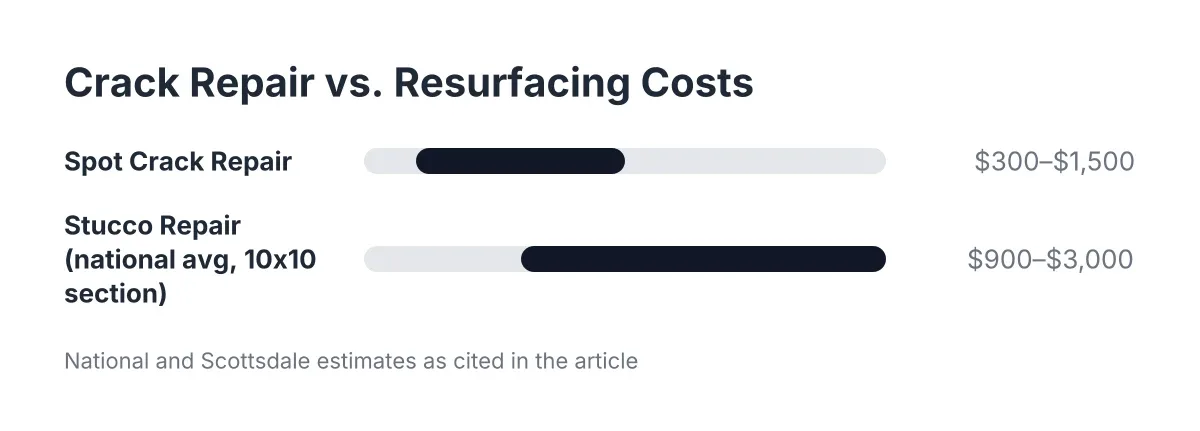
The average stucco repair price nationally runs from $900 to $3,000, averaging about $1,700 for repairing buckled three-coat stucco in a 10×10-foot area, according to Fixr.com. That works out to roughly $9 to $30 per square foot for a repair of that size. Small patches cost more per square foot; large jobs cost less.
That per-square-foot spread deserves a closer look, because it explains most of the confusion homeowners run into. A repair has fixed costs that do not shrink with the job. The crew still has to drive out, set up, mix material, match your color and texture, and clean up whether the patch is two square feet or two hundred.
As a result, a small hole repair might price out at $50 per square foot when you do the math, while a full wall section might land under $10. Neither number is wrong. They just describe different jobs. This is the first reason quotes look inconsistent: contractors quote the job, not a clean per-foot rate, and a small job carries a minimum charge.
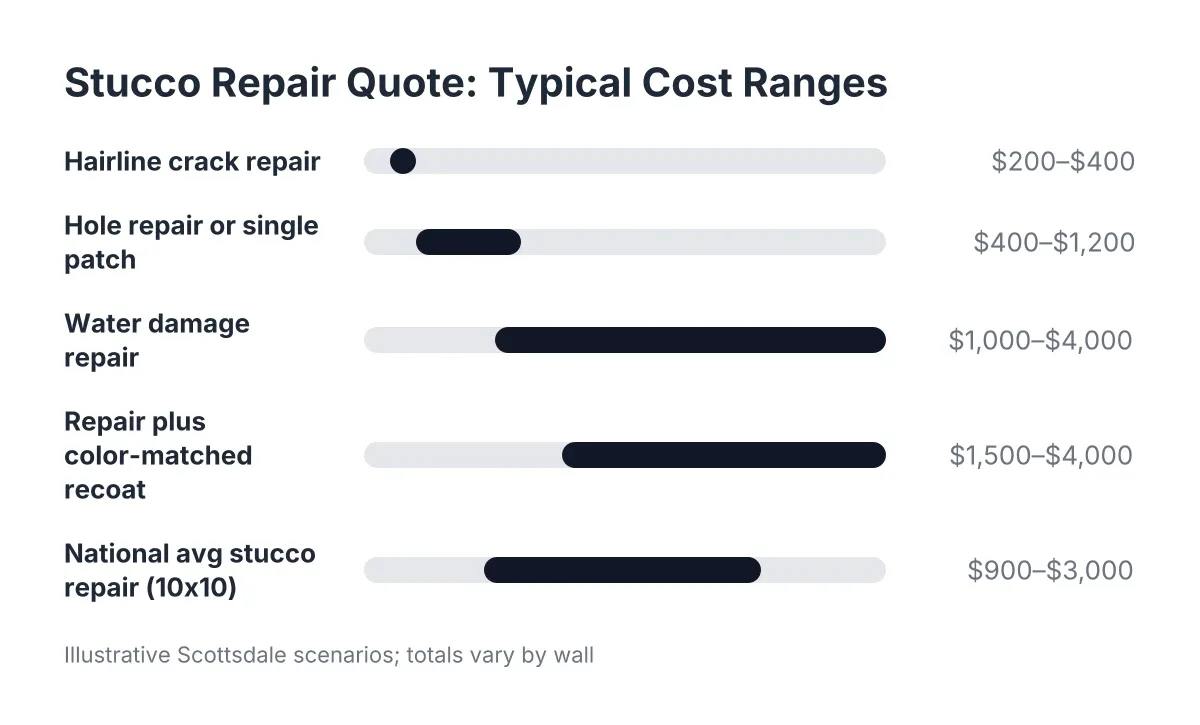
For budgeting purposes, here are illustrative ranges for common Scottsdale repair scenarios. Treat these as planning estimates, not promises, since your wall, access, and finish all move the number:
- Hairline crack repair: often a few hundred dollars for a visit that seals several cracks with elastomeric caulk or patching compound
- Stucco hole repair or single patch: roughly $400 to $1,200 depending on size, lath damage, and texture matching
- Water damage stucco repair: $1,000 to $4,000 or more, because the damaged stucco has to come off before anyone knows how far the moisture traveled
- Repair plus color-matched recoat of a full wall: $1,500 to $4,000 depending on wall size and finish
- Full resurfacing or replacement: priced per square foot across the whole house, discussed below
Stucco is not a niche material here. It remained the most-used exterior wall material in the Mountain division, which includes Arizona, at 48% of new single-family homes started in 2024, according to the National Association of Home Builders. That density of stucco homes is why Scottsdale has plenty of contractors, and why quote quality varies so much.
Why One Quote Is Triple Another
Two contractors can look at the same cracked wall and quote it three ways apart without either one lying to you. The difference is almost always scope, not greed. One contractor is pricing a patch. The other is pricing the repair done the technically correct way, which often means more wall than you expected.
Take a deteriorated corner as an example. The quick version is a spot patch over the damaged area. The correct version is removing the stucco and repatching the full wall section from corner to corner, so there is no visible seam and no weak bond line where the patch meets old material. Additionally, the second approach costs more and lasts longer. If one quote says $600 and another says $1,900 for the "same" corner, this is usually why.
Other scope differences that split quotes apart:
- One coat versus three. Traditional stucco goes on in three coats: a scratch coat, a brown coat, and a finish coat. Some repairs use polymer-modified rapid-setting patch products that replace the three-coat system in a single application. Both can be legitimate; they price differently.
- Texture and color matching. Blending a knockdown dash or sand finish into the surrounding wall takes skill and time. A quote that skips finish matching will be cheaper, and you will see the patch from the street.
- Cause of the damage. A good contractor prices fixing why the stucco failed, not just the crack itself. If poor drainage or movement caused it, patching alone means the crack comes back and you pay twice.
- What is behind the wall. Water damage repair cannot be fully priced until the stucco comes off. An honest quote states an allowance for hidden damage; a lowball quote ignores it and becomes a change order later.
Here is the practical takeaway. When quotes diverge wildly, do not assume the high one is gouging or the low one is a deal. Call both back and ask exactly what area they are repairing, how many coats they are applying, and whether finish matching is included. The answers usually explain the entire gap.
Repair, Resurface, or Replace: Pricing the Big Decision
For the homeowner staring at widespread cracking or an inspection report flagging stucco condition, the real question is not the average stucco repair price for one patch. It is whether the house needs repairs, a resurface, or full replacement, because those are three different budgets.
Spot repairs make sense when damage is isolated: a few cracks, a hole from a removed fixture, one water-stained section below a scupper. You are typically in the hundreds to low thousands total.
Resurfacing applies a new finish coat, and sometimes a base coat, over structurally sound existing stucco. Per square foot it runs a fraction of full replacement because nothing gets torn off. For a Scottsdale house with sound stucco that just looks tired, faded, and hairline-cracked, resurfacing is often the right call. The honest trade-off: if the underlying stucco or lath is failing, resurfacing only buys time. A new finish coat over a delaminating base is money spent on delay, not repair.
Full replacement means tearing off the old stucco down to the lath or sheathing and rebuilding the system. It is the most expensive option per square foot and the only correct one when the base coats have failed broadly, the lath is rusted out, or moisture has gotten behind the wall in multiple places.
How do you know which one your house needs? A contractor should check, and you can preview:
- Push on bulged or hollow-sounding areas. Movement or a drummy sound suggests the stucco has separated from the lath. Widespread separation points to replacement, not resurfacing.
- Look at crack patterns. Scattered hairline cracks are cosmetic and resurface well. Wide, stair-stepping, or recurring cracks signal movement or a base-coat problem.
- Check below roof edges, windows, and scuppers for staining. Water damage that keeps reappearing means the water path needs fixing before any finish work.
- Ask when it was last coated. Stucco that has been painted repeatedly may need extra prep before a new finish coat will bond.
What to Expect When Requesting a Stucco Repair Quote
Suppose a homeowner in north Scottsdale gets three bids on a 2,200-square-foot house with widespread hairline cracking. Bid one, at $6,000, is a crack-and-paint job. Bid two, at $14,000, is a full resurface with an acrylic finish coat. Furthermore, bid three, at $38,000, is tear-off and replacement. In that scenario, none of the three is automatically wrong; they are three different diagnoses. The homeowner's job is to find out which diagnosis is accurate, and the checks above plus a second opinion usually settle it.
If your walls show bulging, soft spots, or repeated water staining, bring in a professional before choosing between resurfacing and replacement. Guessing wrong in either direction is expensive: replacing sound stucco wastes money, and resurfacing failed stucco wastes the resurface.
Factors That Move the Repair Price Up or Down in Scottsdale
Beyond scope, a handful of specific factors push the average stucco repair price up or down here. Knowing them helps you sanity-check whether a line item belongs on your estimate.
Height and access. Ground-floor patches are straightforward. Second-story gables, parapets, and areas over pool equipment or landscaping need ladders or scaffolding, which adds labor time.
Lath condition. If the wire lath behind the stucco is intact, the patch goes faster. If it is rusted or torn away, the repair includes new lath and paper, which adds material and time. A related detail: when stucco gets cut open, a rough edge that leaves the wire lath exposed and torn is actually what the repair contractor wants, because it lets them tie the new patch into the old system and weatherproof it properly. A clean, tight grinder cut forces them to open up more wall, which adds cost.
Texture type. A heavy Santa Fe smooth finish, a knockdown dash, and a sand float finish each demand a different application to blend invisibly. A knockdown repair, for instance, gets sprayed on and then lightly troweled down to match the surrounding wall. Poor texture matching is the most common visible sign of a cheap repair; if you can see the patch from the sidewalk, the finish work was skipped or rushed.
Color matching. Integral-color stucco fades in Arizona sun, so a fresh patch in the original color can stand out against a faded wall. The fix is either a careful custom color match to the faded tone or recoating the whole wall for uniformity. Landlords dealing with HOA letters know this one well; the HOA does not care that the crack is sealed if the patch is two shades off.
Season and weather. Desert heat affects materials. Caulk-based crack repairs behave poorly when applied in hot afternoon sun, so summer work often gets scheduled for early morning. This rarely changes the price, but it can change the schedule, which matters if you are working against a pre-lease inspection date.
Number of repairs per visit. This is the biggest lever a small landlord controls. Because trip and setup costs are fixed, bundling three small repairs across one property, or across two rentals in the same area, costs far less than three separate service calls. If you own several stucco rentals in the Scottsdale area, walk all of them before you call and list every crack, hole, and stain. One consolidated visit beats three minimum charges.
How to Read a Stucco Repair Estimate Line by Line
You have chosen to get the work done. Now the job is making sure the estimate you sign is complete enough that the price holds. A vague one-line quote is where budget surprises come from, because anything not written down becomes a change order.
A repair estimate worth signing should spell out:
- The exact repair area, in square feet or by wall section, not just "repair stucco as needed"
- The repair method, meaning three-coat rebuild, one-coat polymer patch, or crack sealing, so you know what you are comparing
- Lath and paper, stating whether replacement is included or excluded
- Finish scope, confirming texture matching and stating whether color is matched, painted, or recoated wall-to-wall
- A hidden-damage allowance for water damage jobs, with a stated rate for extra work if rot or damage extends past the visible area
- Cleanup and haul-off of demolished stucco
- Payment terms, since a modest deposit with balance on completion is normal for repair-sized jobs
For the big-project budgeter comparing resurface or replacement bids, add one more requirement: itemization by phase. Tear-off, lath and paper, base coats, finish coat, and color should each carry a number. When bids are itemized, a $14,000 and a $22,000 bid stop being mysterious. You can see that one includes tear-off and the other does not, and now you are comparing the same job.
On the worry that an estimate will balloon once work starts: the honest answer is that stucco can hide damage, especially water damage, and no contractor can price what they cannot see. However, the estimate should say so upfront and state how extras get priced. An estimate that acknowledges the unknown is more trustworthy than one that pretends there is none. Understanding the full range of stucco repair costs and what factors influence them is what lets you hear "we found more damage behind the wall" and judge the added charge instead of just absorbing it.
Where DIY Fits and Where It Costs You More
Some stucco work is genuinely homeowner-friendly, and it is worth saying so. Materials for a small patch, including patch compound, latex additive, and corner mesh, are stocked at general hardware stores. Hairline crack sealing with an elastomeric product is a reasonable Saturday project, and repair work goes on from the bottom up.
The trouble starts with finish work. Sealing a crack is easy; making the repair invisible is not. A patch with mismatched texture is the signature of a repair done without matching the original technique, and it announces itself on every wall it touches. For a rental facing an HOA review or a home going on the market, a visible patch can cost more in perception than the professional repair would have cost in cash.
DIY also cannot answer the diagnostic question. If your cracks keep returning, if a wall sounds hollow, or if staining follows the rainy season, the crack is a symptom. Paying for a professional assessment before spending on repairs, in that case, is the cheapest line item in the whole project.
Benchmarks to Take Into Your Next Quote
Here is the short version to carry into your contractor calls in 2026. Nationally, repairing a 10×10-foot area of buckled three-coat stucco runs $900 to $3,000, averaging about $1,700, per Fixr.com. Small patches carry minimum charges, so their per-foot math looks high; that is normal. Resurfacing costs a fraction of replacement per square foot but only pays off over sound stucco.
Is stucco repair expensive? Compared to living with water intrusion behind an exterior wall, no. Most isolated Scottsdale repairs land in the hundreds to low thousands, and the price scales with scope you can verify: area, coats, lath, and finish.
When quotes spread apart, the spread is information. It means the bidders are pricing different scopes, and your job is to find out whose scope matches what your wall actually needs. Get the area, method, finish work, and hidden-damage terms in writing, and the average stucco repair price stops being a mystery number and becomes a budget you can hold a contractor to.
If you need stucco repair, Scottsdale Stucco Repair can help.
Related guide: Stucco Costs — Complete Guide
Prefer to talk it through? Call (480) 637-3464 — a quick call is usually the fastest way to get a straight answer for your situation.