Stucco Replacement vs. Patch Repair: How to Decide Which One You Actually Need
If a contractor looks at your wall for thirty seconds and recommends full replacement, get a second opinion. Most damaged stucco in Scottsdale does not need to come off the wall. The honest answer to whether you should choose repair vs replace stucco is a decision you can walk through yourself, step by step, before anyone quotes you anything. This guide gives you the criteria a specialist uses, from someone whose business does more patching than replacing and has no reason to sell you the bigger job when the smaller one will hold.
This matters here more than in most places. Stucco remained the most-used exterior wall material in the Mountain division, which includes Arizona, at 48% of new single-family homes started in 2024, according to the National Association of Home Builders. That means a lot of Scottsdale walls are hitting the age where cracks show up and owners have to make this exact call.
Step 1: Map the Damage Before You Call Anyone
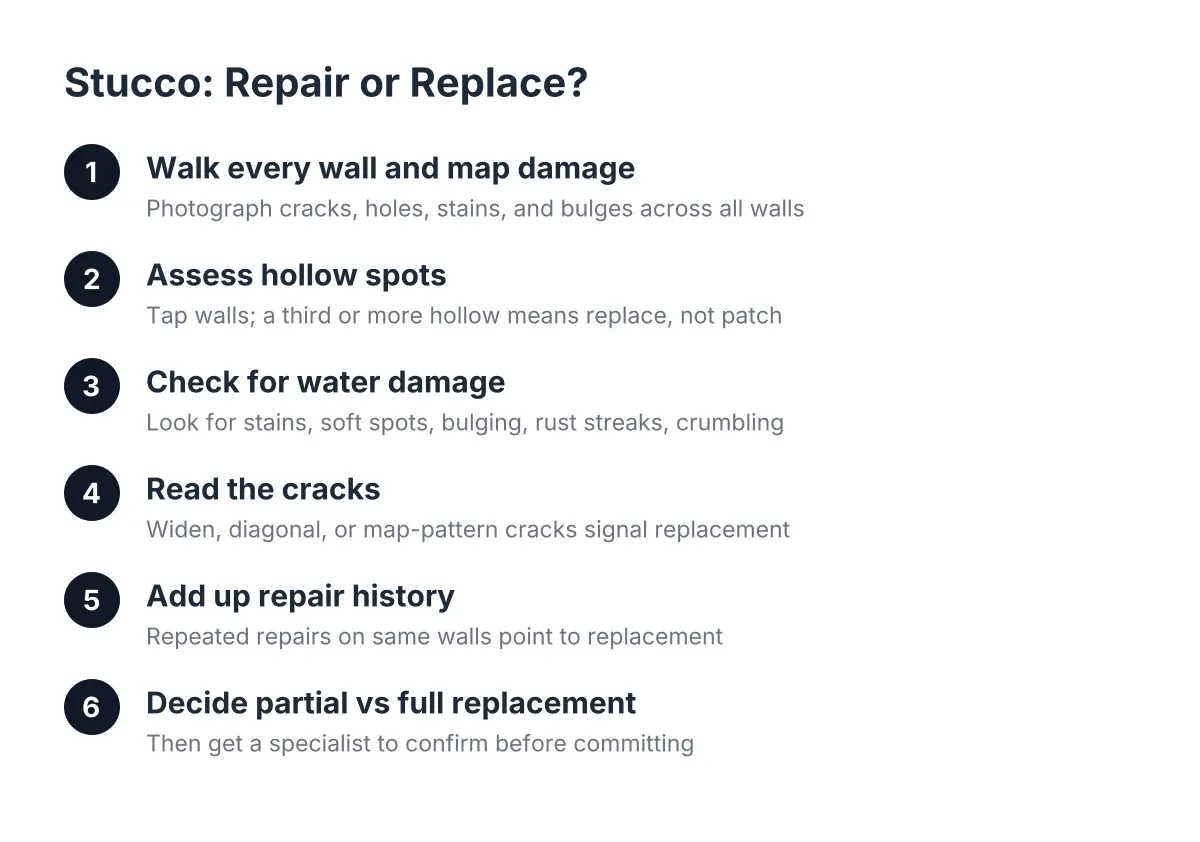
Walk the whole wall, not just the crack that caught your eye. Take photos of every crack, hole, stain, and soft spot, and note where each one sits: near a corner, under a window, along the roofline, or at the base of the wall.
The pattern tells you more than any single crack does. One diagonal crack running from a window corner is usually settling; the house moved, the stucco followed, and a crack repair handles it. Hairline cracks scattered across an entire elevation, plus bulging or hollow-sounding areas, point to a failing base coat or water damage behind the surface. That is a different conversation.
Tap the wall around each damaged area with your knuckles or a screwdriver handle. Solid stucco sounds dense. A hollow, drummy sound means the stucco has separated from the lath or block behind it, and that section cannot be patched over; the loose material has to come off.
If you own rental properties, do this walk at every turnover. A landlord with three or four stucco rentals in the East Valley who photographs the exteriors twice a year catches a $500 patch before it grows into a $5,000 wall.
Step 2: When to Repair Versus Replace Stucco Sections
Score each wall section separately. A house rarely needs full replacement everywhere; the west-facing wall that takes the afternoon sun may be shot while the north side has decades left.
Patch repair is the right call when:
- Cracks are under about 1/8 inch wide and the surrounding stucco sounds solid
- Damage covers less than roughly a quarter of any single wall section
- Holes come from removed fixtures, doorknob strikes, or impact, not moisture
- The base coat underneath is firm when you press on it
- Staining wipes off or sits on the surface rather than bleeding from behind
Replacement of a section, or a full wall, makes sense when:
- Large areas sound hollow or flex under hand pressure
- You see rust streaks bleeding through, which means the lath behind the stucco is corroding
- Water damage has softened the base coat; it crumbles when probed
- The same wall has been patched repeatedly and keeps failing
- Cracks are wide, deep, and spread across most of the elevation
Here is the part most articles skip: the technically correct fix for a badly deteriorated section is not a spot patch on the worst square foot. It is removing the stucco and redoing that wall section from corner to corner, or from one natural break to another. Corners and control joints hide the transition. A patch floating in the middle of a wall is the one your eye finds every time you pull into the driveway.
Step 3: Run the Numbers on Stucco Replacement vs. Patch Repair
The math is straightforward once you know the damage pattern. The national average cost range to repair stucco runs $900 to $3,000, averaging about $1,700 for repairing buckled three-coat stucco in a 10×10-foot area, according to Fixr.com. Full wall replacement multiplies that by the square footage involved, plus demolition and disposal.
The rule that keeps the decision honest: if fixing the damaged areas costs more than about half of what replacing the whole wall section would cost, replacement wins. You pay once instead of paying for patch after patch on a wall that is failing underneath.
However, the reverse is true more often. Suppose a landlord gets an HOA letter about two cracks and a fist-sized hole on a rental in North Scottsdale. As an illustrative estimate, that is a few hundred dollars of stucco patching and color matching, done in a day, with a clean invoice for the file. A contractor who quotes full replacement for that job is solving their revenue problem, not your wall problem.
One honest trade-off in favor of patching: a patch will never be invisible on day one. New stucco cures lighter and the texture takes skill to blend. If the patch texture cannot be matched closely enough, painting the whole wall or section is the standard fallback to get a uniform look. Budget for that possibility before you decide.
Step 4: Find the Cause, or the Crack Comes Back
A patch on a wall with an unsolved problem is a rental agreement, not a repair. Before any stucco work starts, figure out why the damage happened.
Check the usual suspects first. Irrigation heads spraying the base of the wall cause most of the water damage on Scottsdale block walls and homes. Clogged scuppers and bad roof drainage send monsoon water down behind the stucco. A gate that slams into the same corner will crack any patch you put there.
For example, a block wall that cracks every year along the same line probably has a footing or expansion joint issue. Patching it annually costs more over five years than cutting a proper control joint once. Fix the cause, then fix the stucco, in that order.
Step 5: Deciding What System to Use for Stucco Replacement
If replacement wins, you get to choose the system, and this is where owners of bare block walls and additions come in. Stuccoing over a concrete block wall or a new addition counts as stucco installation, not repair, and block is a good base for it; the process differs from re-stuccoing a wood-framed wall because block does not need the same lath and paper assembly.
Know your options among stucco finish types before anyone mixes mud:
- Traditional three-coat stucco: scratch coat, brown coat, and finish coat. Proven, durable, and what most older Scottsdale homes already have.
- One-coat systems over block: for repair work, polymer-modified patch products can replace the three-coat sequence in a single application, which is why small patches finish faster than people expect.
- Synthetic stucco (EIFS): a foam-and-acrylic system with a different look and different moisture behavior. Matching synthetic stucco to traditional stucco on the same house takes care; confirm which one your house has before approving any bid.
Then decide on finish. A color-coat finish carries the color through the material, so chips show less. Painting stucco exterior walls gives you unlimited color choice and is the reliable way to blend a large repaired area with old, weathered stucco next to it, but it commits you to repainting on a cycle.
Step 6: Plan for the Disruption Honestly
Patch repair barely disrupts anything. A typical crew handles crack repair and small patching in a day: prep in the morning, patch midday, texture before they leave, and color after cure. Tenants stay put; nobody moves furniture.
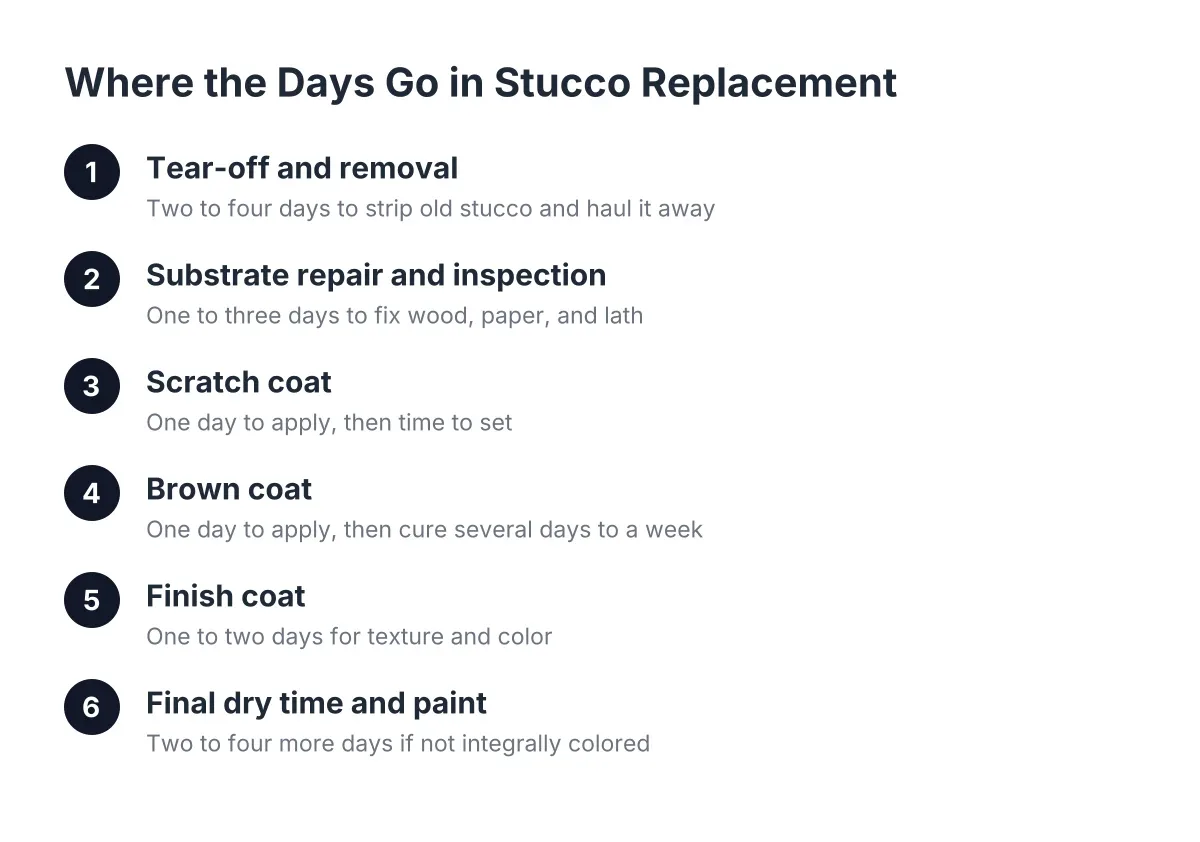
Full wall replacement is louder and longer. Expect demolition dust, a debris pile, plastic over nearby windows, and several days minimum per wall, since each coat needs cure time before the next goes on. In summer heat, crews often start at dawn and stop by early afternoon, which stretches the calendar. If you are coordinating around a tenant or a pre-lease inspection deadline in 2026, schedule replacement between leases when you can, and save occupied periods for patch work.
Step 7: Get Bids That Separate Patch Repair From Stucco Replacement
Ask every bidder to price the job both ways, or to state in writing why only one option is viable. A specialist can defend the recommendation wall by wall. A generalist tends to quote whatever is easiest to sell.
Questions worth asking on every bid:
- Which wall sections need replacement, and which only need patching?
- Will you patch corner to corner, or spot-patch mid-wall?
- How will you match the existing texture and color, and what happens if the match is not close enough?
- What is causing the damage, and does the bid address it?
- Is my existing finish traditional or synthetic stucco, and does the bid use the same system?
A poor texture match on an old patch usually means the last person who touched the wall did not know the original technique. Ask to see the bidder's texture work up close before you sign anything.
One caution on doing this yourself: hairline crack repair with a quality patch compound is a fair weekend project, but anything involving hollow stucco, lath, water damage behind the wall, or structural cracks belongs with a professional. Sealing moisture inside a wall costs far more to undo than the patch saved.
The Short Version
Most Scottsdale stucco damage is a patch, not a teardown. Replace a wall section when the base coat has failed, when water has gotten behind the stucco, or when repeated repairs keep failing in the same spot; patch everything else and fix the cause. Work through the decision one wall at a time, get the price both ways, and you will spend money on the wall exactly once.
If you need stucco repair, Scottsdale Stucco Repair can help.
Related guide: Stucco Replacement — Complete Guide
Prefer to talk it through? Call (480) 637-3464 — a quick call is usually the fastest way to get a straight answer for your situation.