Stucco Paint vs. Colorant: Which Gives a Lasting Color Match on Repairs?
The fear behind every stucco repair is the same: a patch that shows. You fix a crack or a hole, the wall is sound again, and then every afternoon the low sun rakes across the surface and there it is, a rectangle two shades off from everything around it. Whether that happens usually comes down to one decision made before anyone mixes a bucket: do you color the repair with stucco colorant blended into the finish coat, or do you paint over it afterward? This guide walks through both approaches, when each one actually produces an invisible repair, and how to vet the answer a contractor gives you.
If you are getting a house ready to list in Scottsdale, this decision matters more than usual. Buyers and inspectors walk the exterior in full daylight. A structurally perfect patch that reads as a blotch from the curb raises a question in a buyer's mind that a clean wall never would.
Why Repaired Stucco So Often Shows
A stucco patch shows for one of two reasons: the color is off, or the texture is off. Sometimes both. Understanding which problem you are fighting tells you which coloring method makes sense, because paint and integral color solve different halves of the problem.
Traditional stucco goes on in three coats. First a scratch coat, thin and scored so the next layer grips. Then a brown coat that builds thickness. Finally a finish coat, which is the layer that carries the color and texture you see. When a crew repairs a hole or resurfaces a section, they rebuild those layers, and the finish coat is where the match succeeds or fails.
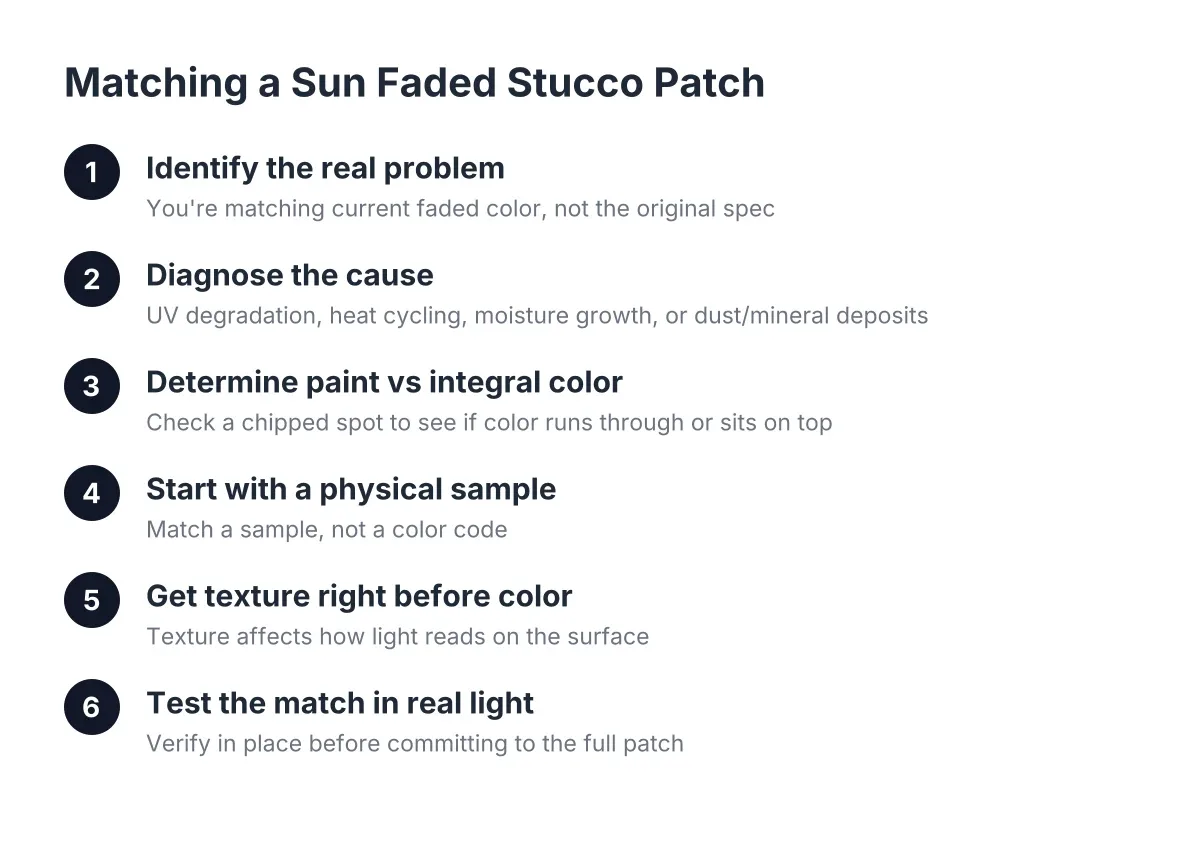
Here is the part most homeowners do not hear until after the fact. Your existing wall is not the color it was when it was applied. Fifteen or twenty years of Arizona sun bleaches pigment, and it does not bleach evenly. A south-facing wall fades harder than a north-facing one. Discoloration is often not even fading; on shaded or damp sections it can be growth embedded in the pores of the material, not surface dirt that rinses off. So the target you are matching is a faded, weathered, uneven version of the original color, and no chart from the manufacturer shows that shade.
Texture is the other half. Even a perfect color match will telegraph a patch if the trowel work does not blend. The reverse is also true: a well-matched texture painted the wrong shade still reads as a repair. That is why serious stucco color matching work treats color and texture as one problem, not two separate line items.
What Stucco Colorant Actually Is
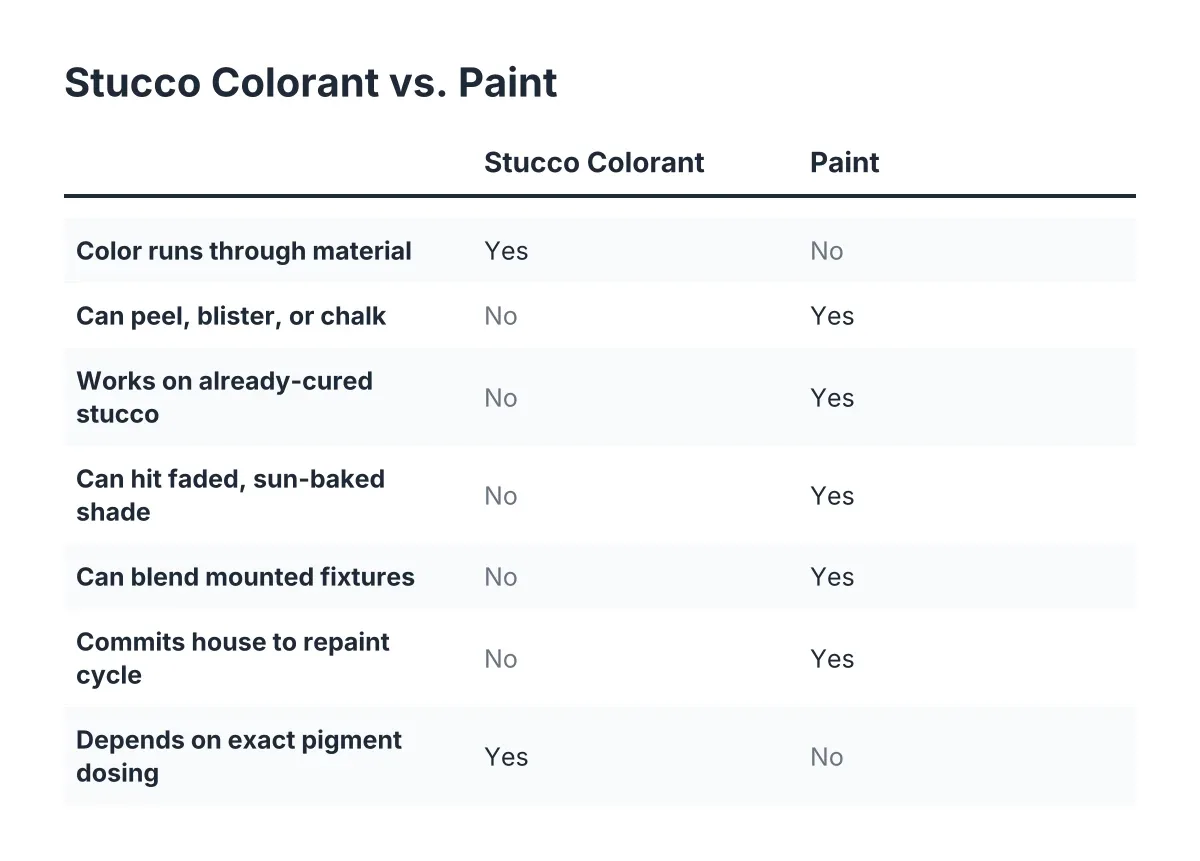
Stucco colorant is pigment mixed directly into the wet finish coat before it goes on the wall, so the color runs all the way through the material instead of sitting on top. This is called integral color. Chip the surface years later and the material underneath is the same shade, which is why integrally colored stucco never peels or flakes the way a coating can.
The colorant itself is usually a mineral oxide pigment, sold as a powder or liquid that the crew doses into the mix by weight. Manufacturers publish color charts with dozens of standard shades, and a skilled finisher can adjust between them. If you have ever asked what colors stucco comes in, the honest answer is a wide range of earth tones, tans, grays, and warm whites that hold up well in desert light, plus custom blends when the standard chart falls short.
The catch is control. Integral color depends on exact pigment dosing, consistent water content, and consistent curing conditions. A batch mixed slightly wetter dries lighter. A patch that cures fast in July sun can land a different shade than the sample panel did. Experienced finishers manage this with weighed pigment loads and test panels, but it is a craft, not a paint-by-numbers process.
Can You Add Color to Stucco That Is Already on the Wall?
You cannot add integral color to stucco that has already cured; the pigment must be mixed into the wet finish coat before application. Once stucco hardens, your coloring options are paint, a tinted fog coat, or applying a new pigmented finish coat over the old surface. Each of those is a legitimate fix, but none of them is integral color in the true sense.
This distinction matters when you are comparing quotes. If one contractor says they will "color match with colorant" on a small crack repair without recoating the surrounding finish, ask exactly what they mean. On a hairline crack repair, the realistic play is often a patch material toned as close as possible, followed by paint or a fog coat to unify the area. That is fine, but you should know it going in.
Paint Over the Repair: The Case For and Against
Painting is the other route, and finished stucco surfaces are commonly coated with masonry paint at some point in their life anyway. With paint, the crew completes the patch, lets it cure, then coats it, and usually the surrounding area, with an elastomeric or acrylic masonry paint tinted to match.
Paint has real advantages for a repair scenario:
- Match precision. Modern paint tinting can hit a faded, sun-baked shade that no standard stucco colorant pigment chart contains. Bringing a physical sample chip to the paint counter gets you closer than eyeballing ever will.
- Uniformity. Paint covers the patch, the old surface, and the transition between them in one continuous film, hiding minor tonal differences underneath.
- Speed. For a pre-listing seller working against a closing date, paint over a cured patch is faster than staging a full pigmented finish coat, and it photographs clean for the listing.
- Fixture blending. Light fixtures, conduit, and raceways mounted on the wall can be painted to match, which integral color obviously cannot do.
The trade-offs are just as real. Paint is a film on the surface, so it can peel, blister, or chalk over time, especially on walls that trap moisture. Once you paint stucco, you have committed the house to a repaint cycle; going back to a bare integral finish later means grinding or recoating. Paint can also slightly soften the crisp shadow lines of a heavier texture if it goes on thick.
There is a moisture caveat worth taking seriously. If the damage came from water, a nonbreathable coating over a wall that has not been properly dried and repaired can trap moisture and make things worse. Water damage stucco repair needs the source fixed first; color is the last step, not the first.
Stucco Colorant vs. Paint: Which Match Lasts Longer?
For long-term color durability, integral stucco colorant wins, because the pigment is part of the material and cannot peel or flake off. For match accuracy against an aged, faded wall, paint usually wins, because tinting can replicate a weathered shade precisely. The right choice depends on which of those two you need more.
Think of it as two different definitions of "lasting."
Integral color lasts in the sense that it never fails as a coating. It will fade over decades, but it fades the way the rest of the wall fades, gradually and without a maintenance cycle. On new stucco installation or full stucco replacement, integral color is the durable default for exactly this reason.
Paint lasts in the sense that the match itself stays accurate. On a repair, you are not matching the original color; you are matching today's faded version of it. Paint can hit that target. Fresh integral color often cannot, because pigment charts describe new stucco, not stucco that has spent 18 summers facing south in Scottsdale.
However, a painted match ages on its own clock. Say a hypothetical homeowner patches and spot-paints one section of a west wall before listing in March. The match looks dead-on at the open house. Three or four years later, the paint and the surrounding stucco have weathered at different rates, and a faint outline can reappear. For a seller, that is usually an acceptable trade. For someone planning to stay in the house ten more years, it argues for painting the entire wall plane, not just the patch.
When Integral Colorant Is the Right Call
Choose integral stucco colorant when the repair is large enough to justify a full finish coat, when the home has never been painted and you want to keep it that way, or when you are resurfacing whole walls at once. In those cases the crew is recoating to natural break points anyway, so the faded-versus-new mismatch problem shrinks.
Integral color also makes sense on unpainted homes where a future buyer or HOA expects a true stucco finish. Painting an unpainted stucco house is a one-way door; do not walk through it for a two-foot patch if a pigmented finish coat on that wall section solves it.
When Paint Is the Right Call
Choose paint when the wall is already painted, full stop. New integral color under existing paint is pointless; you will be painting anyway. Paint is also the practical answer for small crack repairs and patches on heavily faded walls, for tight pre-sale timelines, and for walls with attached fixtures that need to disappear into the field color.
Paint is also the fallback when a perfect match is not achievable by any method. When neither colorant nor spot-painting can hide a patch, painting the entire wall or a full section to a natural break gives you one uniform surface instead of a visible repair. On a wall with heavy, multi-shade discoloration, a careful contractor will pull a small sample piece and match paint to it rather than guessing from a fan deck.
How a Careful Crew Gets the Match Right
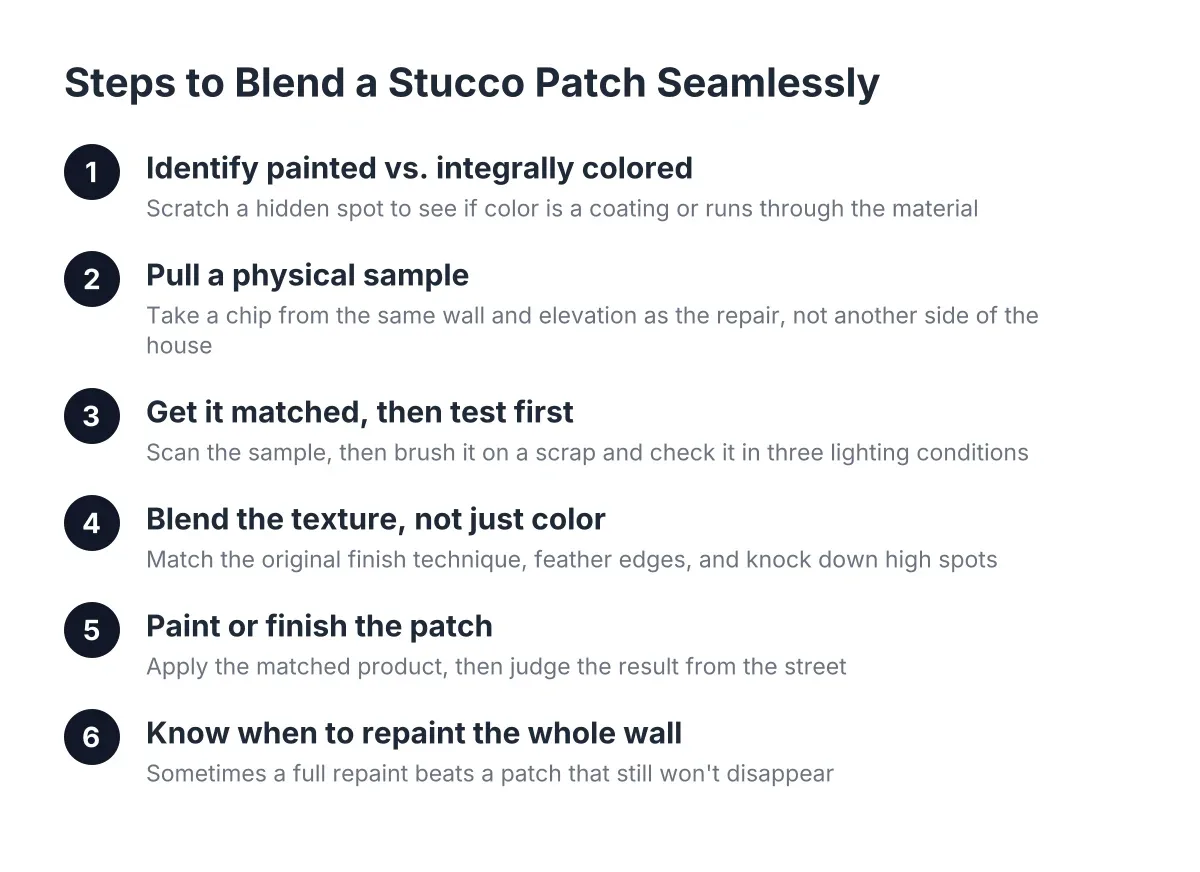
The method matters less than the discipline behind it. Whether the job uses stucco colorant, paint, or both, an invisible repair follows the same sequence, and it is worth knowing so you can tell a careful bid from a rushed one.
- Assess the real color. That means looking at the wall in morning and afternoon light, checking how much each exposure has faded, and pulling a physical sample chip when discoloration varies across the surface.
- Match the texture first. The patch gets floated or dashed to mimic the surrounding finish before any color decision is final, because paint will not hide a texture mismatch. Texture is cosmetic, not structural, but it is the thing your eye catches from thirty feet.
- Test on a panel or hidden area. Whether it is a pigmented finish sample or a brushed-out paint swatch, the test cures fully before anyone commits. Wet stucco and wet paint both dry to a different shade.
- Blend to a natural break. Good crews carry the color to a corner, an expansion joint, a downspout, or a change in wall plane, never feathering out in the middle of an open field of stucco where the human eye picks up the transition.
- Coat fixtures and trim to match. Anything mounted on the wall gets painted to the field color, because a beige wall with a white conduit run reads as unfinished.
If a bid skips the test panel or proposes stopping the color mid-wall, that is your signal to ask questions. For the homeowner who has been burned before, this checklist is a vetting tool: ask each contractor how they handle faded color, where they plan to stop the new color, and whether the price includes blending fixtures. Vague answers on those three points predict a visible patch.
One honest limitation: some matches are not fully achievable, no matter the method. A twenty-year-old custom integral color on a heavily sun-cycled wall may only get to "unnoticeable from the street," not "invisible at arm's length." A contractor who tells you that up front, and offers whole-wall painting as the guaranteed-uniform fallback, is being straight with you. One who promises a perfect spot match sight unseen is not.
What This Looks Like on a Real Timeline and Budget
Suppose a seller in north Scottsdale gets an inspection report flagging stucco cracks and two fist-sized holes on the garage wall, with closing six weeks out. In that scenario, the practical path is crack repair and stucco patching first, texture matched to the existing dash finish, then painting that full wall plane to a corner break with masonry paint tinted from a sample chip. The result is one uniform wall, a clean invoice for the disclosure file, and nothing for the buyer's final walkthrough to catch.
Costs vary with wall size and damage, but for context, Fixr.com puts the national average for repairing buckled three-coat stucco in a 10×10-foot area at $900 to $3,000, averaging around $1,700. Coloring choices sit inside that picture: spot-painting a patch costs less than recoating a wall with a pigmented finish, and painting one full wall section lands between the two. A separate article on this site breaks down Stucco Color Matching costs in more detail if you want numbers before calling anyone.
This is not a niche concern in Arizona. Stucco remains the most-used exterior wall material in the Mountain division, which includes Arizona, at 48% of new single-family homes started in 2024, according to the National Association of Home Builders. Every one of those walls will eventually need a repair, and every repair will face this same colorant-or-paint decision.
Choosing Colors When You Are Painting Anyway
If the repair pushes you into painting a wall or the whole house, you get one upside: a chance to update the color. Exterior stucco paint colors that work in Scottsdale light skew warm and muted, because intense sun makes saturated colors read louder than the swatch suggests. Modern stucco house colors trend toward warm whites, soft grays, greige, and desert clay tones, often paired with a darker trim or garage door for contrast.
Major manufacturers publish exterior palettes built for masonry; stucco paint from Sherwin Williams, Benjamin Moore, and similar lines comes in elastomeric and acrylic masonry formulas made for this exact surface. Whatever brand you choose, test the actual paint on the actual wall and look at it at noon and at 5 p.m. before committing. Desert light changes a color more between those two hours than any fan deck can show.
For pre-listing sellers, resist the urge to get creative. A conventional warm neutral photographs well, offends no buyer, and lets the repair disappear into a wall that looks simply well kept. That is the whole goal: not a wall that looks repaired, but a wall nobody thinks about at all.
The Short Version
Integral stucco colorant gives you color that cannot peel and is the right choice for new installation, replacement, and full resurfacing. Paint gives you a precise match to faded, aged walls and is the right choice for most spot repairs, already-painted homes, and deadline-driven pre-sale fixes. When neither can hide the patch on its own, painting the wall to a natural break is the reliable fallback.
Ask any contractor you are vetting which method they plan to use and why, where the color will stop, and how they will handle the fade. The ones who can answer those three questions specifically are the ones whose patches you will never find.
If you need stucco repair, Scottsdale Stucco Repair can help.
Prefer to talk it through? Call (480) 637-3464 — a quick call is usually the fastest way to get a straight answer for your situation.