Stucco Replacement Timeline: How Long a Full Exterior Project Takes
If your realtor flagged the exterior and your listing date is already on the calendar, the first question is not cost. It is time. Homeowners in this spot want to know whether the stucco replacement timeline is long enough to blow past their photo date, or short enough to squeeze in before the sign goes up in the yard. The honest answer: a full exterior replacement on a typical Scottsdale single-family home usually runs two to four weeks from tear-off to final color coat, and a partial replacement of one or two walls can wrap in about a week. This guide walks through where those days go, what can stretch them, and how to schedule the work backward from a listing date so nothing slips.
One thing worth saying up front, since it shapes everything else: most cracked or patched stucco does not need full replacement. A specialist who does stucco repair every day has no reason to push you into a bigger job than the wall actually needs. Replacement is for stucco that is failing as a system, not for a wall with a few cracks around the windows. We will cover how to tell the difference, because getting that call right is the single biggest factor in how long your project takes.
Repair or Replace: The Decision That Sets Your Timeline
Before you can plan a schedule, you need to know which job you are actually scheduling. The gap is large. A crack repair or patch job on one wall is often a one-to-three-day project, including dry time before paint. Full replacement of all four elevations is a multi-week project with demolition, inspection points, and cure times you cannot rush.
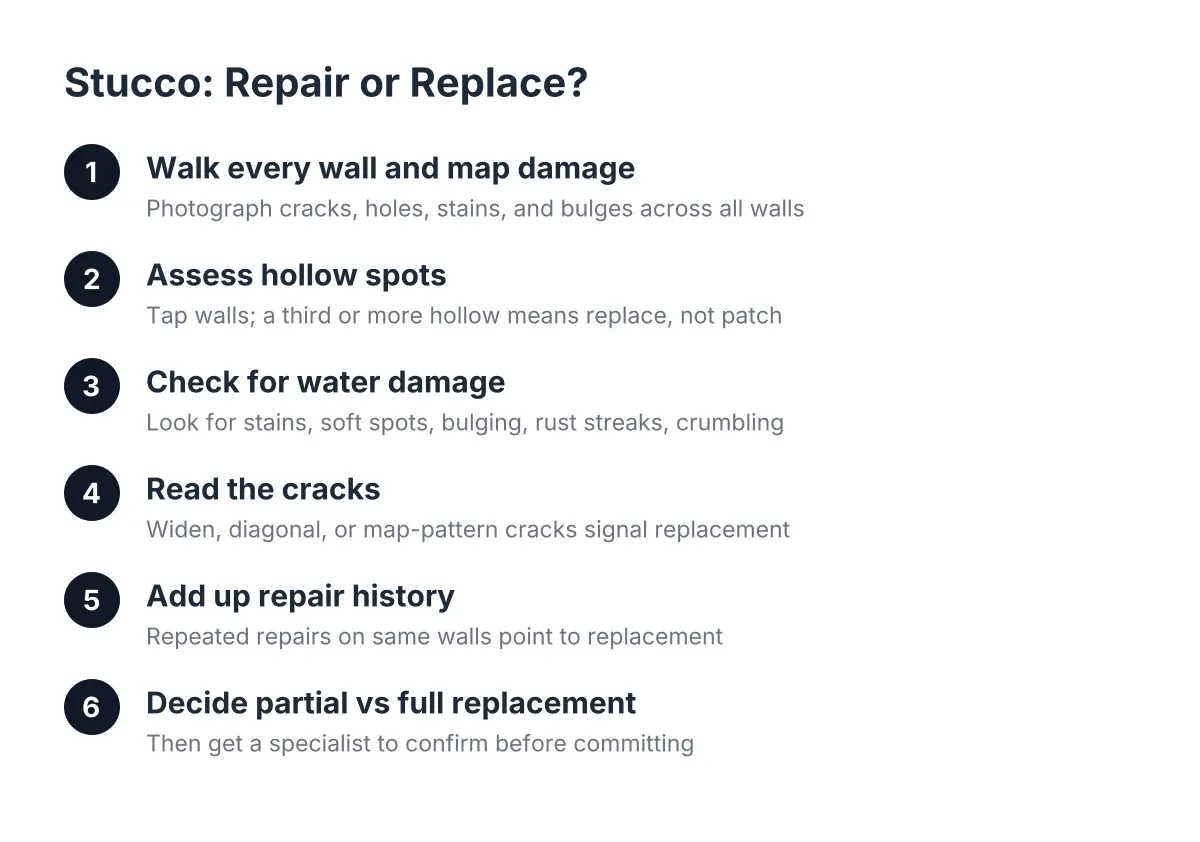
Replacement becomes the right call when the stucco has failed as a system rather than in spots. Look for these signs:
- Large sections that sound hollow when tapped, meaning the stucco has separated from the wall behind it
- Buckling or bulging areas, especially below windows or near the roofline
- Widespread spider-web cracking across entire walls, not just at corners and openings
- Soft or stained drywall inside the house on exterior walls, which points to water getting behind the stucco
- Previous patches layered on patches, where the wall is now a quilt of mismatched textures and colors
If none of those apply and your problem is a handful of cracks, holes in a wall, or a patch that does not match, you are likely looking at stucco crack repair, stucco patching, and color matching instead. That work fits inside almost any pre-listing schedule. The rest of this article assumes replacement is genuinely warranted, because that is where timeline planning matters most.
One caution from how these projects tend to go wrong: a structural crack left alone for years lets the building paper behind the stucco turn brittle. When the wall flexes, that paper can tear, and water intrusion follows. So if a wall has been cracked and ignored since before you started thinking about selling, do not assume it is still a patch job. Have someone open it up and look before you lock in a listing date.
How Long Does a Full Stucco Replacement Take?
A full stucco replacement on an average single-family home typically takes two to four weeks from the first day of demolition to the finished color coat. Partial replacement of a single wall or elevation often finishes in five to eight working days. The spread comes from home size, damage behind the walls, weather, and cure times between coats.
Those cure times are the part homeowners underestimate. Traditional stucco goes on in three coats: a scratch coat that gets scored so the next layer bonds, a brown coat, and a finish or color coat. Each coat needs time to set and cure before the next one goes on. The crew is not standing around; the wall is doing chemistry, and rushing it causes the cracking you just paid to remove.
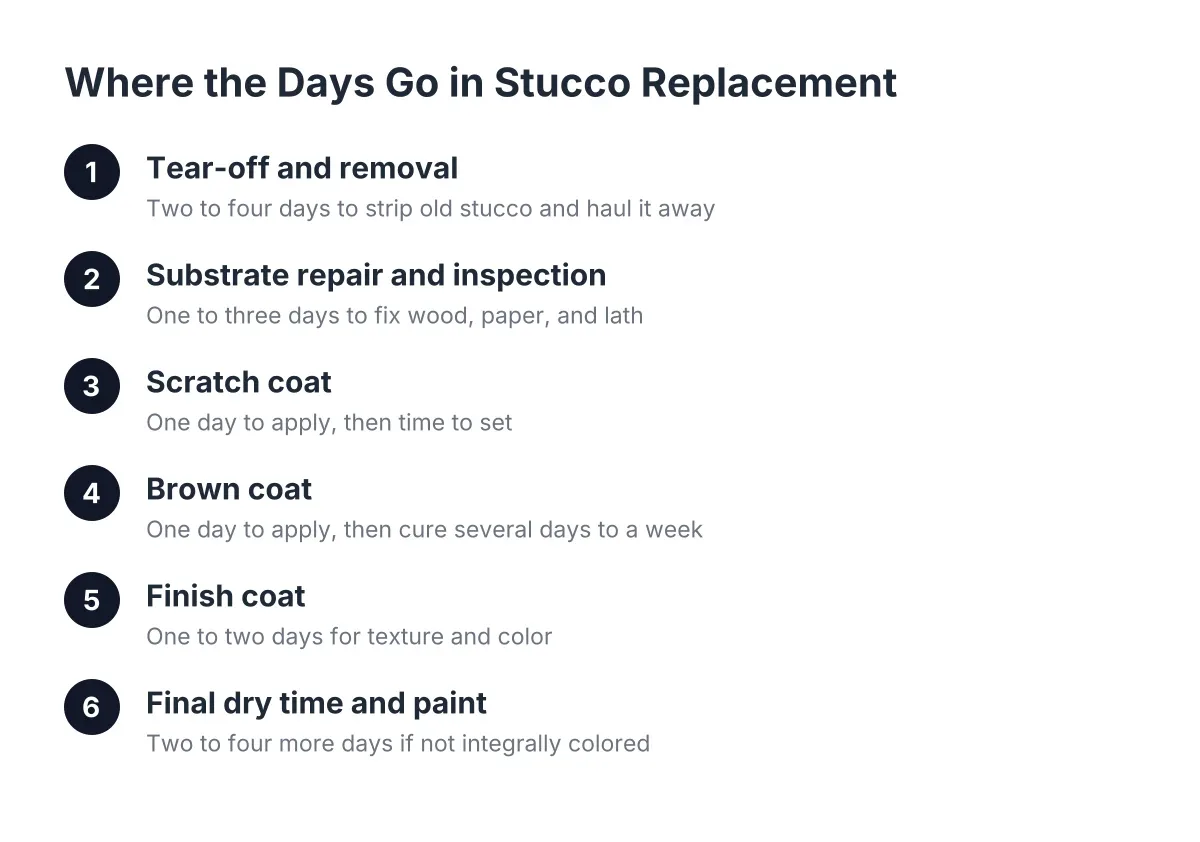
Here is roughly where the days go on a full replacement, assuming a typical crew and no surprises behind the walls:
- Tear-off and removal: two to four days to strip the old stucco down to the framing or sheathing and haul it away
- Substrate repair and inspection: one to three days to fix damaged wood, replace torn building paper, and install new lath
- Scratch coat: one day to apply, then time to set before the next coat
- Brown coat: one day to apply, followed by a cure period of several days to a week depending on conditions
- Finish coat: one to two days for texture and color, whether troweled by hand or applied with a stucco sprayer
- Final dry time and paint, if the finish is not integrally colored: two to four days more
Add those up and you land in that two-to-four-week window. In addition, remember that these are working days. A project that starts on a Monday in early 2026 and runs three working weeks occupies close to a month of calendar time once weekends and any weather days are counted.
What Makes a Stucco Replacement Timeline Long
Several specific factors stretch a stucco replacement timeline long past the initial estimate, and most of them show up in the first week. Hidden water damage behind the old stucco is the most common. Weather, permit timing, and finish complexity fill out the list. Knowing these in advance lets you build a buffer instead of discovering the need for one.
Hidden damage behind the old stucco
Nobody knows what the tear-off will reveal until the tear-off happens. If the sheathing is soft, the framing is water-stained, or the building paper has failed across large areas, that all gets fixed before any new stucco goes up. Skipping it would mean burying a known problem under fresh stucco, which no honest contractor will do and no home inspector will miss later. Budget one to three extra days for moderate substrate repair, and more if water damage runs along an entire wall base.
Weather and cure conditions
Rain stops stucco work cold. A full day of precipitation can mean a full day of no progress, because fresh coats cannot go on wet walls and cannot cure properly in the rain. Scottsdale is friendlier here than most places, but monsoon season, roughly late June through September, can insert stop days without warning. Extreme summer heat also matters; stucco applied to a wall baking at 110 degrees can dry too fast and crack, so crews may shift to early morning hours, which stretches the calendar even when total labor hours stay the same.
Permits and inspections
Full replacement usually involves the city, since you are exposing and repairing the structure and the weather barrier. Permit approval and inspection scheduling add calendar days that have nothing to do with how fast the crew works. Ask your contractor early whether your scope requires a permit and how long the local queue is running, because that answer belongs in your timeline before demolition starts.
Finish choice and texture matching
A standard sand or lace texture goes fast. A smooth stucco finish takes longer, because smooth walls show every imperfection and require more careful troweling and often an extra skim pass. Likewise, if you are replacing only some walls, matching the texture and color of the remaining original stucco takes trial panels and adjustment. That matching work is exactly what makes a partial replacement blend instead of announcing itself in your listing photos, so it is time well spent, but it is time.
Why the Stucco Replacement Timeline Runs Long Compared to Repair
The stucco replacement timeline runs long compared to repair because replacement rebuilds the wall system in layers, and each layer has a mandatory wait built in. A patch can use modern polymer-modified, rapid-setting products that replace the three-coat system in a single application. Full replacement over new lath still follows the traditional sequence, and the sequence cannot be compressed much.
Consider what each approach actually involves. A crack repair means cleaning out the crack, sometimes setting backer material, filling, texturing, letting the patch dry overnight, and painting. Two or three days, most of it dry time. Replacement means demolition, structural verification, new moisture barrier, new lath, then three coats with cure periods between them. The labor is heavier, but the waiting is what dominates the calendar.
This is also why the repair-or-replace decision deserves an honest assessment rather than a reflexive upsell. For context on cost, Fixr.com puts the national average for repairing buckled three-coat stucco in a 10×10-foot area at $900 to $3,000, averaging around $1,700. Full Stucco Replacement across a whole house is a different budget category entirely, often five figures. If a contractor jumps straight to full replacement without tapping walls, checking for hollow spots, or looking at the substrate, get a second opinion before you commit your money and your listing schedule to the bigger job.
Stucco is not a niche concern in this region, which is part of why the trade here is deep enough to get this decision right. According to the National Association of Home Builders, stucco remained the most-used exterior wall material in the Mountain division, which includes Arizona, at 48% of new single-family homes started in 2024. Crews here work on stucco constantly, and that experience shows up in tighter schedules and better texture matching.
Planning Backward From a Listing Date
If you are fixing the exterior before photos, showings, or an appraisal, plan the project backward from the date that cannot move. Suppose a homeowner in north Scottsdale has listing photos scheduled for April 15 and two walls with hollow, buckling stucco that a pre-listing inspection flagged. In that scenario, here is a realistic backward schedule:
- April 12 to 14: buffer days for touch-up, final walkthrough, and cleanup
- April 8 to 11: paint or final color coat, plus dry time
- April 1 to 7: brown coat application and cure
- March 27 to 31: tear-off, substrate repair, lath, and scratch coat
- Mid-March: contractor selected, scope confirmed, permit in hand if required
- Early March: walls assessed, quotes gathered, repair-versus-replace decision made
Notice that the homeowner in this example started six weeks out for a two-wall partial replacement. That is the practical rule: take the working estimate your contractor gives you, then add a week of buffer for weather and hidden damage. If the walls come off clean and the skies stay dry, you finish early and nobody complains. If the buffer gets used, your photo date survives.
For sellers, sequencing with the rest of your prep matters too. Schedule the stucco work before exterior painting, landscaping cleanup, and photography, in that order. Fresh stucco needs to dry, typically at least overnight for patched areas and longer for full coats, before paint goes on. Standard practice on exterior walls is to pressure wash first, then prime, then paint, so fold the wash into the same window rather than treating it as a separate project later.
What Living Through the Project Looks Like
Day to day, a replacement project is louder and messier at the start than at the end. Tear-off is the disruptive phase: demolition noise, dust, and debris around the foundation for two to four days. Crews typically protect windows, landscaping near the walls, and walkways, but expect the yard closest to the work to be off limits.
After tear-off, the rhythm changes. Substrate repair and lath installation are quieter carpentry days. The coating days involve mixers running and material going up fast, whether hand-troweled or shot through a stucco sprayer, followed by stretches where the wall simply cures and it looks like nothing is happening. Those quiet days are not delays; they are part of the schedule.
A few practical points for the weeks the crew is on site:
- You can stay in the home the entire time; replacement is exterior work
- Keep windows closed on demolition and spray days to keep dust out
- Move patio furniture, grills, and potted plants away from the walls before day one
- Expect crews to work bottom-up on each wall, which is the correct sequence for stucco coats
- Ask for the cure schedule in writing so you know which quiet days are planned
However, know the limits of a general guide like this one. If your home has EIFS rather than traditional hard-coat stucco, has known structural movement, or shows interior water staining, the scope and schedule need a professional assessment on site. No article can substitute for someone tapping your actual walls.
Getting the Finish Right When Time Is Tight
The last few days of the project decide whether the house photographs as freshly maintained or as recently worked on. Color matching and texture matching are where a rushed schedule shows. New stucco cures to a different shade over its first weeks, so an experienced finisher accounts for that shift rather than matching the wet color to the old wall.
If you are replacing everything, this is simpler; the whole exterior gets one consistent finish and one paint job, and the house reads as uniform in photos. If you are replacing selected walls, insist on a test panel before the finish coat goes on the full wall. A test panel costs a day and saves you from discovering a mismatch when the appraiser is already in the driveway.
For sellers weighing whether the spend is worth it on a house they are leaving: buyers and inspectors read exterior stucco condition as a proxy for how the whole house was maintained. Cracked, hollow, or patched-over walls invite lowball offers and inspection contingencies that cost more than the work. A clean exterior removes that lever from the negotiation. Plan the timeline early, build in the buffer, and the stucco becomes one line on your prep list instead of the thing that moves your listing date.
If you need stucco repair, Scottsdale Stucco Repair can help.
Prefer to talk it through? Call (480) 637-3464 — a quick call is usually the fastest way to get a straight answer for your situation.