Stucco Contractor Guarantees and Warranties: What Protection You Actually Need
You have picked your contractor, or you are one signature away from it. Before any money changes hands, the last thing to pin down is what happens if the work fails. Stucco contractor guarantees and warranties are where good hires get confirmed and bad hires get exposed. A crack repair that reopens in eight months, a patch that flashes a different color every time it rains, a resurfaced wall that starts shedding, these are the failures a written warranty is supposed to cover. This guide walks through what real stucco workmanship warranty protection looks like on a Scottsdale stucco job, what the paperwork should say, which warranty promises are actually red flags, and how to hold a contractor to their word without a fight.
This matters more here than in most places. Stucco remained the most-used exterior wall material in the Mountain division, which includes Arizona, at 48% of new single-family homes started in 2024, according to the National Association of Home Builders. Nearly half the housing stock around you wears the same material, which means plenty of repair work, plenty of contractors chasing it, and a wide range in how seriously they stand behind what they do.
Why Stucco Work Fails, and Why That Shapes Workmanship Warranty Protection
Stucco failures rarely show up on the day the crew leaves. The wall looks clean, the patch is smooth, and everyone shakes hands. The problems surface later, through Arizona's heat cycles, monsoon moisture, and the natural movement of the wall itself.
That timing is the whole reason warranties exist in this trade. A traditional stucco wall is built in layers: a moisture barrier, metal lath fastened over it, then a scratch coat, a brown coat, and a finish coat. A failure in any hidden layer takes months to announce itself at the surface. If the crew skipped scraping loose burrs off the old surface before coating over it, the new layer bonds poorly. You will not see that in week one. You will see it the following summer.
The most common delayed failures on repair work look like this:
- Hairline cracks reopening along the same line, usually because the crack was skim-coated instead of properly opened, backed, and sealed
- A patch that holds but shows a visible outline, because the texture or color was never matched to the surrounding wall
- Bubbling or delamination where new stucco went over a dirty, chalky, or unstable surface
- Moisture staining below a repair, meaning water is getting behind the patch instead of being stopped by it
- Crumbling at the edges of a patch where the lath was cut too cleanly, so the new stucco never tied into the old wire
Each of those is a workmanship failure, not bad luck. A warranty that covers workmanship is your protection against exactly this list. A warranty that quietly excludes cracking, color variation, and moisture is protecting the contractor, not you.
What Stucco Contractor Guarantees and Warranties Should Cover
A useful stucco warranty covers workmanship in writing, names a specific term in years, defines what counts as a failure, and states what the contractor will do about it at no charge. Anything vaguer than that, verbal promises included, is worth close to nothing when a patch fails eighteen months later.
Break the paperwork into three separate questions, because contractors often blur them together.
Workmanship Coverage and Protection
This is the core of any stucco contractor guarantee. Stucco workmanship warranty provisions say: if the repair fails because of how we did the work, we come back and fix it free. That includes patches that debond, cracks that reopen along the repaired line, and coatings that peel because prep was skipped.
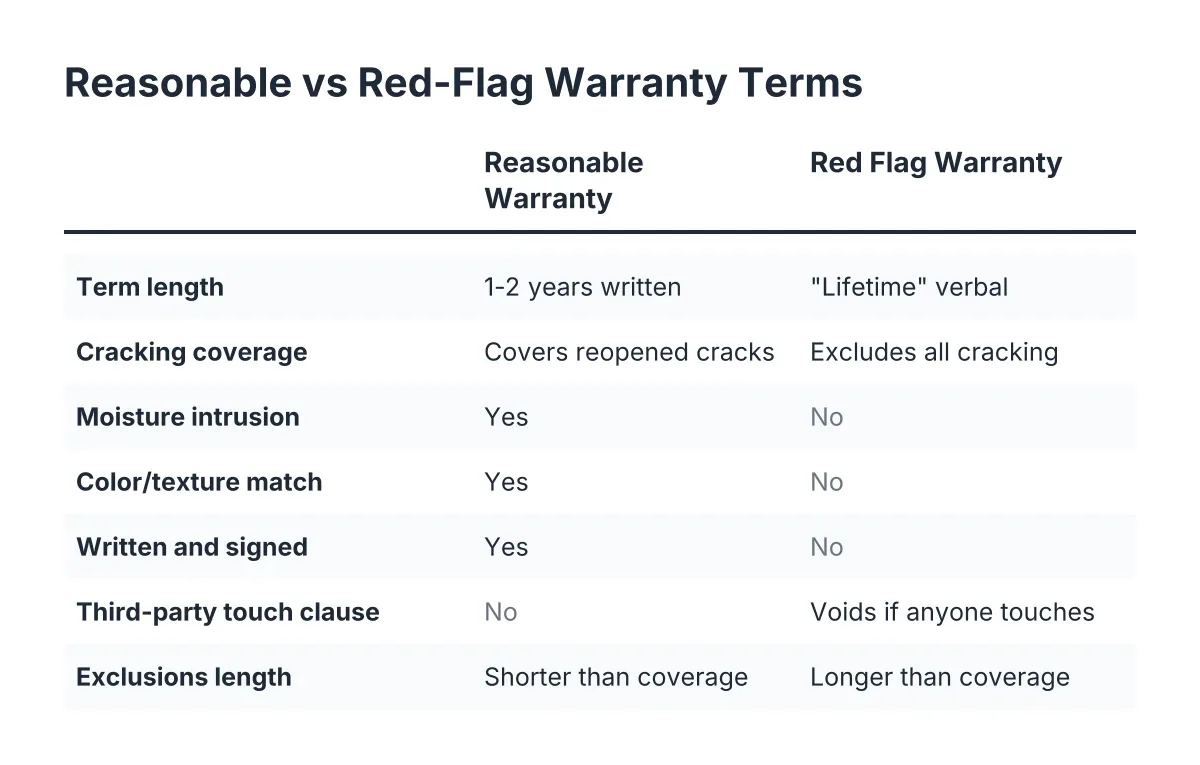
Ask for the term in writing. On stucco repair, one to two years of workmanship coverage is a common and reasonable range; some contractors offer more on full replacement or resurfacing. The exact number matters less than whether it is written, signed, and specific. A two-year written warranty beats a "lifetime" verbal one every single time.
Material warranties: the part the manufacturer controls
Stucco mixes, acrylic finishes, elastomeric coatings, and sealants often carry their own manufacturer warranties. These are separate from the contractor's promise. A manufacturer warranty typically covers product defects, not installation errors, and it usually requires the product to have been applied to spec.
Here is the catch: if the contractor applies the product wrong, the manufacturer warranty can be void and the contractor's workmanship warranty is your only recourse. So ask two things. What products are you using, and does your installation keep the manufacturer warranty intact? A contractor who knows their materials answers both without hesitation.
The exclusions: where warranties actually get decided
Every warranty has exclusions, and honest ones are fine. Stucco is a rigid material on a moving structure; no contractor can promise a wall will never crack again anywhere. Reasonable exclusions include new cracks in undisturbed areas of the wall, damage from settling or foundation movement, impact damage, and problems caused by sprinklers spraying the wall daily.
Unreasonable exclusions gut the warranty. Watch for language that excludes "all cracking" without limitation, excludes moisture intrusion entirely, or voids coverage if anyone else touches the house. If the exclusions section is longer than the coverage section, read it twice and ask direct questions about each line.
Warranty Red Flags That Should Stop the Signing
Certain warranty behaviors predict exactly the outcome you are trying to avoid: a contractor who will not answer the phone when the patch fails.
First, the lifetime warranty with no paper behind it. "Lifetime" sounds like the strongest possible promise, but on stucco repair it often signals the opposite. A contractor who plans to be reachable in five years writes a specific term with specific conditions. A contractor who plans to change phone numbers writes "lifetime" because they will never have to honor it. Whose lifetime, the wall's, the company's, or yours? If the document does not say, the word means nothing.
Second, cash-only jobs with no contract. If you have been burned before, you already know this one, but it bears repeating: a warranty is a contract term, and there is no warranty without a contract. No written scope means no written coverage. Walk away.
Third, the warranty that lives only in conversation. "We always take care of our customers" is not coverage. If the contractor stands behind the work, the sentence costs them nothing to put in writing. Refusal to do so tells you what the promise was worth.
Fourth, a rock-bottom bid paired with a generous-sounding warranty. Suppose one bid comes in at half the others and includes "full lifetime coverage." The math does not work. Proper stucco repair takes prep, matched materials, and return-trip capacity, and none of that fits inside a bid that undercuts everyone. For scale, Fixr.com puts the national average cost to repair buckled three-coat stucco in a 10×10-foot area at $900 to $3,000, averaging about $1,700. A quote wildly below realistic ranges is usually financed by never honoring the warranty.
Fifth, warranties from lead brokers rather than the crew doing the work. Some sites that look like local stucco repair companies resell your information to whoever buys the lead. In that arrangement, the entity you found online and the entity swinging the trowel are different, and the warranty question falls into the gap between them. Confirm the name on the warranty matches the name on the contract, the license, and the truck.
The Questions That Test a Warranty Before You Sign
You do not need to be a stucco expert to pressure-test a warranty. You need five direct questions and the patience to hear complete answers.
- What is the workmanship warranty term, in years, and is it in the contract? The answer should be a number and a yes.
- What specifically counts as a covered failure? Listen for concrete answers: reopened cracks along the repair line, debonding, peeling, moisture behind the patch.
- What is excluded, and why? Honest contractors explain their exclusions in terms of physics, movement, settling, and impact. Evasive ones change the subject.
- If I call about a failed patch, what happens next? You want a process: they inspect, they determine cause, they fix covered failures at no charge.
- Does the warranty transfer if I sell the house? Not always offered, but worth knowing, especially in a Scottsdale market where homes change hands often.
In addition, ask how they handle color and texture matching under warranty. This is the failure homeowners notice most. A structurally sound patch that reads as a gray rectangle on a desert-tan wall is still a failed repair to your eyes. A contractor confident in their stucco color matching and texture matching will address blend quality directly; one who shrugs and says "it fades in eventually" is telling you what their callbacks look like.
The process behind Hiring A Stucco Contractor does not end at the signature, and neither does vetting. How a contractor talks about their warranty before the job predicts how they will behave when you call about it after.
What HOA Boards Need Beyond the Homeowner Basics
Community associations carry a different version of this problem. When the asset is a shared perimeter wall, an entry monument, or a clubhouse exterior, the warranty has to survive board turnover, management company changes, and a paper trail that a reserve-study auditor might request years later.
For a board or property manager, the warranty package should be part of the bid file, not an afterthought. Since most associations require two or three bids and a board vote before approving spend from reserves, put warranty terms on the comparison sheet next to price. A bid that is $1,800 higher but carries a written two-year workmanship warranty on a $12,000 perimeter wall resurfacing project may be the cheaper bid over the life of the asset.
Boards should also require:
- The warranty issued in the association's name, not a board member's personal name
- Warranty terms stated in the contract itself, not a separate handshake document
- A certificate of insurance and W-9 on file before work starts, so a future warranty claim is not the first time anyone verifies the company exists
- Clear scope language, so a claim about the north wall patch cannot be dodged because the contract only said "wall repair"
For example, say an association with 200 units gets a reserve-study finding of widespread cracking along a shared stucco perimeter wall, with a projected repair in the $8,000 to $15,000 range. In that scenario, the board that files a signed contract with explicit warranty terms can enforce a claim three years later even after two board seats have turned over. The board that approved work from an emailed one-line quote cannot.
Making a Warranty Claim When Something Fails
A warranty only pays off if you use it correctly. Most homeowners who lose warranty disputes lose on process, not merit.
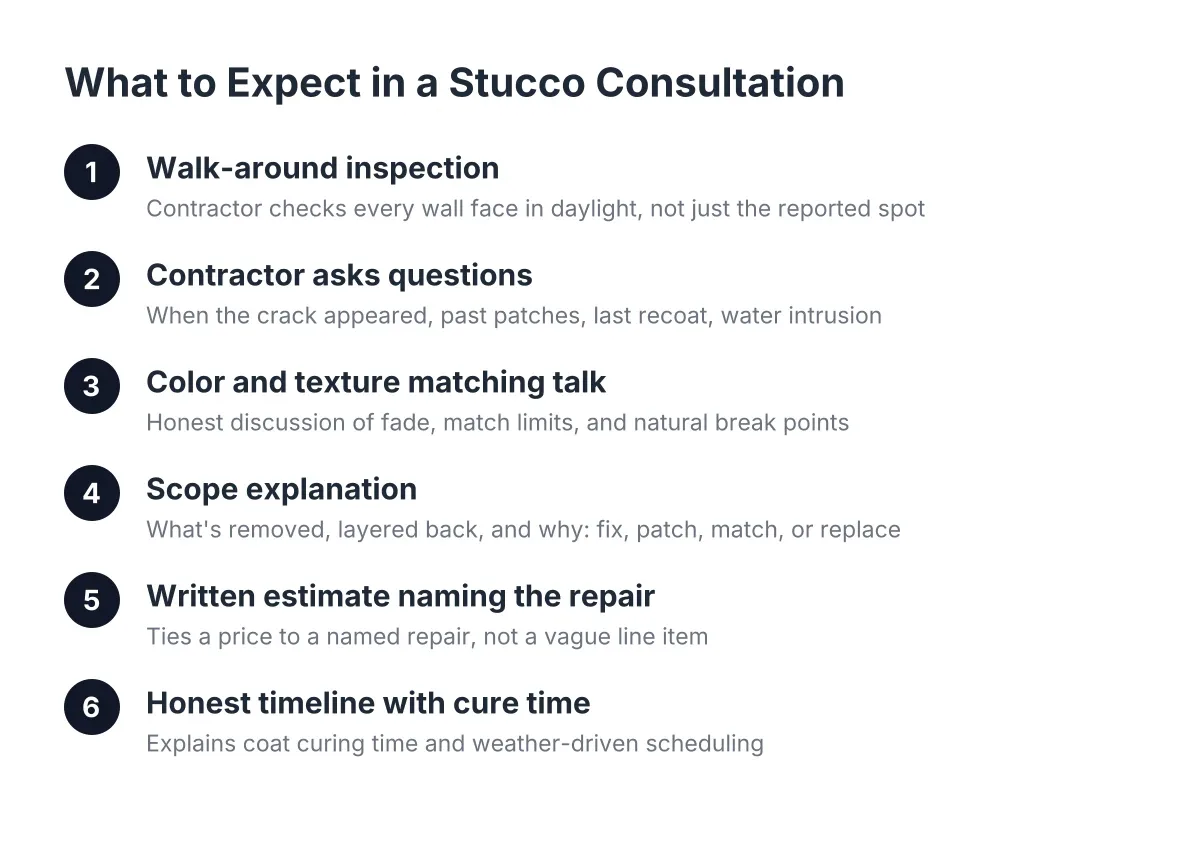
Start by documenting before you call. Photograph the failure in good light, note the date you first saw it, and pull out your contract and warranty document. Match what you see against the covered-failure language so you can describe it in the contract's own terms: "the crack repair on the west wall has reopened along the repaired line," not "the wall looks bad again."
Next, put the claim in writing, even if you also call. An email with photos, the date, and a reference to the warranty term creates the record you will need if the contractor stalls. Keep it factual and calm; you are invoking a contract term, not starting an argument.
Then let the contractor inspect. A legitimate company will want to see the failure before committing to a fix, because cause matters. A reopened crack along the repair line is on them. Additionally, a brand-new crack ten feet away from the patch, caused by the house settling, probably is not, and a fair warranty never claimed it would be. Expect that distinction and do not treat it as dodging.
However, know your escalation path if the contractor disappears or refuses a clearly covered claim. In Arizona, licensed contractors answer to the state registrar of contractors, which handles complaints against licensees, and license bonds exist partly for this reason. This is one more argument for hiring licensed in the first place: an unlicensed handyman's warranty has no enforcement mechanism behind it at all. For disputes involving structural cracking, suspected foundation movement, or active water intrusion inside the wall, bring in an independent inspector or engineer before the dispute hardens; warranty coverage aside, those problems need a professional diagnosis.
The Specialist Difference on Warranty Day
Here is the pattern underneath everything above. Generalist handymen and national remodeling platforms treat stucco as one line item among many. When a stucco patch fails, it is a small, annoying callback in a business built around kitchens and decks, and small annoying callbacks are the first thing an overloaded generalist stops answering.
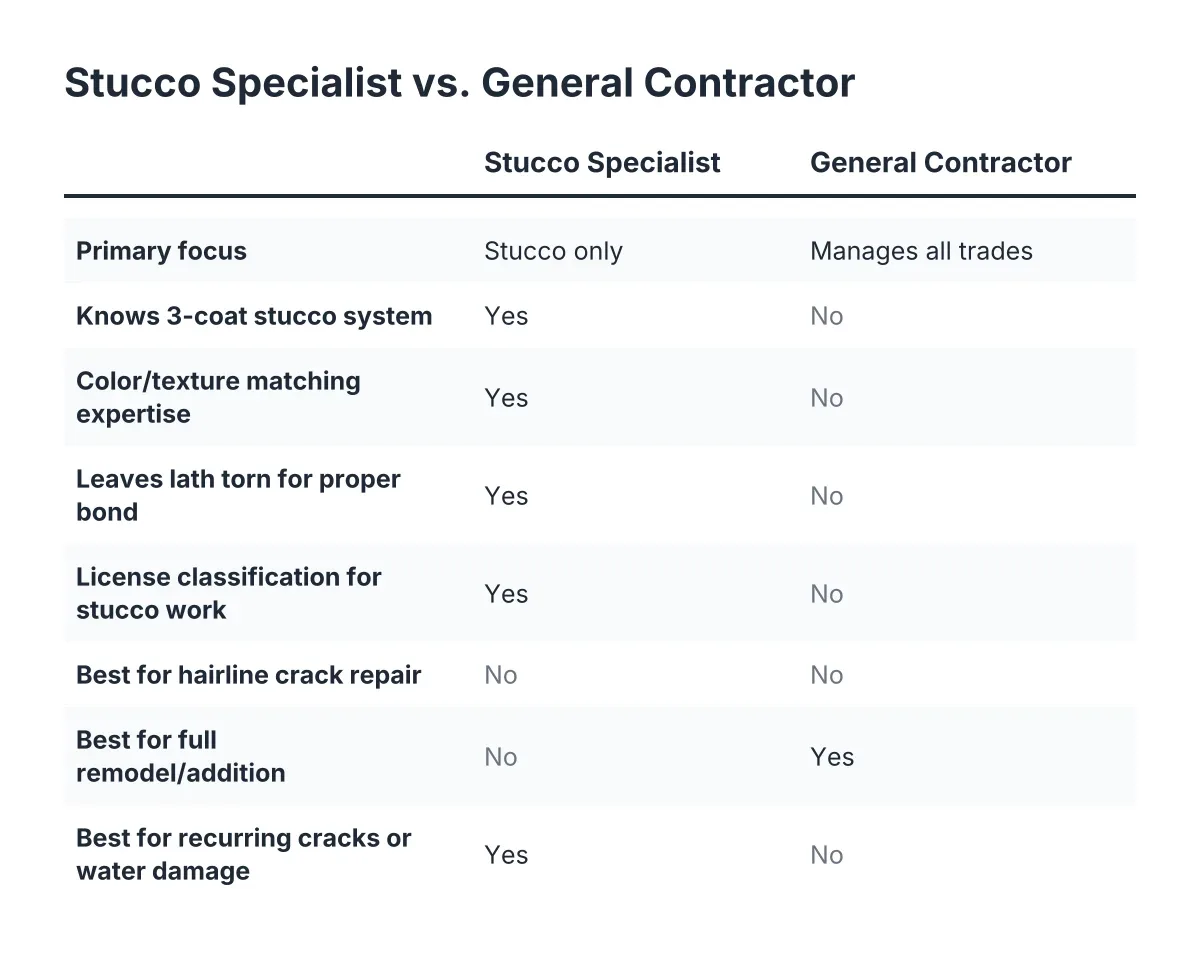
A stucco specialist has the opposite incentive. Stucco repair, crack repair, patching, and replacement are the whole business, so a failed patch in Scottsdale is not a rounding error; it is the reputation. Specialists also fail less in the first place, because the failure modes listed earlier, bad prep, poor lath tie-in, mismatched texture, are exactly the details a stucco-only crew handles every day. Traditional three-coat work in particular, scratch coat through finish coat, is harder than it looks and is the kind of work worth hiring out to people who do nothing else.
None of this means a warranty makes every job risk-free. Stucco lives on a moving structure in a harsh climate, and even excellent work needs occasional maintenance; expecting a warranty to substitute for that is a setup for disappointment. What stucco contractor guarantees and warranties actually buy you is narrower and more valuable: a written promise, from a company that plans to still exist, that failures caused by their work are their problem to fix.
So before you sign, get the term in years, the coverage in plain language, the exclusions explained, and the company name consistent across the contract, the license, and the warranty. That is twenty minutes of reading that decides whether the promise on the wall outlasts the truck in the driveway.
If you need stucco repair, Scottsdale Stucco Repair can help.
Prefer to talk it through? Call (480) 637-3464 — a quick call is usually the fastest way to get a straight answer for your situation.