Stucco Contractor vs. General Contractor: How to Hire the Right Specialist in Scottsdale, AZ
If you have cracked or damaged stucco and you are deciding between a stucco contractor, general contractor, or handyman, this guide walks you through the decision step by step. When you're considering hiring a stucco specialist, the choice becomes clear: for most stucco repair in Scottsdale, AZ, the specialist wins, and not by a little. Stucco is a layered system, not a coat of paint. A patch that ignores how those layers work will telegraph through the finish within a year, and a color match done by eye will glow like a bandage every time the afternoon sun hits the wall. Here is how to sort the specialists from everyone else before you hand over a deposit.
Step 1: Understand What a Stucco Specialist Does That a Generalist Does Not
Start by getting clear on what you are actually buying. Traditional stucco goes on in three coats: a scratch coat that gets scored so the next layer bonds, a brown coat that builds thickness, and a finish coat that carries the color and texture. A repair that lasts has to tie into that system correctly, and it has to match the texture and color of the wall around it.
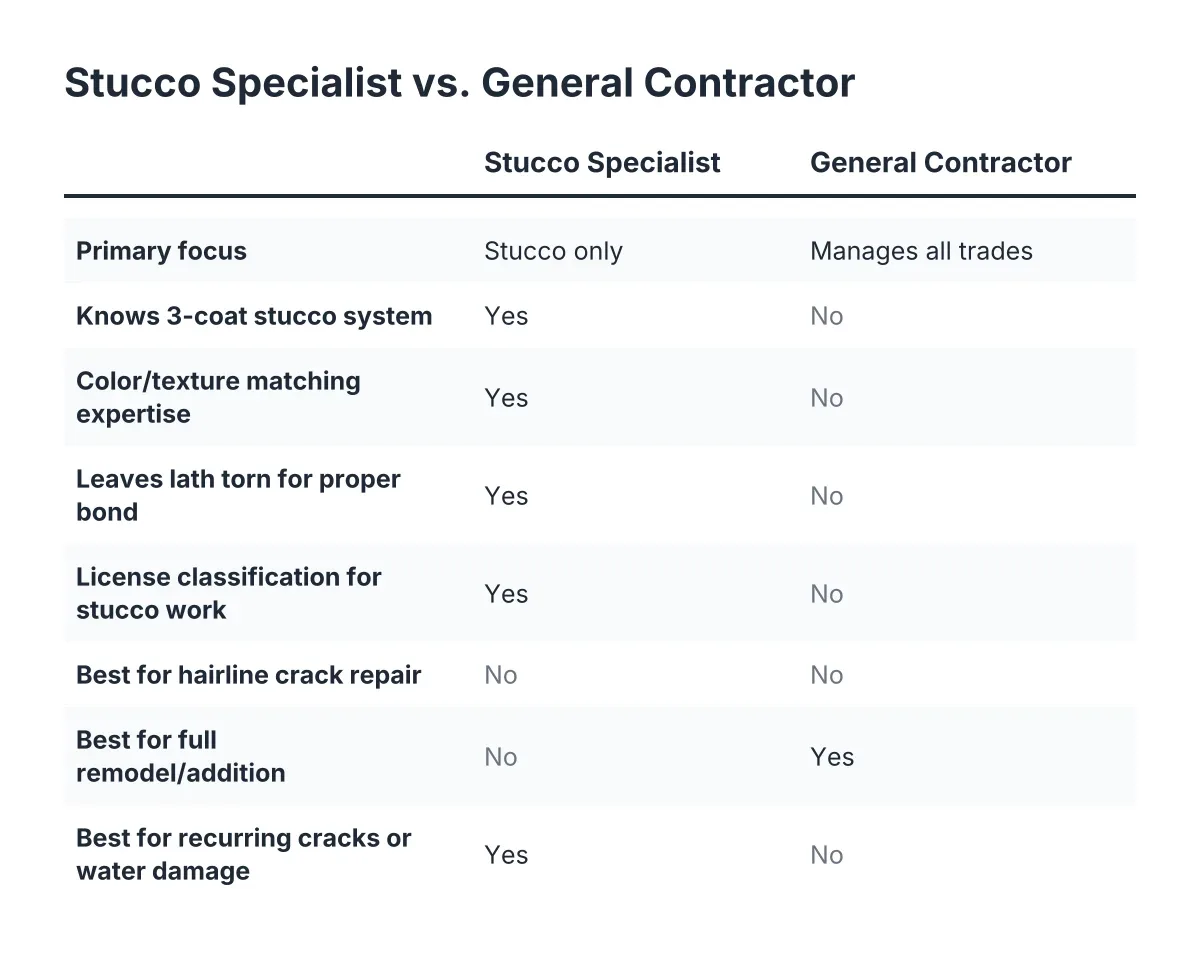
A general contractor manages projects. He hires trades, schedules them, and marks up their work. A handyman does a little of everything. A stucco contractor does one thing: stucco repair, stucco installation, and the color and texture matching that makes a patch disappear.
That difference shows up in small decisions. For example, when a specialist cuts out damaged stucco, he avoids a clean grinder cut on purpose. He leaves the wire lath torn and exposed so the new patch can tie into it and be weatherproofed properly. A clean square cut forces the repair to open up more wall, which adds cost. A generalist who does not know that detail costs you money without meaning to.
Stucco is also everywhere here. According to the National Association of Home Builders, stucco remained the most-used exterior wall material in the Mountain division, which includes Arizona, at 48% of new single-family homes started in 2024. In a market this saturated with stucco homes, there is no reason to settle for someone who treats it as a side job.
Step 2: Match the Job to the Right Kind of Contractor
Next, decide what your project actually calls for. Not every job needs a specialist, and being honest about that will save you time getting quotes.
- Hairline cracks under about 1/16 inch: A careful homeowner can fill these with a flexible stucco crack sealant. For wider cracks, a backer rod, which according to Sika is a closed-cell foam cord, creates a backing inside the crack before sealant goes in.
- Cracks that keep returning, spider-web fissures, or holes in a wall: Call a stucco contractor. Recurring cracks usually point to movement or a bonding problem underneath, and a surface fill will not hold.
- Water damage, soft spots, or staining below windows: Call a stucco contractor now, not next quarter. Water behind stucco spreads and gets more expensive the longer it sits.
- Stucco as part of a full remodel or addition: A general contractor makes sense to run the whole project, but ask who is actually doing the stucco. You want a stucco sub, not the framing crew finishing the wall on a Friday afternoon.
The scratch and brown coats look simple in videos. They are not. Applying them is harder than it looks, and it is one of the jobs experienced tradespeople consistently recommend hiring out. Timing alone will beat a first-timer; professional plasterers can apply multiple coats in one day because they know how to dose accelerators, and getting that wrong hardens the mix in minutes, before it can be worked.
Step 3: Verify the License Before You Talk Price
In Arizona, residential contracting work above a small dollar threshold requires a license from the Arizona Registrar of Contractors. Look the company up on the ROC website by name or license number before the first phone call goes anywhere. Confirm the license is active, check the classification, and see whether complaints are on file.
Then ask for proof of insurance, not a verbal yes. A legitimate stucco repair company can send a certificate of insurance the same day you ask. If the answer is "we're covered, don't worry about it," you have your answer about the company too.
This step matters more for stucco than for many trades because the failure is delayed. A bad patch can look fine for six months, then crack, stain, or fall out. If the contractor was unlicensed and unreachable by then, you pay twice. This is the single most common way homeowners get burned when hiring a stucco contractor, and it is entirely avoidable with ten minutes on the ROC site.
Why Hiring a Stucco Specialist vs. General Contractor Affects Licensing
A stucco contractor and a general contractor hold different license classifications in Arizona, and the classification tells you what the state has actually vetted them to do. A general contractor's license covers running projects; it does not mean anyone on his crew has ever floated a finish coat. Check that the license classification matches the work you are hiring for, not just that a license exists.
Step 4: Get Quotes and Read Them Like a Skeptic
Get two or three written quotes. Not phone estimates, not a number scribbled on a card. A fair stucco repair quote spells out:
- The scope: what gets cut out, patched, or resurfaced, and roughly how many square feet.
- The system: how many coats, and whether lath or paper gets replaced.
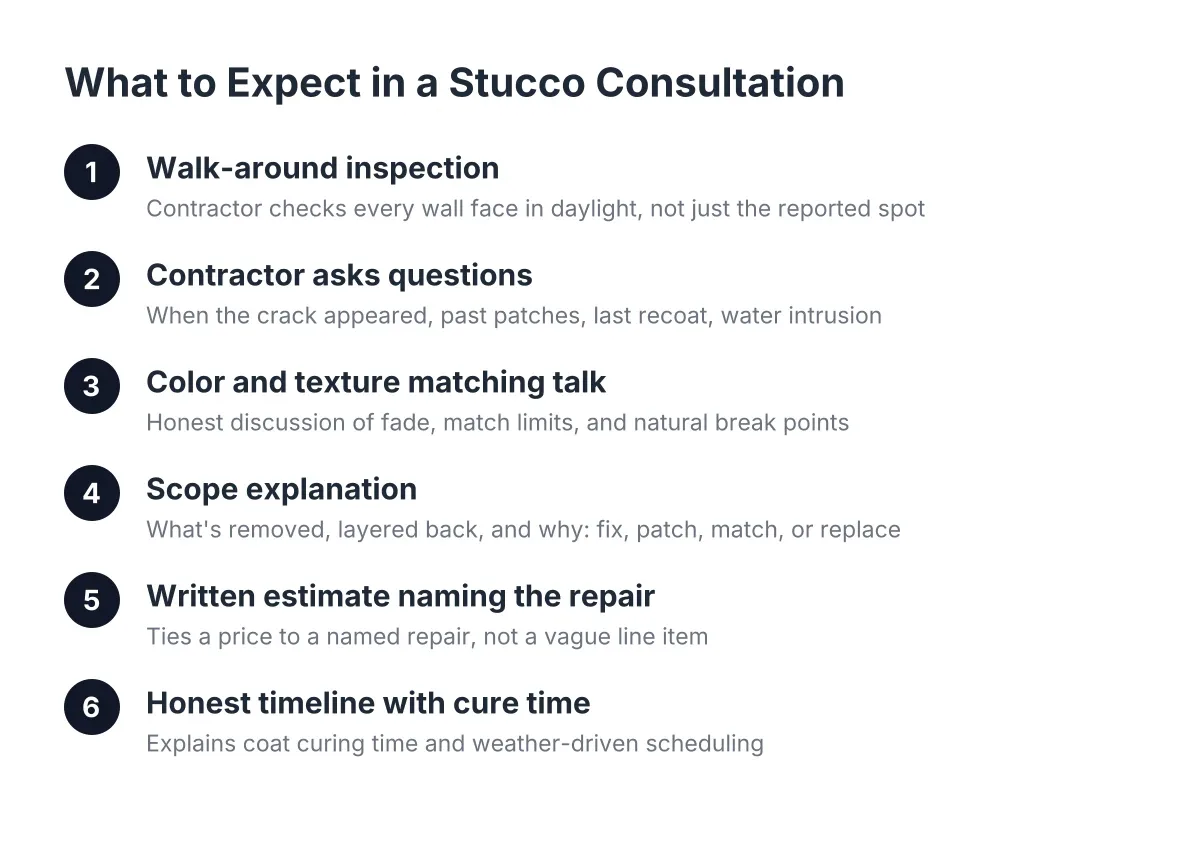
- The match: how color and texture matching will be handled, and whether the finish coat extends to a natural break in the wall so the patch does not sit in the middle of a flat plane.
- The money: total price, deposit, and when the balance is due.
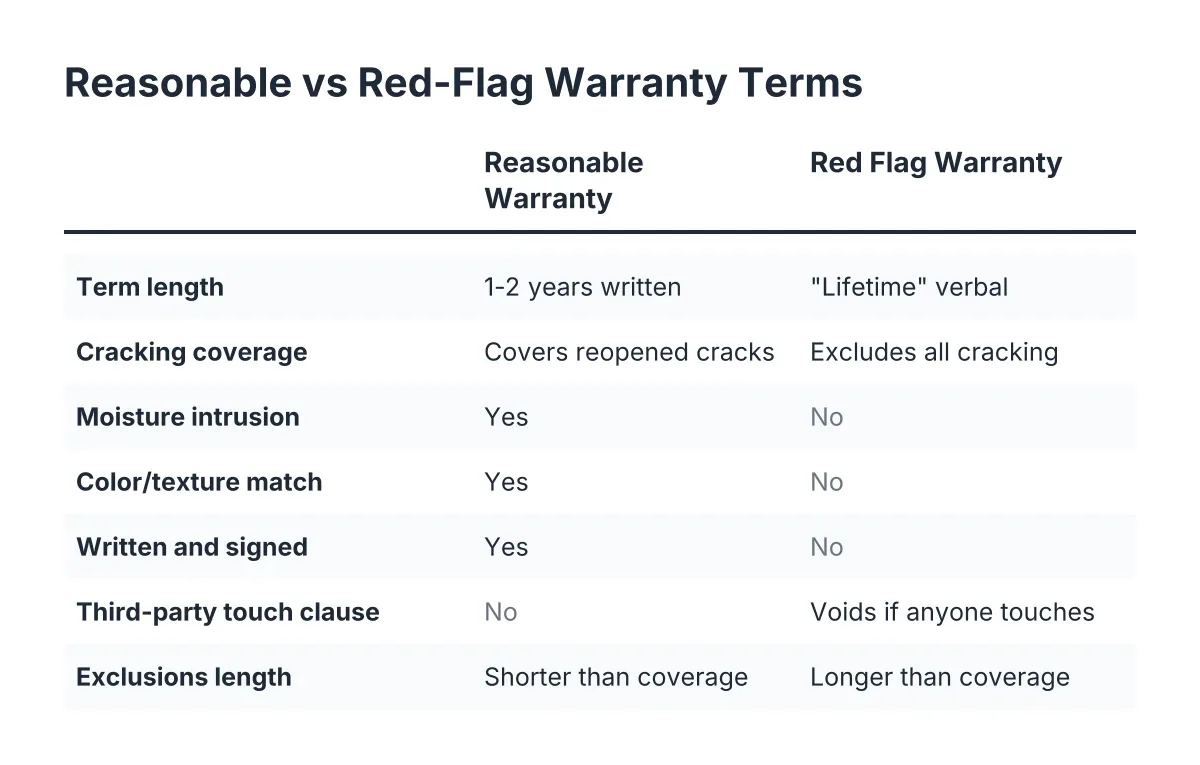
- The paper: license number, insurance, and a written warranty on the repair.
For budgeting, Fixr.com puts the national average cost to repair stucco at $900 to $3,000, averaging around $1,700 for a buckled three-coat section in a 10×10-foot area. Your Scottsdale quote will vary with access, damage depth, and finish type, but a bid wildly below that range for comparable work should raise a question, not excitement. Hiring a stucco specialist rather than a generalist will typically fall within this standard range.
Suppose a homeowner in McCormick Ranch gets three bids to fix water damage below a parapet: $650 cash from a handyman with no contract, $1,900 written from a stucco contractor with a scope and warranty, and $3,400 from a general contractor who will sub the work out. In that scenario, the middle bid is usually the honest one. The low bid skips the lath repair that caused the damage, and the high bid is paying for a middleman.
Cash-only, contract-free, and today-only pricing are the three flags that matter most. Any one of them alone is reason to keep looking.
Step 5: Questions to Ask When Hiring a Stucco Specialist
Before you sign, ask these in person or on the phone and listen for specifics, not confidence:
- "How will you match my texture and color?" A specialist talks about test patches, sun-fade on the existing finish, and carrying the new finish to a natural edge. There is no single correct troweling technique, so what you want to hear is that they will match your wall, not apply their default finish.
- "What is under my stucco, and how will you tie the patch into it?" The right answer mentions lath, paper, and weatherproofing the edges of the patch. A generalist answers "we'll fill it and paint it."
- "What happens if the repair cracks in a year?" You want a written warranty and a person who will still answer the phone. Vague reassurance is not a warranty.
A useful side benefit of these questions: they are cheap to ask and expensive to fake. Anyone can say "licensed and insured" on a website. Few can explain why a torn lath edge weatherproofs better than a clean cut unless they have actually done the work.
Step 6: Structure the Payment So You Cannot Get Burned
Never pay in full up front. A reasonable structure for a typical Scottsdale repair in the $800 to $8,000 range is a modest deposit to schedule the work, with the balance due on completion after you have walked the wall in daylight. Check the patch from ten feet back and from an angle, since texture mismatches hide straight-on and show in raking light.
However, keep one trade-off in mind: even a perfect texture match can read slightly different in color until the new finish cures and weathers, and some repairs need a second look or a reapplication to settle in. A good contractor tells you that up front instead of promising invisibility on day one. If the damage traces back to a structural or drainage problem, bring in the appropriate professional for that issue before the stucco work, because stucco over an unfixed cause is money spent twice.
The Bottom Line for Scottsdale, AZ Homeowners
When the job is stucco and only stucco, the stucco contractor beats the general contractor on knowledge, price structure, and accountability. The generalist earns his place on multi-trade projects; the specialist earns it every time the work is crack repair, stucco patching, hole repair, water damage repair, or a full replacement where the match has to be invisible.
If you are in Scottsdale, AZ and looking at cracks, holes, or aging stucco right now, reach out to a local stucco repair specialist for a written estimate. Bring photos of the damage, ask the three questions above, and check the license before anyone sets a ladder against your wall. Ten minutes of vetting is the cheapest insurance a stucco job will ever have.
If you need stucco repair, Scottsdale Stucco Repair can help.
Prefer to talk it through? Call (480) 637-3464 — a quick call is usually the fastest way to get a straight answer for your situation.