Licensed Stucco Contractor Credentials: Licensing, Bonding, and Insurance Explained
If you are getting a Scottsdale house ready to list, or wrapping up an addition that needs new stucco to match the original walls, the difference between a licensed stucco contractor and an unlicensed handyman is not paperwork trivia. It is the difference between a patch that blends in before photos and a mismatched repair you end up paying to fix twice. Stucco is everywhere in Arizona; according to the National Association of Home Builders, stucco was the most-used exterior wall material in the Mountain division at 48% of new single-family homes started in 2024. That means plenty of people advertise stucco work here, and not all of them are qualified to do it.
This guide walks through the seven credentials and checks that matter when you are vetting stucco repair companies, what each one actually protects you from, and the red flags that tell you someone is a generalist treating stucco as a side job.
1. Verify the License With the Arizona Registrar of Contractors
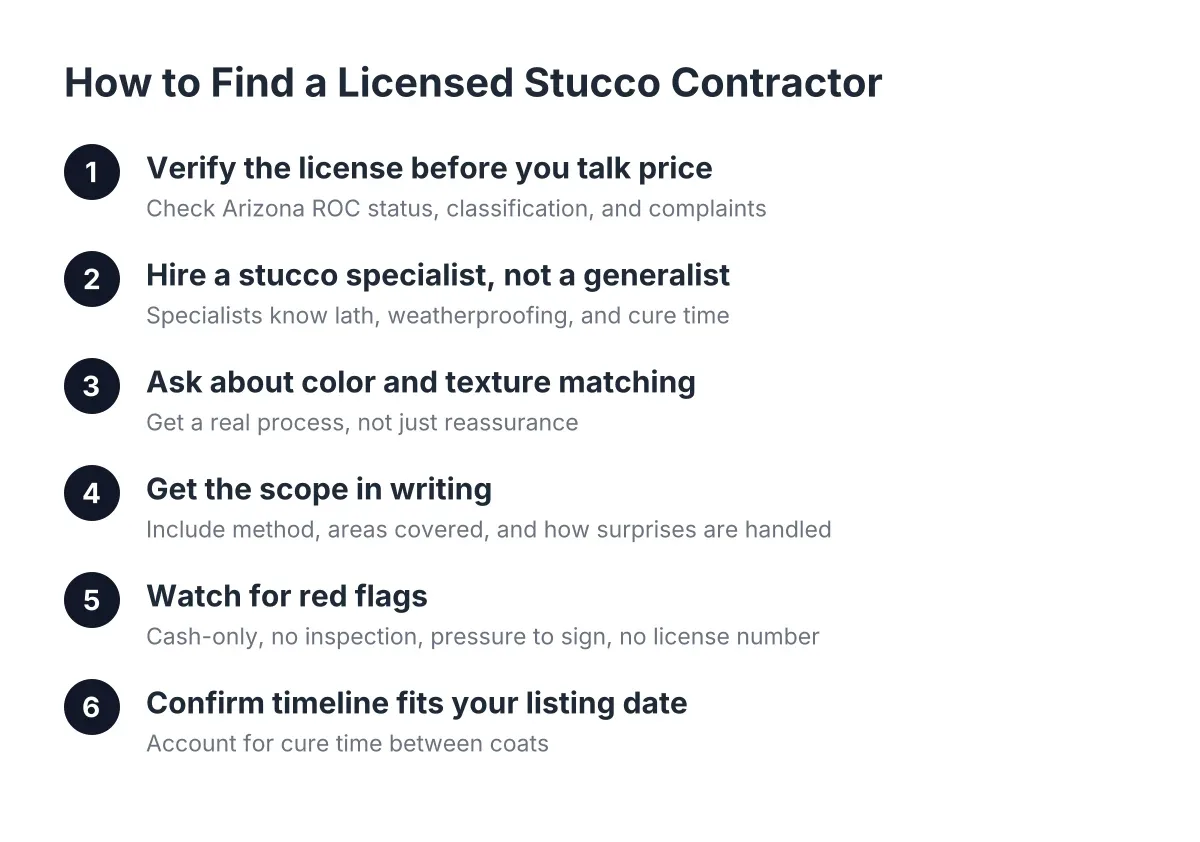
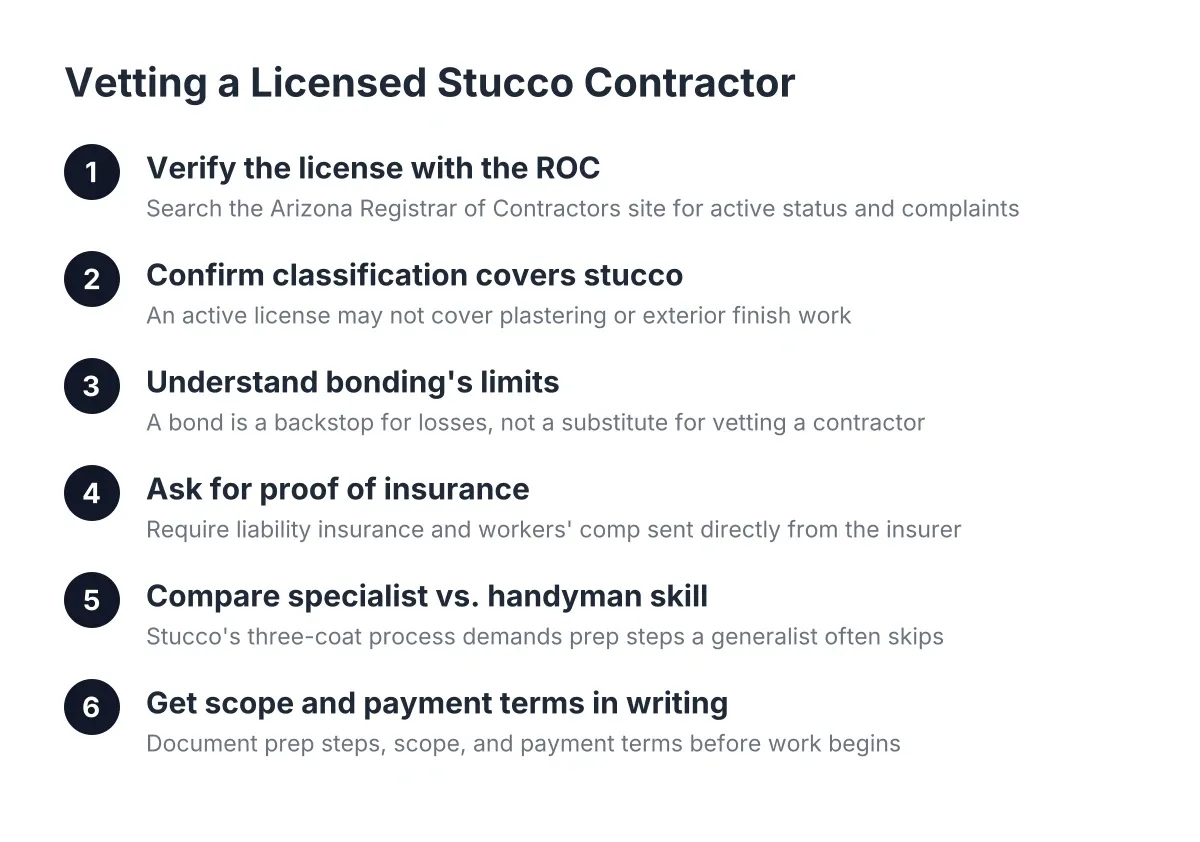
An Arizona contractor license is the first filter, and it takes about two minutes to check. In Arizona, the Registrar of Contractors (ROC) licenses contractors, and you can search any company name or license number on the ROC website to see whether the license is active, what classification it covers, and whether complaints have been filed.
Why it matters for you specifically: if you are selling the house, an unpermitted or unlicensed repair can surface during inspection and become a negotiating point against you. If you are building an addition, your general contractor should already expect the stucco sub to be licensed, but it is worth confirming rather than assuming.
Ask for the license number before you ask for a price. A legitimate licensed stucco contractor will give it without hesitation. Someone who dodges the question, or says a license is not needed for "small repairs," is telling you something.
2. Confirm the License Classification Actually Covers Stucco
Not every active license covers the work you need. Arizona classifies licenses by trade, and stucco work falls under specific classifications for plastering and related exterior finishes. A contractor licensed only for painting or general handyman work may be operating outside their classification when they patch your exterior wall.
Therefore, when you look up the license, read past the "active" status. Check what the classification allows. This is one of the clearest ways to separate a stucco specialist from a generalist who lists stucco patching between drywall and gutter cleaning.
For a pre-sale fix, this matters more than it sounds. A painter can hide a crack for a few weeks. A stucco contractor repairs the crack, matches the texture, and blends the color so it holds up through photos, showings, the appraisal, and the buyer's inspection.
3. Understand What Bonding Protects (and What It Does Not)
A contractor bond is a financial guarantee the contractor posts as a condition of licensing. If the contractor abandons the job, does defective work, or violates licensing rules, you may be able to file a claim against the bond to recover part of your loss.
However, bonds have limits. Bond amounts are capped, and a claim process takes time. A bond is a backstop, not a substitute for choosing well in the first place. Think of it this way: the bond exists so that when things go wrong, you are not left with zero recourse. It does not make a bad contractor a safe choice.
For a homeowner mid-addition with $2,000 to $15,000 riding on the stucco scope, the practical takeaway is simple. Bonded and licensed means there is a system behind the contractor. Unlicensed means you are on your own if the work fails.
4. Ask for Proof of Both Liability Insurance and Workers' Compensation
Insurance is where unlicensed operators cut corners, and it is where the risk lands on you. Two policies matter:
- General liability insurance covers damage the contractor causes to your property, such as a scaffold cracking a window or overspray ruining a neighbor's car.
- Workers' compensation covers injuries to the crew. Without it, a worker hurt on your property can pursue a claim against you as the homeowner.
Ask for a certificate of insurance sent directly from the insurer, not a photocopy handed to you on site. Certificates can be faked; a document emailed from the insurance agent is harder to forge.
In addition, if a general contractor is coordinating your addition, ask whether the stucco sub carries their own coverage or works under the GC's policy. Either answer can be fine. No answer is not.
5. Know Why a Licensed Stucco Contractor Beats a Handyman for This Trade
A licensed stucco contractor beats a handyman on stucco work because stucco is a bonding trade, and bonding failures do not show up until after the check clears. Traditional stucco goes on in three coats: a scratch coat, a brown coat, and a finish coat. Each layer depends on proper surface prep, and the scratch and brown coats in particular are harder to apply well than they look.
Here is what separates the specialist's process from a quick patch. Before any new material goes on, the surface has to be cleaned of loose debris, oils, and anything else that blocks adhesion. Loose burrs and rough spots get scraped off. The wall gets wetted so it does not pull moisture out of the fresh coat. Over painted surfaces, a bonding agent is usually needed because paint resists new mud. Skip any of those steps and the patch can look fine for a month, then delaminate or crack along the edges.
A handyman doing occasional exterior wall repair rarely follows that sequence, because on most other trades it does not exist. That is why stucco repair red flags so often trace back to prep, not to the finish coat the homeowner watched go on.
6. Weigh Color and Texture Matching Skill Alongside Credentials
Credentials tell you a contractor is legitimate. They do not tell you the contractor can make a patch disappear, and for a pre-sale fix, invisibility is the whole point. Stucco color matching and stucco texture matching are learned skills; Arizona sun fades finishes unevenly, so matching the original color chip often produces a patch that reads darker or brighter than the surrounding wall.
So ask credential questions and craft questions together. Useful ones include:
- How do you match color on a wall that has faded for 15 years?
- Will you do a test patch in a low-visibility spot before the main repair?
- How do you match the existing texture, and can I see photos of past blends on similar finishes?
- If the color match is off after it cures, what happens next?
Suppose a seller in North Scottsdale has three previous patches near the front windows, each a slightly different shade, and the realtor flagged them before listing photos. In that scenario, the right contractor does not just fill the cracks. They plan how to blend or resurface the affected sections so the wall photographs as one continuous finish.
7. Get the Scope, Prep Steps, and Payment Terms in Writing
A written scope is a credential in practice. It shows the contractor knows what the job requires and is willing to be held to it. For stucco repair or installation, the estimate should spell out surface prep, the number of coats, how color and texture matching will be handled, cleanup, and the payment schedule.
Be cautious of anyone demanding a large payment up front. A modest deposit is normal; most of the money should be due as work is completed. Also confirm who pulls permits if the scope requires them, especially on an addition where new stucco installation is part of a larger permitted build.
Fixr.com puts the national average cost to repair stucco at $900 to $3,000, averaging about $1,700 for a buckled three-coat section around 10 by 10 feet. Use ranges like that as context, not gospel; a written, itemized estimate from a local contractor who has seen your wall is worth more than any national average.
Red Flags That Signal an Unlicensed or Unreliable Operator
Most bad hires announce themselves early if you know the signals. Watch for these when comparing stucco services near me or vetting a referral:
- No license number on the estimate, truck, or website, or a number that does not check out with the ROC.
- Cash-only pricing or a discount for skipping the paperwork.
- A quote given without inspecting the wall, especially for water damage stucco repair where hidden problems drive the real cost.
- Vague answers about color matching, or a promise that the patch will match perfectly with no test patch and no caveats.
- Pressure to sign today because the price expires.
- Stucco listed as one of a dozen unrelated trades with no evidence of actual stucco projects.
One honest caveat: even a careful color match on badly faded stucco may require resurfacing a larger section, or repainting the wall, to look uniform. A trustworthy contractor will tell you that up front instead of promising an invisible patch on a 20-year-old finish. If the damage traces to water intrusion behind the wall, bring in a professional to assess it before anyone patches over the symptom.
The Bottom Line on Hiring a Licensed Stucco Contractor
Credentials are how you avoid the disappearing handyman and the national platform that treats stucco as a checkbox. Verify the ROC license and its classification, confirm bonding and both insurance types, and then test the skill that credentials cannot certify: color and texture matching against your actual wall.
The order matters when you are Hiring A Stucco Contractor on a deadline. License and insurance checks take minutes and eliminate the riskiest options fast. Craft questions and a test patch take a little longer but protect the outcome you actually care about, whether that is a wall that photographs clean for your listing or new stucco on an addition that blends into the original house. When you search for licensed stucco contractors near me, treat the results as a starting list, not a shortlist; the checks above are what turn a list of names into a safe hire.
If you need stucco repair, Scottsdale Stucco Repair can help.
Prefer to talk it through? Call (480) 637-3464 — a quick call is usually the fastest way to get a straight answer for your situation.