Stucco Crack Repair Cost Per Linear Foot in Scottsdale: A Local Pricing Guide
If you are getting a Scottsdale house ready for photos, a listing, or an appraisal, the stucco crack repair cost is usually the first number you need before anything else moves. Cracks around windows and along corners show up in listing photos, and realtors flag them early for a reason. This guide breaks down what crack repair runs per linear foot here, which cracks are cosmetic and which signal a deeper problem, and how to spend the right amount, not the most, before your date on the calendar arrives.
That last point matters more than most pricing articles admit. A hairline crack and a structural crack can look similar in a photo, but they are priced differently, fixed differently, and carry different risks if you ignore them. Read on and you will be able to walk your own exterior walls, sort the cracks you see into categories, and know what a fair quote looks like before the first estimator shows up.
How Much Does Stucco Crack Repair Cost Per Linear Foot?
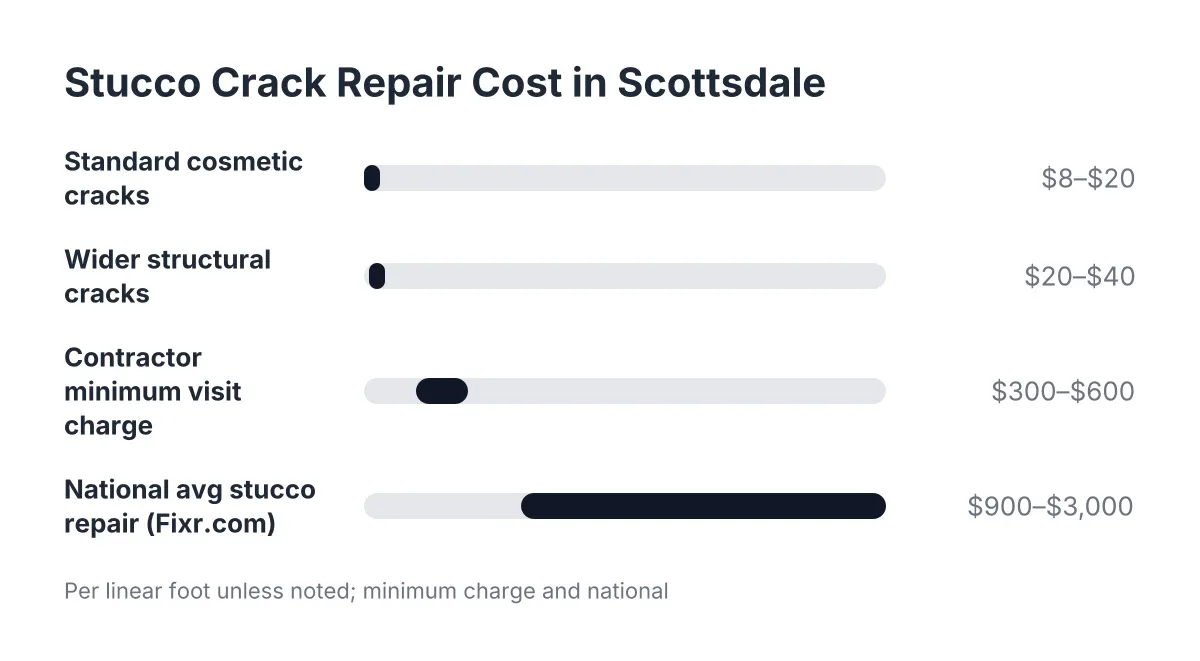
Stucco crack repair in the Scottsdale area typically runs in the range of $8 to $20 per linear foot for standard cosmetic cracks, as a general estimate. Wider structural cracks that need backer rod, flexible sealant, and texture blending often land closer to $20 to $40 per linear foot. Most whole-house crack repair visits fall between a few hundred dollars and a few thousand, depending on how many walls are involved.
Those per-foot figures are illustrative ranges, not quotes, and your actual number depends on access, crack depth, and how much color and texture matching the finish needs. For wider context, the national average cost range to repair stucco is $900 to $3,000, averaging around $1,700 for repairing buckled three-coat stucco in a 10×10-foot area, according to Fixr.com. Crack repair alone usually costs less than that kind of section repair, because you are sealing lines rather than rebuilding a wall area.
One more thing to know before comparing quotes: most contractors set a minimum charge per visit, often in the $300 to $600 range as an estimate. If you have a single 4-foot crack by the garage, you will likely pay the minimum rather than a strict per-foot price. That is why it pays to walk the whole exterior and fix everything in one visit, especially before listing photos.
Why Scottsdale Homes Crack the Way They Do
Stucco is the dominant exterior wall material in this part of the country. Stucco remained the most-used exterior wall material in the Mountain division, which includes Arizona, at 48% of new single-family homes started in 2024, according to the National Association of Home Builders. Nationally, the U.S. Census Bureau's 2024 Survey of Construction found stucco accounted for about 27% of principal siding material on homes that began construction in 2023.
That popularity comes with a trade-off in our climate. Scottsdale walls swing from cool mornings to 110-degree afternoons, and stucco expands and contracts with every swing. The cement finish is rigid, so the movement relieves itself through small cracks, most often at the corners of windows and doors, along control joints, and near the foundation line.
On a pre-2010 home, which describes most of the stucco housing stock here, some cracking is expected. It does not mean the house is failing. It does mean buyers and appraisers will notice, because a web of fine cracks around every window reads as deferred maintenance in photos even when the wall underneath is sound.
Cosmetic or Structural: How a Specialist Reads a Crack
Here is the read a stucco specialist does before pricing anything. You can do most of it yourself with a credit card and ten minutes.
- Hairline cracks, under about 1/16 inch. If a credit card edge will not slide into the crack, it is superficial. These are finish-coat cracks from normal thermal movement. They do not need caulking; a quality primer and paint will flood and bridge a true hairline on their own.
- Spider-web or map cracking. Fine interconnected cracks spread across a wall section, often from the finish coat curing fast in heat or from nearby work that flexed the wall. Cosmetic in most cases, but widespread webbing may call for resurfacing that section rather than chasing each line.
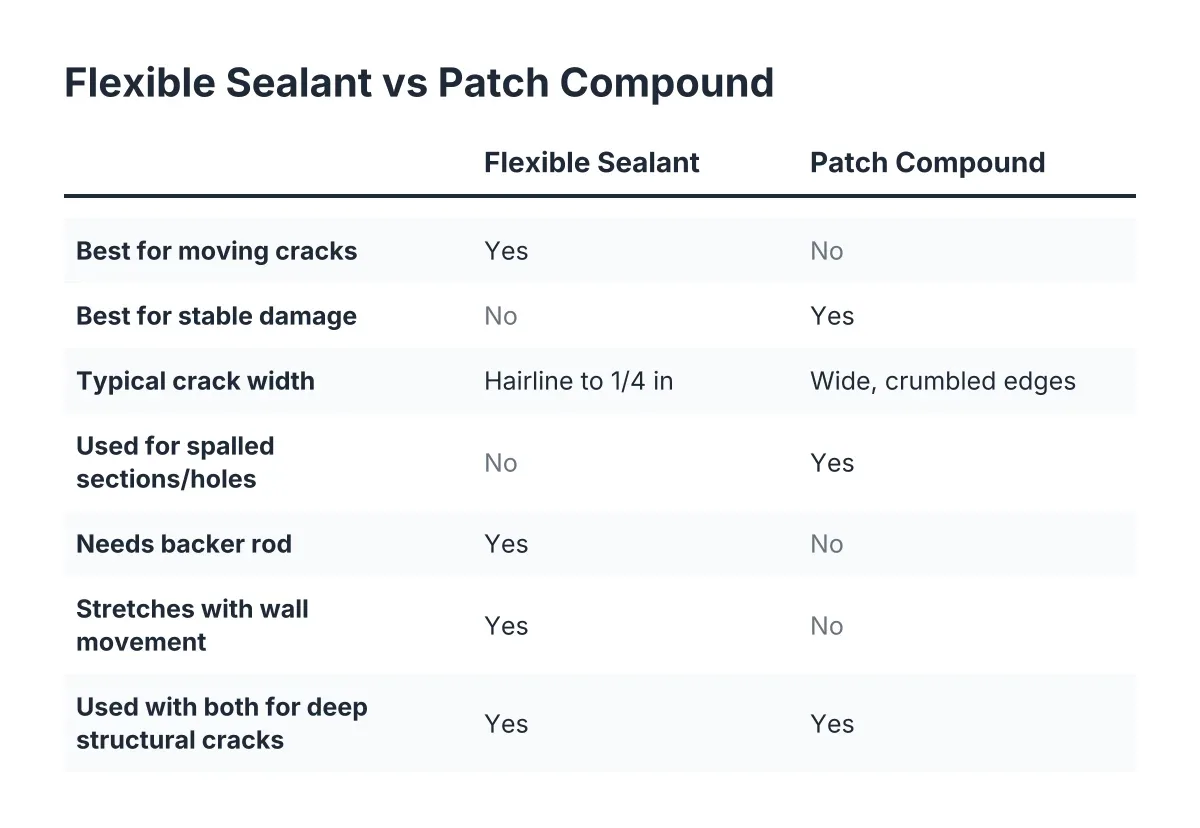
- Cracks 1/16 to 1/4 inch. Wide enough to let monsoon rain reach the paper and lath behind the stucco. These need to be opened, backed, and sealed with a flexible stucco crack sealant, not just painted over.
- Cracks wider than 1/4 inch, stair-step patterns, or cracks with offset edges. If one side of the crack sits higher than the other, the wall has moved. This points to settling or a framing issue, and the stucco repair should wait until someone evaluates the cause.
Direction tells you something too. When homeowners ask about horizontal vs vertical stucco cracks, the short version is this: vertical and diagonal cracks radiating from window corners are usually stress relief and rank low on the worry scale. Long horizontal cracks, especially mid-wall, deserve a closer look because they can trace lath seams or indicate movement behind the wall.
There is one common Scottsdale pattern worth calling out. A crack at a wall corner where the stucco sits on top of a hard concrete foundation is usually minor. The concrete and the stucco expand and contract at different rates, and the crack forms at the boundary between them. It looks alarming at the base of the house, but it is rarely a structural concern.
So, are stucco cracks dangerous? Most are not. The danger is not the crack itself but what gets through it. A structural crack left open for years lets sun and moisture reach the building paper behind the stucco. Once that paper turns brittle, normal wall flexing can tear it, and at that point you are dealing with water damage repair inside the wall, not a surface fix.
What Drives Your Stucco Crack Repair Cost Up or Down
The per-foot range is wide because five factors move the number on every job. Knowing them helps you read a quote instead of guessing whether it is fair.
Crack width and depth. A hairline that paint will seal costs a fraction of a 3/16-inch crack that has to be widened, backed, and caulked. Structural-width cracks need backer rod, a closed-cell foam cord that creates a foundation inside the crack before sealant goes in, according to Sika. That extra material and labor is why wider cracks cost two to three times more per foot.
Total footage and grouping. Per-foot pricing drops as footage rises, because setup, ladders, and color mixing happen once. Thirty feet of cracks fixed in one visit almost always costs less than three separate ten-foot visits.
Height and access. Ground-level cracks are cheap to reach. Cracks on a second-story gable or above a pool enclosure need taller ladders or scaffolding, and that time lands in your price.
Texture and color matching. This is the line item that matters most if you are selling. Sealing a crack is fast; making the repair disappear is the craft. Matching a sand, lace, or skip-trowel texture, then blending color so the patch does not flash in afternoon light, adds labor. A visible gray caulk line down a tan wall can look worse in listing photos than the crack did, which is the exact outcome a pre-sale fix is supposed to prevent.
Underlying cause. A patch over a crack caused by poor drainage or a vibrating gate motor will crack again. A good estimator identifies the cause and addresses it, or at least tells you about it, so the repair holds past your closing date instead of past next summer.
Timing affects quality too, even if it does not show up on the invoice. Larger caulked repairs behave best when applied in the cool of the morning. Sealant applied to a sun-baked west wall at 3 p.m. in June can skin over and cure poorly, which shortens the life of the repair.
A Pre-Listing Scenario With Real Numbers
Suppose a homeowner in McCormick Ranch is listing in five weeks. Their realtor walked the exterior and flagged cracks at the corners of four windows, a longer diagonal crack near the garage, and an old patch from a cable install that never matched the wall color. Call it about 28 linear feet of cracking plus one 2-square-foot mismatched patch.
In that scenario, an illustrative quote might look like this: roughly 22 feet of hairline and narrow cracks at $10 to $14 per foot, about 6 feet of wider cracking at the garage at $25 to $35 per foot, and $150 to $300 to float, texture, and color-blend the old patch. Total estimate: around $700 to $1,100 for the visit, finished in a day, with texture matched and color blended so nothing reads as a repair in the listing photos.
Compare that against the cost of not doing it. An inspector notes "stucco cracking, recommend evaluation," a cautious buyer imagines the worst, and the credit they request at negotiation typically dwarfs the repair bill. For a pre-sale fix, the question is rarely whether the repair pays for itself; it is whether the color match is good enough that no one asks about the wall at all.
DIY Kit or Professional: Where Each One Wins
A stucco crack repair kit from the hardware store runs $15 to $50 as an estimate, and for the right crack it works. The honest comparison of a crack repair kit vs professional work comes down to two questions: how wide is the crack, and how visible is the wall?
DIY makes sense when the crack is hairline, the wall is getting fully repainted anyway, and the location is low and out of sight lines. Paint does the sealing on a true hairline, so your main job is cleaning the crack and priming well.
Professional repair earns its cost in three situations:
- The crack is structural width. Proper repair means routing the crack, setting backer rod, applying a flexible sealant rated for stucco, and rebuilding texture over it. Done wrong, the caulk line telegraphs through paint forever.
- The wall will be photographed. Texture and color matching is where DIY repairs announce themselves. Tube sealant smeared flat over lace texture is visible from the street, and buyers notice patches faster than they notice cracks.
- There are signs of water behind the wall. Staining, soft spots, or bubbling paint near a crack mean the fix is bigger than the crack, and opening the wall blind can make it worse.
One limitation worth stating plainly: a crack repair contractor is not a structural engineer. If a crack is wider than 1/4 inch, shows offset edges, or pairs with cracked drywall or sticking doors inside the house, have the foundation evaluated before anyone touches the stucco. Sealing over a moving crack just resets the clock.
Getting Accurate Quotes Without Overpaying
Crack repair quotes in Scottsdale vary more than most trades because scope is easy to define loosely. The fix is to make every bidder price the same job. Searching for stucco crack repair near me will surface everyone from national remodeling platforms to painters who caulk cracks as an afterthought, so the comparison step matters.
First, walk the exterior yourself in early morning light, when shadows make cracks easiest to see. Photograph each one with something for scale, and estimate total linear feet. Note which walls face the street or will appear in listing photos; those are the walls where texture and color matching justify extra cost.
Next, get two or three quotes and ask each contractor the same four questions:
- How will you treat hairline cracks versus wider cracks, and which of mine are which?
- Will you use backer rod and flexible sealant on the wide ones, or surface caulk only?
- How will you match my existing texture and color, and will the repair be visible up close?
- Is repainting the repaired areas included, or do I need a painter afterward?
That last question catches the most common pricing surprise. Many crack repairs end at "sealed and textured," leaving paint-ready patches in a different shade. If your timeline ends at listing photos, make color blending or painting part of the written scope, not an assumption.
Finally, be suspicious of both extremes. A quote far below the others usually means caulk-and-go with no texture work, which looks fine for a month and obvious by the open house. A quote far above, or one that jumps from crack repair to full replacement without explaining why, deserves a second opinion. When someone asks how much stucco repair should cost, the honest answer is that the middle of three comparable bids, with texture and color matching in writing, is usually the right one.
What Happens on Repair Day
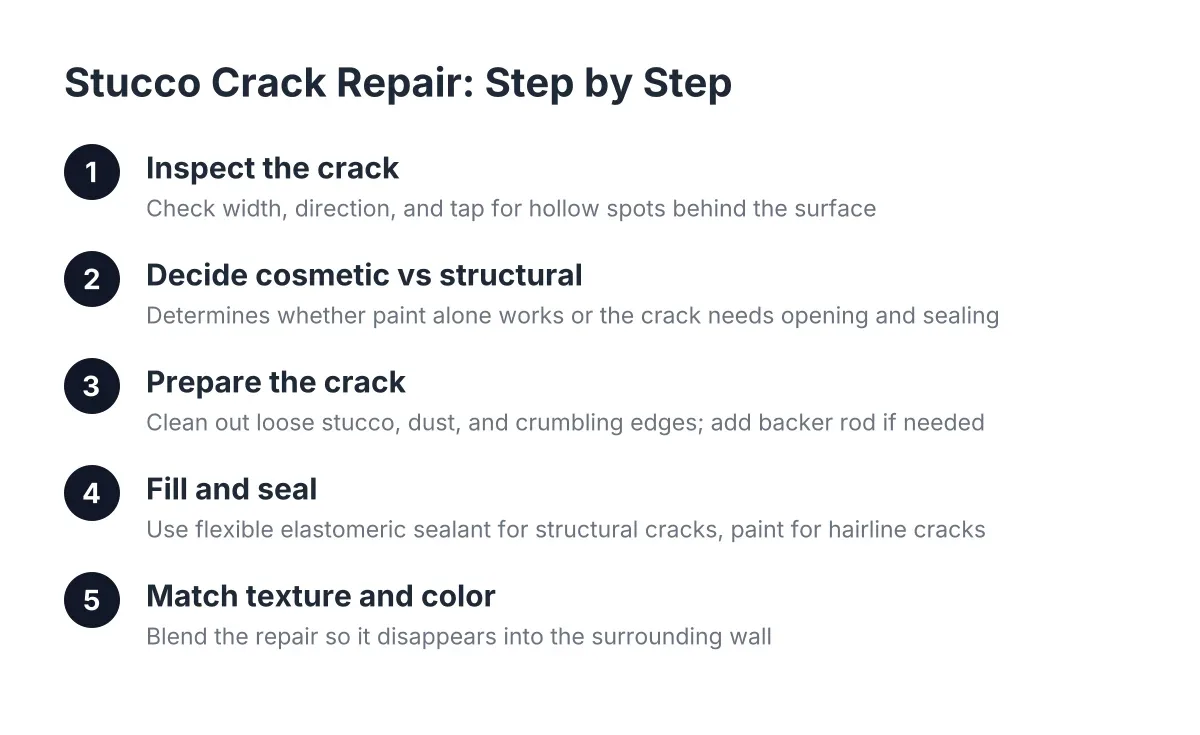
Knowing the process helps you judge whether you got what you paid for. A proper Stucco Crack Repair visit follows a sequence, and shortcuts show within a season.
The crew starts by cleaning out each crack and sorting them on the wall: hairlines marked for primer and paint, wider cracks marked for sealant. Wide cracks get opened enough to accept backer rod, then filled with a flexible sealant that can move with the wall through our daily temperature swings. Work proceeds from the bottom of the wall upward, which keeps fresh material from being disturbed by work above it.
Then comes the part a seller should watch: texture. The repaired line gets floated and textured to match the surrounding finish, whether that is sand, lace, or skip trowel, before any color goes on. Color blending happens last, feathered past the repair so there is no hard edge for sunlight to catch. On a well-matched repair, you should have to hunt for the fix from five feet away.
Timeline-wise, most whole-house crack repair visits finish in one day, with color work sometimes requiring a short return trip after materials cure. For a seller, that means crack repair rarely threatens a listing date; the risk is waiting until the week of photos to schedule it, since cure time before painting is not negotiable.
The Bottom Line for Scottsdale Sellers
Cracked stucco is one of the cheapest exterior problems to fix relative to how much it costs you in buyer perception. Most Scottsdale cracks are cosmetic, priced by the linear foot, and gone in a day. The cracks that are not cosmetic announce themselves: width over 1/4 inch, offset edges, horizontal runs, or moisture signs nearby.
Sort your cracks before you call anyone, get the texture and color match in writing, and schedule with enough margin ahead of photos for paint to cure. Do that, and the stucco crack repair cost stays in the hundreds instead of the thousands, and the only thing buyers see is a clean, well-kept wall.
If you need stucco repair, Scottsdale Stucco Repair can help.
Prefer to talk it through? Call (480) 637-3464 — a quick call is usually the fastest way to get a straight answer for your situation.