How Water Penetrates Stucco Cracks: Damage Progression and Prevention
A crack in a stucco wall does not do much damage on its own. The trouble starts when water intrusion through stucco cracks occurs and water gets behind the wall, where you cannot see what it is doing. In Scottsdale, that usually means monsoon rain hitting a south or west wall sideways, finding a crack that has been widening all summer, and soaking the paper and framing behind the stucco. This guide walks through how that damage actually progresses, which cracks let water in and which do not, and how to stop the problem at the stage you are in right now, not the stage it will reach next July.
If you are reading this because a crack by your window gets longer every summer, or a wall sounds hollow and stains after every storm, you are the person this is written for. The goal is to help you act with confidence instead of guessing.
How Stucco Is Supposed to Keep Water Out
Stucco is not waterproof, and it was never designed to be. A traditional three-coat stucco wall works as a system: the stucco itself sheds most of the water, and a layer of building paper behind it catches whatever soaks through and lets it drain back out. Paint on top adds another shedding layer.
That matters because it changes how you should think about a crack. A hairline crack in an otherwise sound wall is a small breach in the first line of defense, and the paper behind it still does its job. A wide crack in an older wall where the paper has dried out and gone brittle is a different animal. There, the backup layer may already be torn, and water that gets in has a straight path to the sheathing and framing.
Stucco is everywhere in Arizona, so this is not a niche problem. According to the National Association of Home Builders, stucco remained the most-used exterior wall material in the Mountain division, which includes Arizona, at 48% of new single-family homes started in 2024. Nationally, the U.S. Census Bureau's 2024 Survey of Construction found stucco accounted for about 27% of principal siding material on homes that began construction in 2023. Nearly every Scottsdale neighborhood has walls built on this same system, and the same failure pattern.
When Water Intrusion Through Stucco Cracks Occurs
When water penetrates stucco cracks, it follows a predictable progression: first it wets the stucco around the crack, then it reaches the building paper, then it finds any tear or seam in that paper, and finally it soaks the sheathing and framing behind the wall. Each stage is more expensive to fix than the one before it. Here is how that plays out on a real wall.
Stage one: water in the stucco itself
Stucco is porous, so a little moisture in the material is normal. The crack concentrates it. Instead of spreading evenly across the surface and evaporating, rain funnels into the crack and saturates a narrow strip of stucco from face to paper. In Scottsdale's dry air, this stage often goes unnoticed because the wall dries fast between storms. The only sign might be a faint dark streak along the crack for a day after rain.
Stage two: water reaches the building paper
Once the crack runs the full depth of the stucco, every storm puts water directly on the paper. New paper handles this fine; it is built to shed water down and out. The problem is age. Arizona heat cycles bake the paper year after year, and old paper turns brittle. A wall that flexes with temperature swings can tear brittle paper right along the crack line. Delaying repair of a structural crack for years is what creates this condition, and it is the single most common way a cheap fix becomes an expensive one.
Stage three: wet sheathing and framing
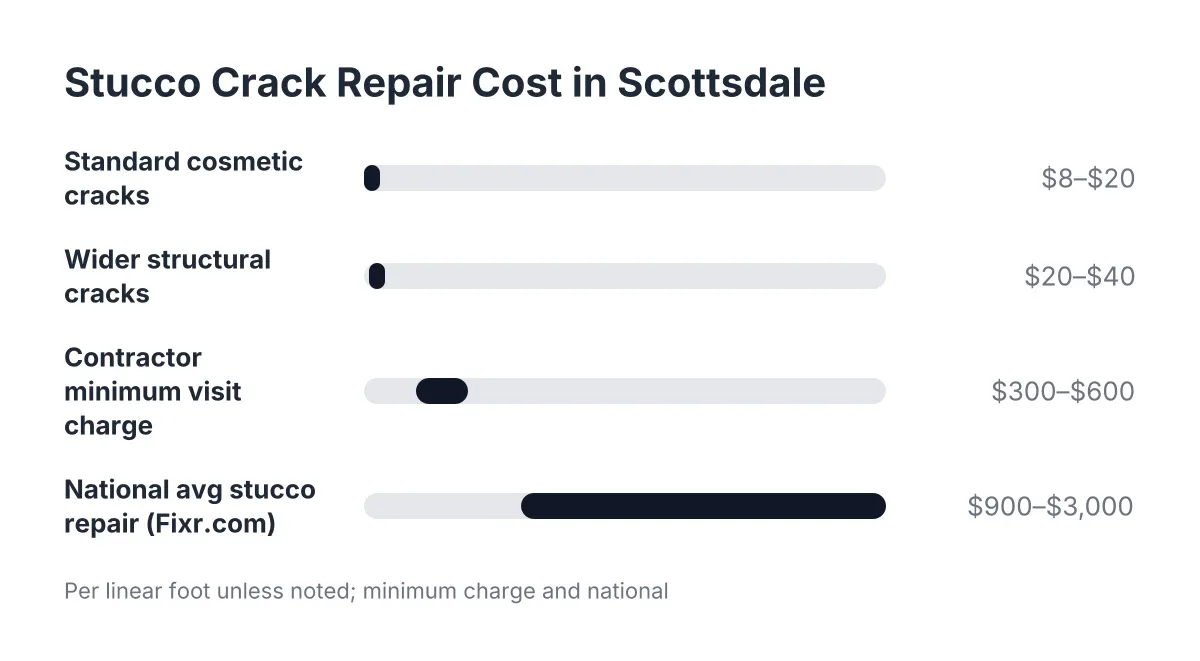
With the paper torn, water that penetrates the stucco crack has nothing left to stop it. It wets the sheathing, wicks into framing, and starts the damage you can hear and see: a hollow sound when you knock on the wall, rust stains bleeding through paint, soft spots, and bulging or buckling stucco. At this stage you are no longer looking at crack repair. You are looking at cutting out a section, drying or replacing what is behind it, installing new paper, and patching with new stucco. According to Fixr.com, the national average cost to repair stucco runs $900 to $3,000, averaging about $1,700 for repairing buckled three-coat stucco in a 10×10-foot area. A hairline crack sealed early costs a small fraction of that.
An illustrative Scottsdale timeline
Suppose a homeowner in north Scottsdale notices a diagonal crack off a window corner in spring 2024. It is thin, so they leave it. By summer 2025 it has opened to the width of a nickel's edge, and the first big monsoon storm leaves a tea-colored stain below the window. By early 2026 the wall sounds hollow under the stain, and the HOA has sent a letter about visible exterior wall damage. In that scenario, the repair went from a morning of crack sealing to a cut-out-and-patch job with paper replacement, purely because water had two monsoon seasons to work.
Which Cracks Let Water In: A Specialist's Read
Not every crack is a water problem. The practical question is not "is there a crack" but "can water get through it, and what is behind it when it does." Here is how a stucco specialist sizes up the common types.
Hairline cracks
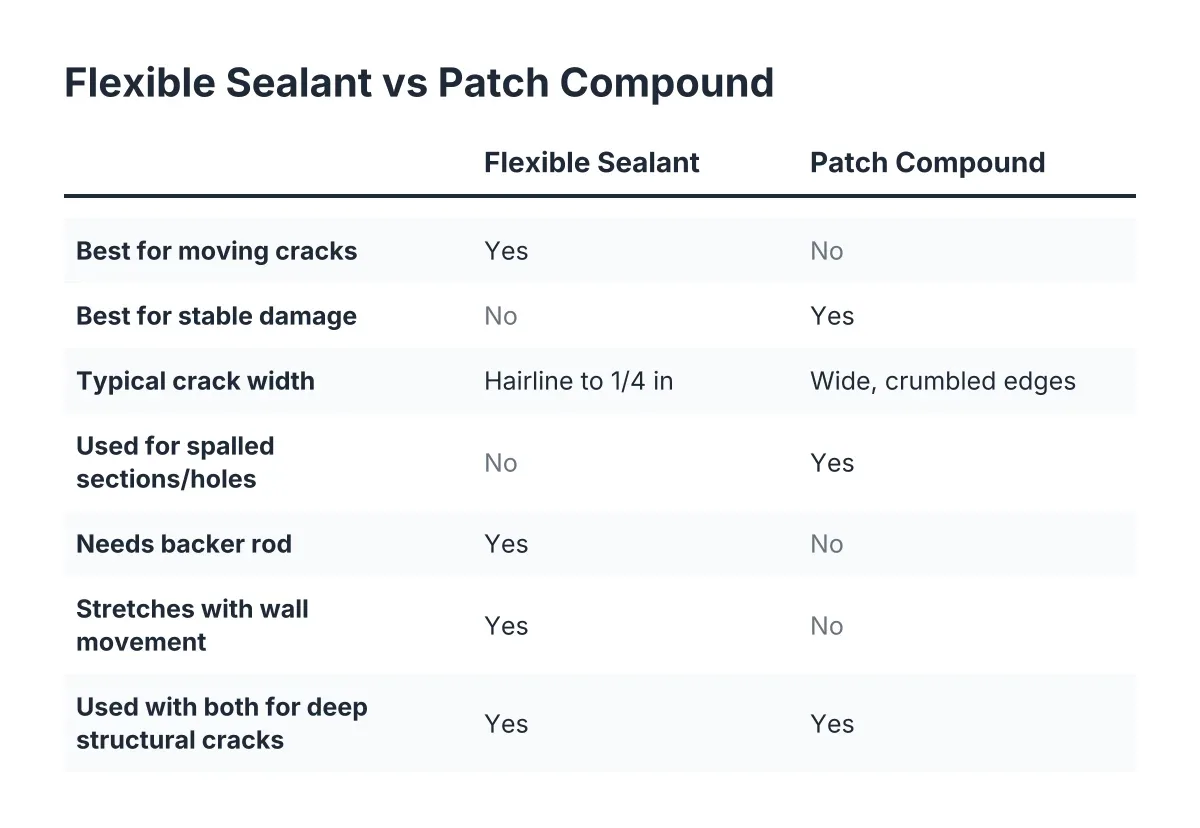
Hairline cracks are thin surface cracks, about the width of a credit card edge or less. Many appear during curing; small cracks after the first coat of stucco are a normal part of the process, not a defect. These are superficial. They do not need caulking, because a good quality primer and paint will bridge and flood the hairline and seal it on their own. Water rarely penetrates a painted hairline in any meaningful amount. Watch them, but do not panic over them.
Structural cracks
Structural cracks are wider and deeper. If you can slide a dime into the crack, or if you can see depth when you look at it edge-on, treat it as structural. These cracks typically run the full thickness of the stucco, which means every storm delivers water straight to the paper. They need to be filled properly, with sealant pushed deep into the crack, not just painted over. Paint cannot bridge a gap that wide; it will split along the same line within a season.
Horizontal vs vertical stucco cracks
Direction tells you about cause. Vertical and diagonal cracks usually trace back to settling, shrinkage, or movement around openings like windows and doors; they are the most common and are often manageable. Horizontal cracks deserve more caution, especially long ones at a consistent height, because they can signal movement in the structure or a problem at a horizontal joint. A long horizontal crack is a good reason to have someone look at the wall before deciding on a fix.
Corner cracks at the foundation line
A crack where stucco meets the top of a concrete foundation is usually minor. Concrete and stucco expand and contract at different rates, and the joint between a hard foundation and softer stucco cracks as a result. It still needs sealing so water cannot ride the crack down to the foundation line, but it is rarely a structural red flag.
Are stucco cracks dangerous?
Stucco cracks are rarely dangerous to the structure in the short term, but they become expensive when ignored, because the real damage happens behind the wall where water reaches paper, sheathing, and framing. The danger is cumulative, not sudden. A crack that has survived three monsoon seasons unsealed has had three seasons to tear the paper and wet the framing. The exceptions that justify urgency are long horizontal cracks, cracks paired with bulging or soft stucco, and any crack that stains after every storm. Those suggest the damage has already moved past the surface.
How to Fix Stucco Cracks Before the Next Storm
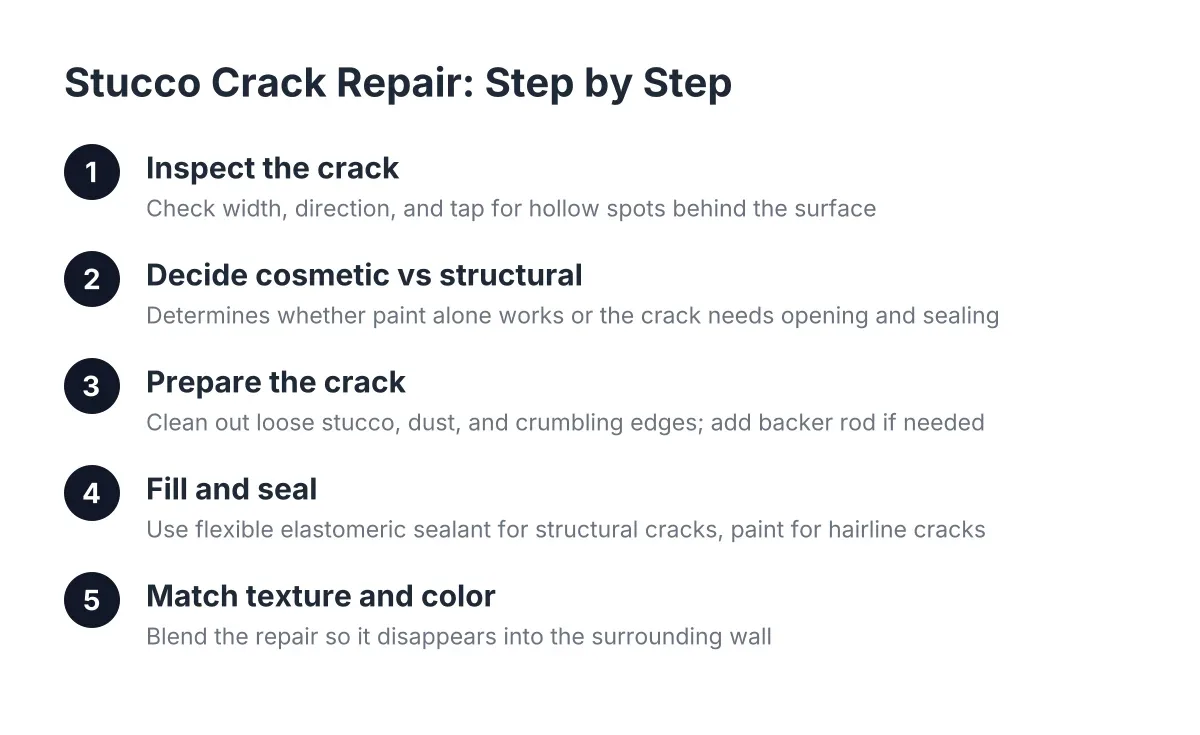
The repair itself is not complicated. Doing it in the right order, with the right material, at the right depth, is what separates a repair that disappears from a patch that pops out or shows through in a year. Here is the sequence a competent repair follows on a structural crack.
- Open and clean the crack. Loose material and dust get brushed or blown out so the sealant bonds to sound stucco, not debris.
- Set backer rod in wide cracks. Backer rod is a closed-cell foam cord used to create a backing inside a crack before applying sealant, according to Sika. It gives the sealant the right shape and depth instead of letting it sink into a void.
- Fill to full depth. On a stucco wall about an inch thick, sealant in a structural crack should be pushed all the way back to touch the building paper, not smeared across the surface. A surface-only bead leaves a hidden channel where water can still travel.
- Texture match the repair. A smooth caulk line on a sand-finish or lace-finish wall shows from the street. The sealant gets textured to match the surrounding stucco while it is still workable.
- Prime and paint. An elastomeric paint over the repaired area adds a flexible, water-shedding layer that moves with the wall instead of cracking along the old line. On walls with widespread hairlines, elastomeric paint across the whole elevation is often the smarter move than chasing each crack.
Timing matters in the desert. Large crack repairs with caulking go better in the early morning than in the hot afternoon sun, because heat makes the sealant skin over and cure poorly before it can be tooled and textured. A repair done at 2 p.m. on a 110-degree wall in July is a repair you may be redoing.
Repair kit vs professional stucco crack solutions
A hardware store stucco crack sealant kit can handle a short, clean, vertical hairline on a wall you plan to repaint anyway. Where kits fall short is everything else: getting sealant to full depth, setting backer rod correctly, matching a lace or sand texture so the fix disappears, and reading whether the crack is cosmetic or a symptom. Professional repairs earn their cost on structural cracks, water-stained walls, and any repair that will be visible from the street or judged by an HOA inspector. If two contractors quoted you without even looking at the wall, that is a sign they skipped the diagnosis, which is the part that matters most.
One honest trade-off: sealing a crack treats the symptom. If the cause is ongoing settling, vibration from a nearby road, or poor drainage dumping water at the base of the wall, the crack can return even after a correct repair. A partial patch is quicker and cheaper than re-stuccoing a wall, but the underlying cause still needs attention or you will be back on this page in two years. When water intrusion through stucco cracks recurs and a wall shows bulging, widespread softness, or repeated cracking in the same spot, bring in a professional to find the cause rather than sealing the same line again.
Preventing Water Intrusion Through Stucco Cracks
Prevention in Scottsdale is mostly about timing and inspection habit, not products. Water needs two things to do damage: an open path and repeated exposure. Take away either one and the wall stays sound.
- Walk your walls every spring, before monsoon season. Check around windows, doors, hose bibs, light fixtures, and anywhere something penetrates the wall. Those penetrations are where leaks start, and keeping water out is the single most important goal when patching around vents and boxes.
- Seal structural cracks before the first storm, not after. A crack sealed in May never sees the sideways rain of a July microburst. A crack sealed in September already took the hit.
- Repaint on a schedule. Paint is the wall's shedding layer. Chalky, faded paint has lost most of its water resistance. Elastomeric paint is worth considering on older walls with a history of hairline cracking.
- Fix drainage at the base of walls. Soil or gravel piled against stucco, or a downspout dumping at a wall corner, keeps the bottom of the wall wet and invites cracking and wicking from below.
- Act on stains the first time, not the third. A stain after one storm means water penetrates the stucco crack somewhere above it. The source is almost never at the stain itself; water travels down and sideways behind the wall before it shows.
For HOA boards and community managers, the same logic applies at scale. Perimeter walls, entry monuments, and clubhouse exteriors crack the same way houses do, and a reserve-study inspection that flags cracking is the cheap moment to act. Sealing cracks across a community wall during a planned maintenance cycle costs a fraction of cutting out and re-stuccoing failed sections after two more monsoon seasons, and it is far easier to budget from reserve funds as prevention than as emergency repair.
What to Do This Week If Your Wall Is Already Stained
If you are past prevention and into damage control, here is the practical order of operations for 2026 monsoon prep.
First, knock on the wall around the stain with your knuckles. A sharp, solid sound means the stucco is still bonded; a dull, hollow sound means it has separated from the wall behind it and the damage is deeper than the surface.
Next, trace upward from the stain. Look for the crack, the window corner, or the fixture penetration feeding it. Note whether the crack is hairline or wide enough to hold a dime, and whether it runs vertical, diagonal, or horizontal.
Then decide the lane. Hairline crack, solid wall, no hollow sound: paint-grade fix, low urgency, handle it before summer. Wide crack or a crack that regrows every year: structural repair with backer rod and full-depth sealant. Hollow sound, soft spots, or bulging: this is water damage stucco repair, not crack repair, and it means opening the wall to assess the paper and framing.
Finally, get eyes on it before you get numbers on it. Any quote given without seeing the wall is a guess about the cheapest version of your problem. The crack you can see is the entry point; the cost lives in what the water did after it got in. Acting before the next storm season is the one variable completely in your control, and it is the one that decides whether this stays a small repair.
If you need stucco repair, Scottsdale Stucco Repair can help.
Related guide: Stucco Crack Repair — Complete Guide
Prefer to talk it through? Call (480) 637-3464 — a quick call is usually the fastest way to get a straight answer for your situation.