Stucco Texture Options for Installation: Smooth, Rough, and Spanish Styles in Scottsdale, AZ
If you are planning a new stucco install on a home, addition, or exterior wall in Scottsdale, the texture decision matters more than most people expect. Your stucco texture options at installation affect how the wall looks, how it hides flaws, how it repairs later, and in some cases what you pay. This guide walks through the main textures, how each one gets applied, what drives the cost, and how to vet the contractor who does it. No sales script, just the information a careful homeowner needs before signing anything.
Stucco is not a niche choice here. According to the National Association of Home Builders, stucco remained the most-used exterior wall material in the Mountain division, which includes Arizona, at 48% of new single-family homes started in 2024. Nationally, U.S. Census Bureau Survey of Construction data shows stucco accounted for about 27% of principal siding material on homes that began construction in 2023. In Scottsdale, picking the right texture is less about trend and more about matching the neighborhood, the architecture, and your long-term maintenance tolerance.
Why Texture Is the First Decision in a Stucco Install, Not the Last
Texture is usually treated as a finishing touch. That is backwards. The texture you choose shapes the finish coat application, the skill level required, the material mix, and how forgiving the wall will be over the next twenty years.
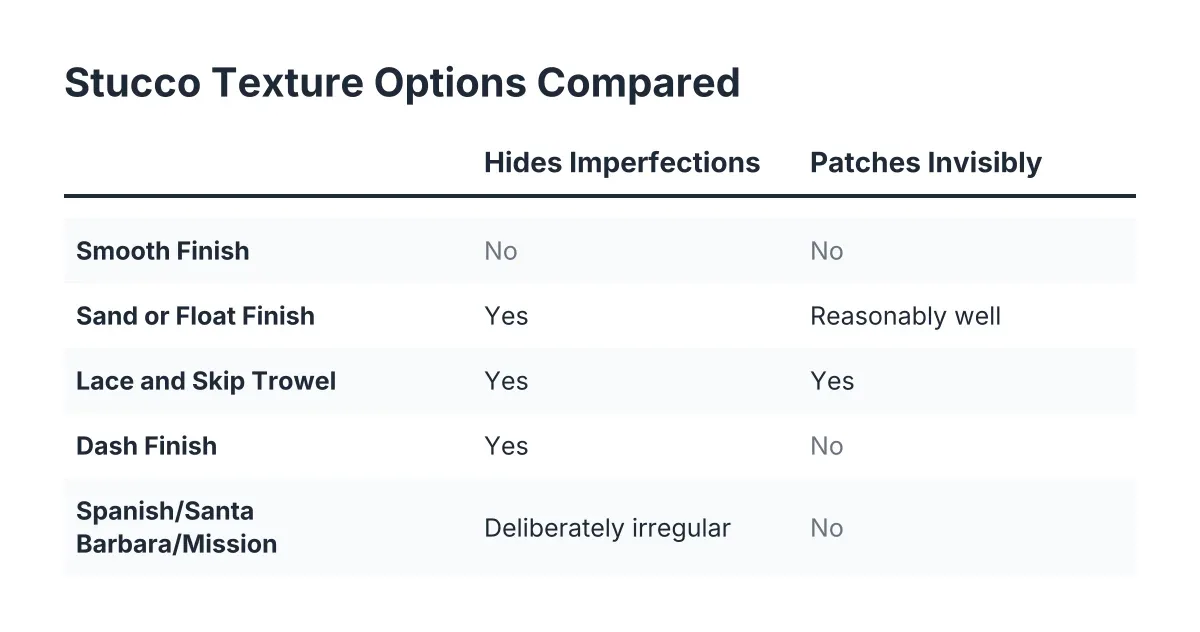
Here is the practical reality: textured finishes hide imperfections. A sand or lace finish conceals small waves in the brown coat, minor trowel marks, and the hairline movement cracks that Scottsdale's heat and expansive soil eventually produce. A smooth finish hides nothing. Every ripple in the coats underneath telegraphs through, which is why smooth stucco demands the most skilled applicator and the flattest base coats.
Texture also determines how repairs blend later. A flattened, textured finish can be patched almost invisibly because small irregularities in the patch disappear into the surrounding surface. Smooth finishes are the opposite; even a careful patch tends to show until the whole wall panel is refloated or resurfaced. If you expect to sell the home within a few years, that repairability difference matters, because a visible patch is exactly the kind of thing a buyer's inspector photographs.
Understanding the Main Stucco Texture Options Available
Most stucco texture options for a new installation fall into six families: smooth, sand (float), lace, dash, Spanish (Santa Barbara or Mission style), and skip trowel. Each uses a different finish-coat technique and sand fineness, and each sits at a different point on the cost, difficulty, and repairability scale. The texture goes on in the final coat, after the base coats cure.
One thing worth knowing before the breakdown: there is no single correct troweling technique. Two skilled applicators can produce the same named texture with different hand motions and tools. What matters is that the finished wall is consistent across every elevation and that the contractor can reproduce the texture later if a patch is ever needed.
Smooth Finish
Smooth stucco gives you the clean, modern look common on newer Scottsdale custom homes and contemporary remodels. It is applied with a trowel and worked flat, sometimes with a fine sand or no aggregate at all in the finish mix.
The trade-offs are real. Smooth is the hardest texture to apply well, the most likely to show hairline cracking, and the hardest to patch without the repair standing out. Expect to pay more per square foot for the labor, and expect any future crack repair to involve blending a larger area than the crack itself.
Sand or Float Finish
A sand finish uses fine aggregate in the finish coat, floated to a uniform, lightly gritty surface. It is one of the most common textures in the Valley because it looks clean from the street, hides minor imperfections, and patches reasonably well.
The fineness of the sand controls the look, from nearly smooth to visibly granular. That same detail matters years later: a repair crew matching a sand finish has to match the sand fineness in the patch mix, or the repaired spot reads as a different texture even after painting.
Lace and Skip Trowel
Lace is the workhorse texture across older Scottsdale neighborhoods. The applicator dashes or trowels on finish material, lets it set briefly, then knocks it down with a trowel to create the familiar flattened, mottled pattern. Skip trowel is a cousin, applied in a sparser, more irregular pattern with visible flat islands.
These textures are the most forgiving of all the stucco texture options an installation crew can offer. They conceal base-coat waviness, tolerate hairline cracks visually, and take patches better than any other finish. If your priority is a wall that stays presentable with minimal fuss, lace or skip trowel is the practical pick.
Dash Finish
Dash is a sprayed or flung texture with a uniformly rough, pebbled surface. It is fast to apply, which keeps labor cost down, and it hides substrate flaws well. The downside is feel and cleaning: the ridges and pores in a rough dash surface let dust, algae, and mildew settle deeper into the material than a smoother finish would, so shaded north-facing walls need occasional washing.
Spanish, Santa Barbara, and Mission Styles
Spanish-style textures use irregular, hand-troweled passes that leave soft ridges and shallow valleys, giving the old-world adobe look that suits Scottsdale's Spanish Colonial and territorial architecture. Santa Barbara finishes use fine sand worked in semi-smooth, irregular motions. Mission finishes are rougher and more sculptural.
These finishes are deliberately inconsistent, which is their charm and their challenge. Because the pattern is freehand, the applicator's style becomes part of the wall. If you ever need stucco patching on a Spanish finish, the repair crew has to study and mimic that original hand pattern, which is why texture matching is a specific skill and a specific line item, not an afterthought.
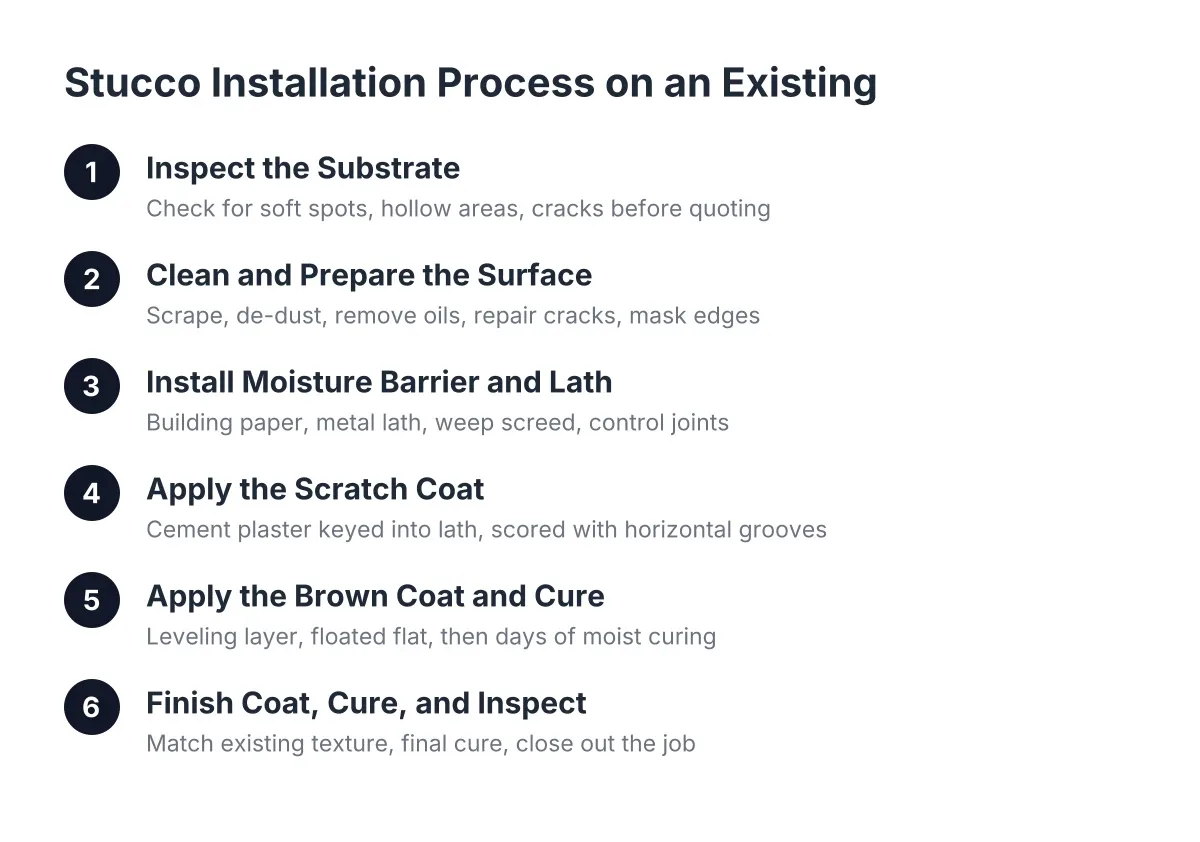
How Texture Gets Applied: The Three-Coat Installation Process
A traditional stucco installation in Scottsdale is a three-coat system, and the texture only enters the picture at the end. Understanding the sequence helps you read a quote and spot a contractor who plans to cut corners.
- Prep and lath. The crew installs a weather-resistive barrier over the sheathing, then metal lath fastened to the structure. This layer is what keeps water out of the wall; it is also the layer a bad crew rushes because you will never see it again.
- Scratch coat. A thin base coat goes over the lath and gets scored horizontally so the next layer has something to grip. It cures before the next step.
- Brown coat. A thicker leveling coat that establishes the flat plane of the wall. The flatter this coat, the better any texture looks, and the only acceptable base for a smooth finish.
- Finish coat. The color and texture coat, applied with the technique your chosen texture requires: floated for sand, dashed and knocked down for lace, hand-troweled for Spanish styles.
One-coat systems exist, using a single thicker base coat over foam or lath before the finish. They install faster and cost less in labor, but the wall has less mass and less tolerance for impact. For a decision-stage homeowner comparing bids, the key question is simple: is this bid for three-coat or one-coat, and does the contract say so in writing? If two quotes are far apart in price, this is often why.
Timing runs roughly one to three weeks for a full install on a typical home, driven by cure times between coats more than labor hours. A contractor who promises a dramatically compressed schedule is either spraying a one-coat system or skipping cure time, and skipped cure time shows up later as cracking.
A note on synthetic stucco: EIFS systems use foam insulation board with a thin acrylic finish instead of cement coats. They offer wide texture and color flexibility and good insulation, but they are a different wall assembly with different failure modes, especially around water intrusion. If a bid says EIFS or "synthetic," ask the contractor to explain the drainage detail before you compare it against a cement stucco bid.
What Texture Choice Does to Installation Cost
Texture affects stucco installation cost mainly through labor, not material. The finish coat mix costs about the same whether it goes on as dash or smooth; what changes is the applicator hours and the skill premium.
As a rough 2026 guide for comparing bids, framed as an estimate rather than a quoted price list:
- Dash and heavy rough textures sit at the low end, since spraying is fast and forgiving.
- Lace, skip trowel, and sand finishes sit in the middle, the standard-labor baseline most Scottsdale bids assume.
- Spanish and Santa Barbara hand finishes run higher, because the irregular hand work is slower and depends on one skilled applicator staying consistent across the whole house.
- Smooth finishes cost the most, often meaningfully more, because they demand an extra-flat brown coat and expert finish work, and because callbacks for visible flaws are more likely.
Beyond texture, the usual cost drivers apply: total square footage, wall height and access, three-coat versus one-coat, integral color versus paint, and how much prep the existing structure needs. For context on what stucco work costs when something goes wrong later, Fixr.com puts the national average cost to repair stucco at $900 to $3,000, averaging around $1,700 for a buckled three-coat section in a 10×10-foot area. That repair number is worth keeping in mind when choosing texture, because a forgiving texture lowers the odds a future repair needs to be that large to look right.
Choosing a Texture When You Plan to Sell
Suppose a homeowner in north Scottsdale is prepping a house to list in 60 days, and the inspector or realtor has flagged cracked, chalky stucco on two elevations. In that scenario, the decision is not "which texture do I love" but "which texture matches the rest of the house and gets the job closed cleanly before listing photos."
For a pre-listing situation, three rules of thumb hold up:
- Match, do not reinvent. If two walls get resurfaced, the new texture must match the untouched walls. A buyer walking the exterior notices a texture seam faster than a color difference. This is where stucco texture matching and stucco color matching stop being upsells and become the whole job.
- Favor forgiving textures on full resurfaces. If the entire house gets a new finish coat, lace or sand gives you the best odds that any last-minute touch-up before closing blends invisibly.
- Get the scope in writing for disclosure. A written scope and a clean invoice describing the repair or resurfacing work is paperwork you will hand to the buyer's side. Cash-only, no-contract work creates a disclosure problem on top of a quality risk.
One trade-off worth being honest about: texture matching is a cosmetic skill, not a structural one. A patch with a slightly off texture does not mean the wall is failing, and a perfect texture match does not prove the underlying crack was fixed correctly. You need both the structural repair and the cosmetic blend, and a good written scope separates the two.
Vetting the Contractor Behind the Texture
Texture quality is applicator quality. The same bag of finish mix produces a sharp, consistent lace on one house and a blotchy mess on the next, and the difference is the person holding the trowel. If you have been burned by a contractor before, here is how to pressure-test a stucco installation bid without taking anyone's word for it.
Ask every bidder these questions, and expect direct answers:
- Which exact texture is in this bid, and can I see it on a wall? Ask for addresses of local work you can drive past, or at minimum a sample panel on your own wall before the finish coat goes on. A sample panel costs the contractor an hour and tells you everything.
- Is this three-coat or one-coat, and is that written in the contract? Vague wording like "stucco system" is where surprise substitutions hide.
- Who applies the finish coat? On hand textures like Spanish styles, you want to know whether the person who did the sample is the person doing the house.
- What is the payment schedule? A reasonable structure ties payments to completed stages, such as after lath inspection and after the brown coat. A large upfront deposit with nothing in writing is the classic disappearing-contractor setup.
- How will future patches be matched? A contractor who can explain how they would match this texture in a repair two years from now understands the finish they are selling. Keep a record of the finish product, color, and texture name; it makes any future stucco repair or crack repair far easier to blend.
In Arizona, you can verify a contractor's license status yourself through the state's contractor licensing board before any money changes hands. Do it for every bidder, not just the one you like. A legitimate local crew expects that check and will not flinch at it.
Matching Texture Later: Why Your Choice Today Shapes Every Future Repair
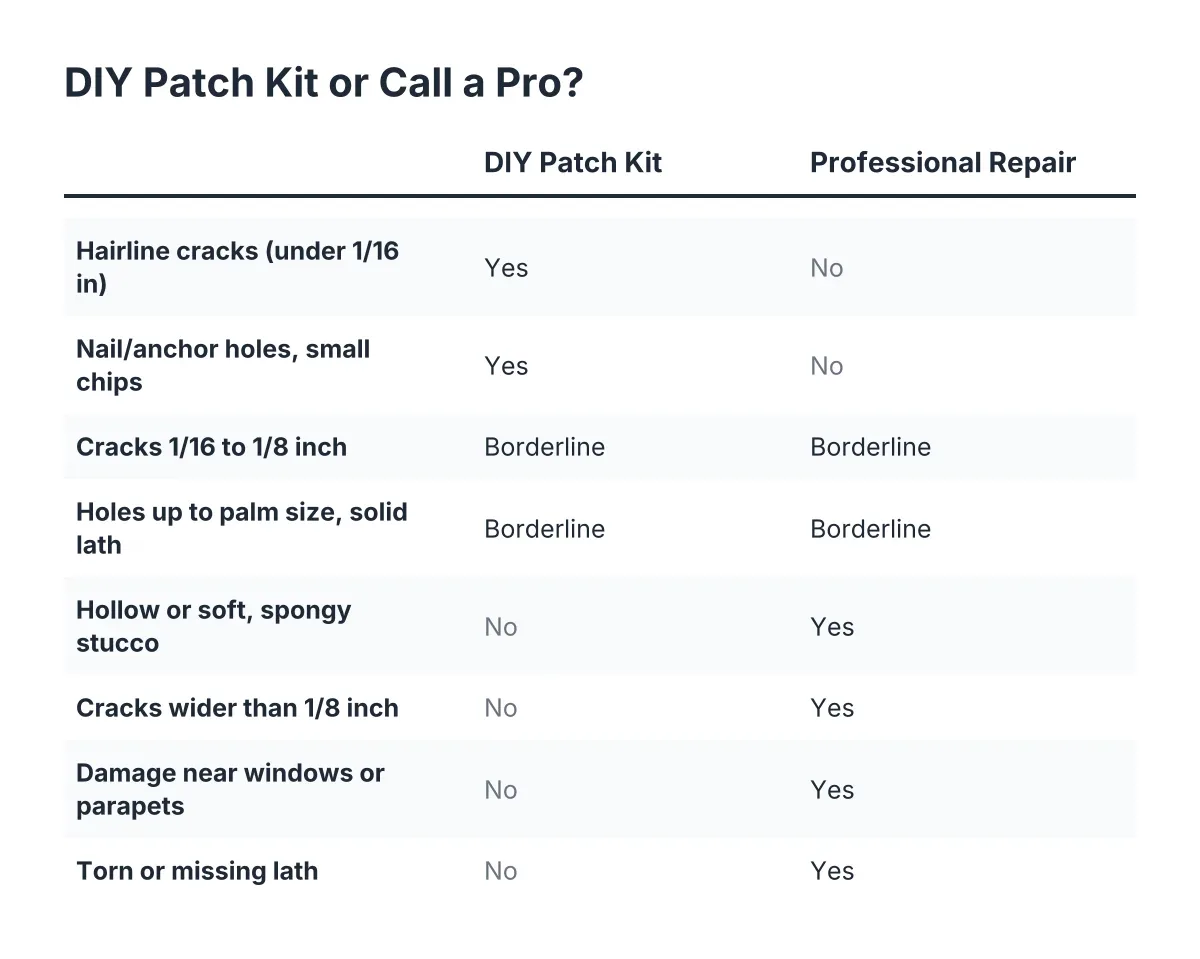
Every Scottsdale stucco wall eventually needs something: a hairline crack from thermal movement, a hole from a doorknob or a trellis anchor, or water damage at a parapet. When that day comes, the repair sequence is always the same. The damaged area gets cut out or filled with a base coat first, so the surface sits flush, and only then does the texture coat go on over it.
The texture you chose at installation decides how hard that last step is. Lace and sand patches blend with standard technique. Spanish hand textures require the repair applicator to copy the original pattern by eye. Smooth finishes often force the crew to refinish a whole panel to hide one patch. None of this makes any texture wrong; it just means the decision you make during stucco installation follows the house for its whole life, and a seller five years from now inherits it.
That is the honest summary of stucco texture options at installation time: rough and knocked-down textures buy you forgiveness, hand textures buy you character at a labor premium, and smooth buys you a modern look that demands skill now and patience later. Pick the one that fits the house and your timeline, get the texture name and coat system in writing, and verify the license before the first coat goes on. For anything structural behind the stucco, such as sheathing rot or widespread water damage, bring in a professional to open up the wall before anyone talks finish coats.
If you need stucco repair, Scottsdale Stucco Repair can help.
Prefer to talk it through? Call (480) 637-3464 — a quick call is usually the fastest way to get a straight answer for your situation.