Stucco Color Fading in Arizona: Why Patches Show and How to Blend Them
Here is the fear nobody says out loud when they call about a stucco repair: "Will I be able to see the patch?" It is a fair question, and in Scottsdale it has a specific answer that starts with the sun. Stucco color fading in Arizona is the single biggest reason a technically sound repair can still look wrong from the curb. The crack gets filled correctly, the texture gets floated in, and then the new material sits there two shades darker than the wall around it, like a bandage on your house. This guide explains why that happens, what actually causes stucco color fading in the Arizona desert, and the specific techniques that make a sun faded stucco patch disappear instead of announcing itself.
If you are mid-project, say a room addition or patio enclosure where new stucco has to meet a wall that has baked in the sun since 2009, this matters even more. You are not matching a color chip. You are matching fifteen years of UV exposure.
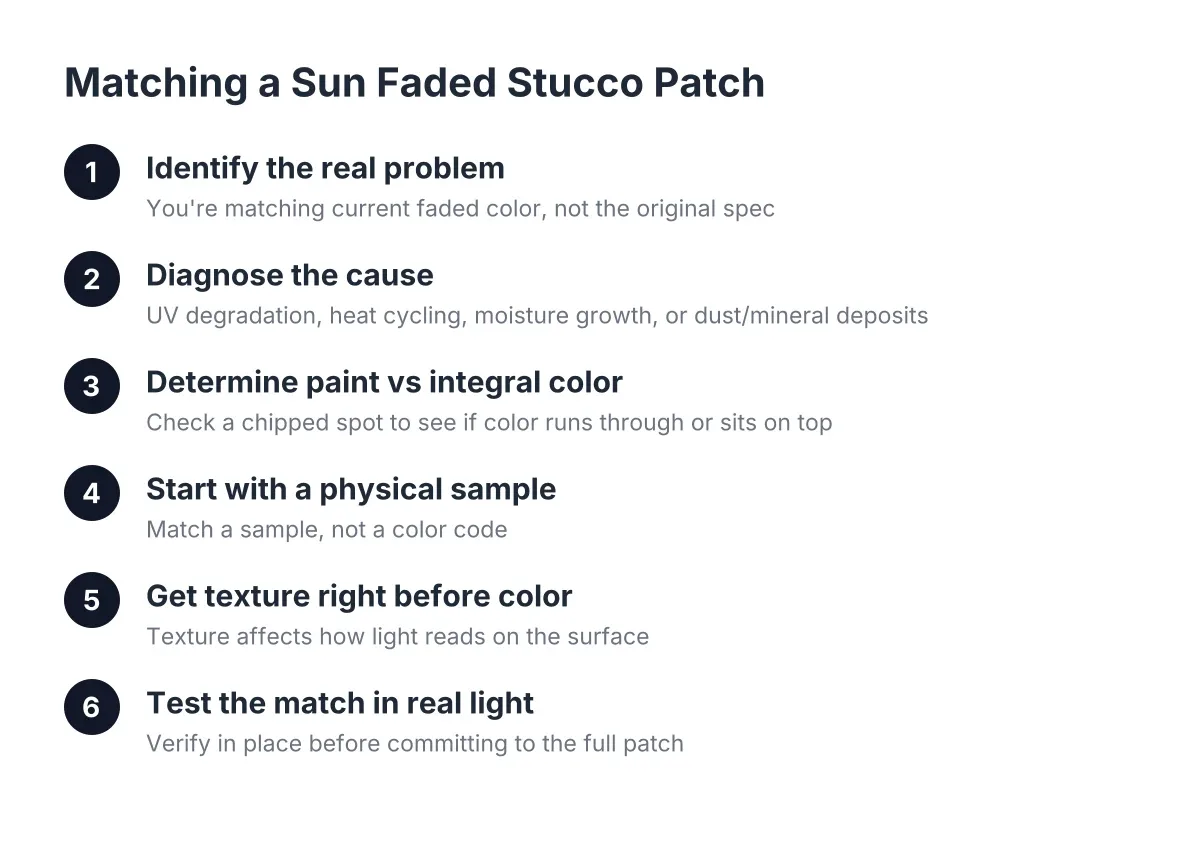
The Real Problem: You Are Not Matching a Color, You Are Matching Time
When your stucco went on, it had one color. Today it has several. The south and west walls have taken the brunt of the afternoon sun and faded the most. The north wall, or a section shaded by a mesquite tree or a covered patio, may look close to original. Additionally, the wall behind the pool equipment might be darker from moisture and mineral staining.
So when someone promises to "match your stucco color," the honest question is: match it where? A repair on a sun-blasted west wall needs a different target than the same repair on a shaded courtyard wall, even if both walls were finished with the identical color the day the house was built.
This is why national platforms and generic painting outfits get it wrong so often. They pull the original color from a stucco color chart or a manufacturer code, mix to that spec, and apply it. The mix is technically correct and visibly wrong, because the wall around it stopped being that color years ago. Matching faded stucco means matching the wall as it exists today, in its current light, at its current age.
What Causes Sun Faded Stucco Patch Discoloration in Arizona
Arizona stucco fades because ultraviolet radiation breaks down the pigments in the finish, and Scottsdale gets more intense UV exposure than most of the country. Add heat cycling, monsoon moisture, and airborne dust, and the surface you see today can sit noticeably lighter and duller than the original finish, unevenly across different walls of the same house.
Break it down and there are four forces at work:
- UV degradation. Sunlight attacks pigment at the molecular level. Organic pigments, common in warmer earth tones, fade faster than mineral-based ones. The deeper the original color, the more dramatic the shift over time.
- Heat cycling. Summer wall surfaces in Scottsdale can swing more than 60 degrees between afternoon and pre-dawn. That expansion and contraction opens micro-pores in the finish coat, which scatters light differently and reads as chalky or washed out.
- Moisture and growth. Discoloration is not always fading. On shaded or damp sections, what looks like a color change is often growth embedded in the pores of the stucco itself, not surface dirt. It will not rinse off with a hose, and if it has built up for years it may take more than one treatment to clear.
- Dust and mineral deposits. Desert dust settles into texture. Irrigation overspray leaves mineral haze near grade. Both shift the apparent color of the lower few feet of a wall.
The practical takeaway: before anyone talks about matching, someone needs to figure out which of these is happening on your wall. Fading gets matched. Growth gets cleaned first, then evaluated. Treating embedded growth as a color problem produces a patch matched to grime, and it will stand out the moment the wall is ever washed.
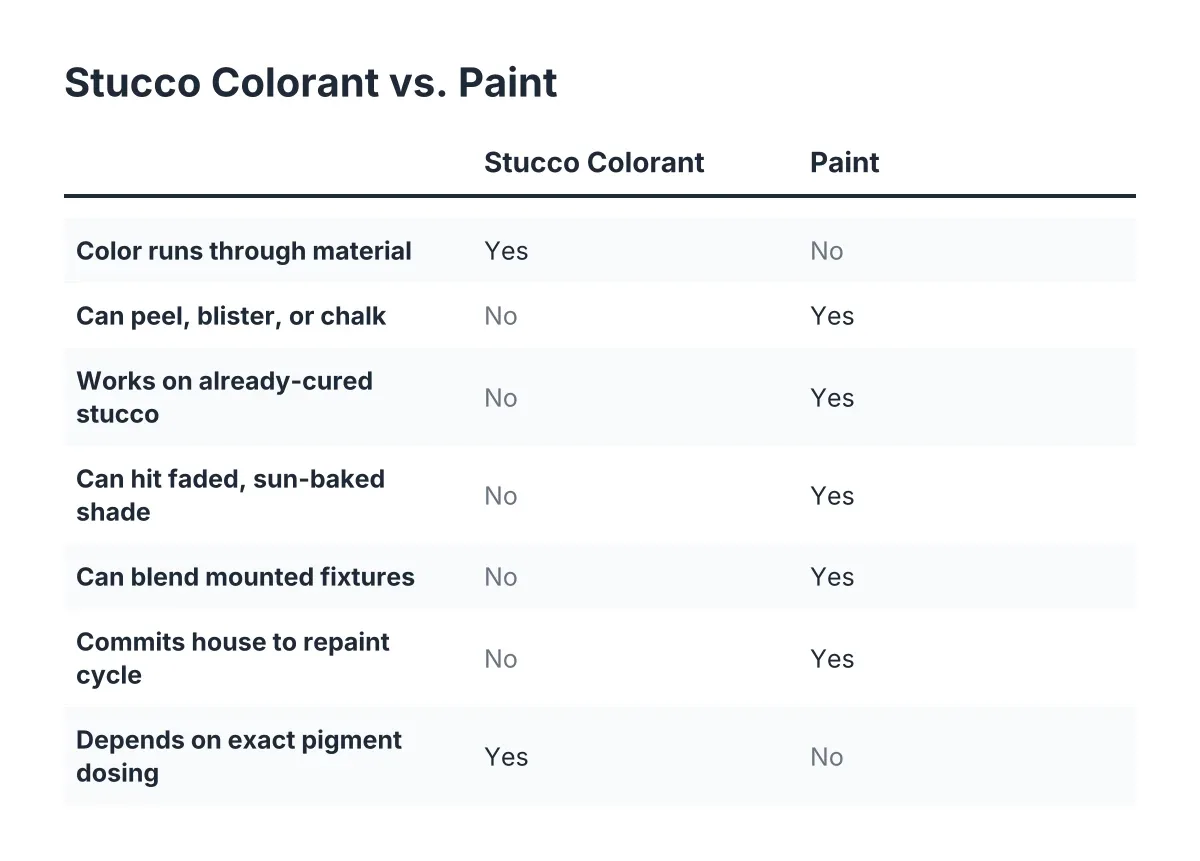
Paint Color or Integral Color: Know What You Have Before Anyone Mixes Anything
Stucco holds color in one of two ways, and the repair approach is different for each. This is a question worth asking any contractor you are vetting, because if they cannot explain the difference clearly on the phone, that tells you something.
Integral color means the pigment was mixed into the finish coat itself. Traditional stucco goes on in three coats: a scratch coat that gets scored so the next layer bonds, a brown coat that builds the wall flat, and a finish coat that carries the texture and, in an integrally colored system, the pigment. The color is part of the material, not a layer on top of it. Many Scottsdale homes built from the 1990s onward have integral color finishes.
Painted stucco means the finish coat was gray or a base tone, and the color came from exterior paint applied afterward. Any house that has been repainted since construction falls into this category, whatever it started as.
Why it matters for fading:
- Integral color fades within the material. There is no paint layer to scrape or re-coat; the matching has to happen in the new finish mix itself, tinted to the wall's current faded state rather than its original formula.
- Painted stucco fades at the paint layer. A patch can be primed and painted, but paint from the original bucket, even if you kept it in the garage, will no longer match the wall it once covered. The wall moved; the bucket did not.
- A repair on integral color that gets "fixed" with a dab of paint creates a sheen mismatch. Paint reflects light differently than a cementitious finish, so even a perfect color read can look wrong at 4 p.m. when the sun rakes across the wall.
If you are unsure which you have, look at a chipped or damaged spot. If the color runs through the material, it is integral. Furthermore, if you see a distinct thin colored skin over a gray or tan base, it is painted.
How Professionals Match Sun Faded Stucco Patches So the Repair Disappears
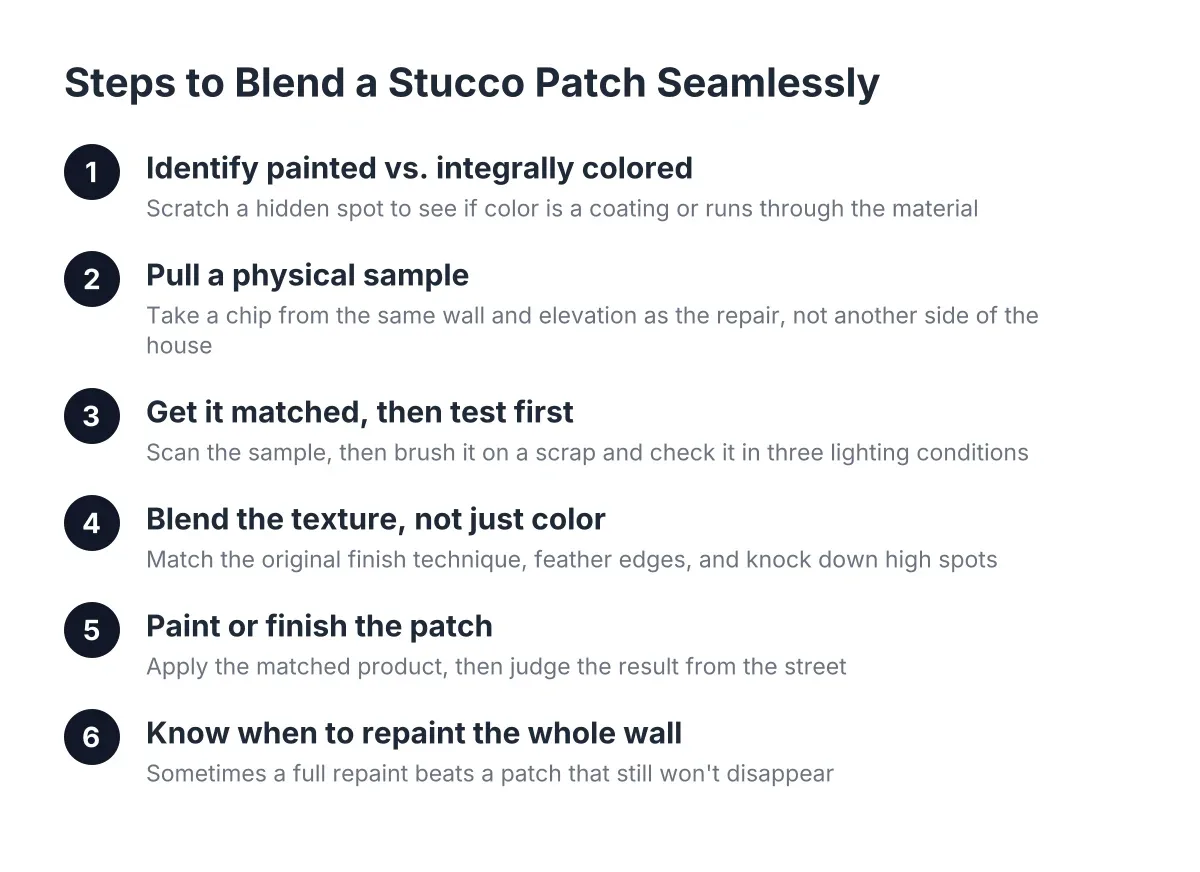
Matching faded stucco is a measured process, not a guess against stucco paint colors on a fan deck. A careful contractor reads the wall's current color from a physical sample, tests the match in the exact spot where the repair will live, and blends texture before color ever goes on. Each of those steps exists because skipping it produces a visible patch.
Start with a physical sample, not a color code
On a wall with real fading, especially one showing multiple shades, the reliable move is to take a small sample piece from an inconspicuous area near the repair and use it for the color match. A sample captures the wall as it is, including the fade. A color code captures the wall as it was on installation day. For a repair, the code is history; the sample is truth.
Location matters as much as the sample itself. A chip pulled from a shaded north wall will not match a repair going on the west face. The sample should come from the same wall, same exposure, within a few feet of the damage when possible.
Get the texture right before the color
Texture failure is the number one reason patches stay visible, and it survives paint. A patch with the wrong texture shows through even after the entire wall is repainted, because texture mismatch is about how the surface catches light, not what color it is. Skip trowel, sand finish, dash, lace: each scatters shadows in its own pattern, and your eye picks up the difference from the street.
The good news is that texture can usually be blended without tearing anything out. If a fresh patch reads slightly proud or coarse against the surrounding wall, knocking down and scraping the high spots often brings it in line, no full removal of the base coat required. This is standard technique, and it is a fair thing to ask a contractor about directly: how will you match my texture, and what happens if the first pass does not blend?
Test the match in place, in real light
Color on a sample board in the shade is not color on your west wall at 3 p.m. A faded stucco color match should be tested on or immediately beside the repair area and viewed in morning light, afternoon light, and from the distance you actually see the wall, which for most homeowners is the driveway or the street. New cementitious finishes also shift as they cure, typically drying lighter than they look wet, so judging a match on a wet patch is another common way repairs go wrong.
Timing plays a role too. Desert heat is hard on materials during application, not just after. Crack repairs that involve sealants behave better in early morning than in full afternoon sun, where heat can make caulk cure poorly. On wider cracks, a backer rod, which according to Sika is a closed-cell foam cord placed in the crack to create a backing before sealant goes in, keeps the sealant at the right depth so it flexes instead of failing. These details never show up on a thin listing page, and they are exactly the details that separate a repair that lasts from one you pay for twice.
Know when blending loses and painting the wall wins
Here is the honest limitation, and any contractor who will not say it is not leveling with you. Sometimes the fade is too advanced, or the original finish is a discontinued blend, and no sun faded stucco patch will ever be invisible on its own. The professional fallback in that case is to paint the entire wall or section, corner to corner, so the whole plane reads as one uniform color. A well-executed patch under a full-wall coat becomes hard to distinguish from the surrounding surface; a patch alone on a badly faded wall rarely does.
The decision rule is about natural break points. Paint from inside corner to inside corner, never to an arbitrary line mid-wall, because the eye forgives a slight shade shift at a corner and catches it instantly on a flat plane. On a heavily faded south exposure, matching one wall to itself beats chasing an impossible match to a ten-year-old shade that no longer exists anywhere on the house.
Blending New Construction Stucco to a Faded Original Wall
New stucco meeting old stucco is the hardest version of this problem, because the mismatch runs in both directions. Suppose a Scottsdale homeowner adds a 300-square-foot casita off the back of a 2008 house. The addition gets fresh stucco, correctly installed, three coats, textured to match. Even with a perfect color read of the existing wall, that new finish will cure and then begin its own fading clock, while the original wall keeps fading on its fifteen-year-old clock. Match them perfectly today and they can drift apart over the next several seasons.
In that scenario, a contractor who knows this trade will walk you through the options honestly rather than promising an invisible seam forever:
- Match to current, accept drift. Tint the new finish to the faded wall as it stands. The joint looks clean now; expect minor divergence over time, mostly noticeable at the transition line.
- Blend the transition. Feather the new finish past the joint and blend texture across it, so there is no crisp line for the eye to compare shades against. Gradual transitions hide drift far better than hard seams.
- Paint the shared elevation. Coat the entire connected wall plane, old and new together, in one color. Both surfaces then fade in step from the same starting point. This is the most durable answer when the addition joins a badly faded elevation.
This is worth settling before the finish stage of your build, not after. If your general contractor treats the stucco scope as an afterthought, the color and texture conversation tends to happen the week the crew shows up, which is too late to sample, test, and decide properly. Stucco remains the dominant exterior finish in this region, still on 48% of new single-family homes started in the Mountain division in 2024 according to the National Association of Home Builders, so the match-new-to-old problem is common here. Common does not mean everyone handles it well.
Slowing Stucco Color Fading on Arizona Homes
You cannot stop the desert sun, but you can slow what it does to your walls and keep future repairs easier to hide. Prevention here is less about products and more about habits.
First, wash the walls on a schedule. Routine cleaning keeps growth from embedding deep in the stucco's pores. A wall cleaned regularly needs only gentle treatment; a wall ignored for a decade may need repeated applications to clear embedded growth, and aggressive cleaning shortens the finish's life. Clean walls also make every future color match easier, because you are matching pigment instead of pigment plus grime.
Next, when it is time to repaint, choose with fading in mind. Lighter earth tones, the tans, warm grays, and soft desert neutrals that dominate Scottsdale stucco colors, hide fade far better than saturated terracottas, deep browns, or dark accent shades. Dark colors also run hotter in summer sun, which accelerates both fading and thermal cracking. If your HOA palette allows a range, the lighter end of it will look consistent years longer. High-quality elastomeric or masonry coatings with UV-resistant pigments cost more per gallon and hold color noticeably longer than budget exterior paint.
Finally, fix small cracks before monsoon season. A hairline crack is a moisture path, and moisture behind the finish coat creates staining and discoloration that no amount of color matching fixes from the outside. Water damage repairs are always bigger than crack repairs. Catching a crack at an eighth of an inch is a patching job; catching it after two monsoon seasons can mean cutting out and replacing a section of wall. For scale, Fixr.com puts the national average cost to repair stucco between $900 and $3,000, averaging about $1,700 for a buckled 10×10-foot area of three-coat stucco, and staying ahead of water intrusion is how you stay at the low end of ranges like that or below them.
What to Ask Before You Let Anyone Patch Your Wall
If you have been burned by a contractor before, you already know that every stucco repair website reads the same. The way through is to ask questions that only someone who does this work can answer well. Color matching is a useful test, because the shortcuts show immediately and the knowledge cannot be faked on the spot.
Ask these before signing anything:
- Is my stucco integrally colored or painted, and how did you determine that? The answer should involve looking at your wall, not quoting a generic process.
- How will you match the faded color, from a sample of my wall or from a color chart? "We'll match it, no problem" is not an answer. Taking a physical sample from the repair area is.
- How do you match my texture, and what do you do if the first pass does not blend? Listen for specifics: knocking down high spots, feathering edges, floating the finish to mimic the existing pattern.
- At what point would you recommend painting the whole wall instead of blending a patch? A contractor who names that scenario honestly is telling you they will not hide behind a mediocre patch.
- Will the scope, including the color and texture match approach, be in writing? Verbal promises about invisible repairs are worth exactly what they cost.
Anyone offering dedicated Stucco Color Matching as part of their repair work should handle these questions without hesitation. If the answers are vague, the patch probably will be too.
One more note on realistic expectations, because trust runs both ways. Even excellent work has limits. A fresh cementitious patch continues to cure and shift shade for weeks, and on some heavily faded or discontinued finishes, a truly invisible blend without painting the wall is not achievable. A contractor who tells you that up front, before taking your deposit, is showing you how they will handle everything else on the job. On complex cases, extensive water damage behind the finish, or structural cracking that keeps returning, get a professional assessment before anyone starts patching, because the color match is the last step of a sound repair, never a cover for an unsound one.
The sun is not negotiable in Scottsdale. Stucco color fading in Arizona will keep happening to every exterior wall in the valley, yours included. But a visible patch is not the price of a repair. It is the price of a rushed one. Matched from a real sample, textured to blend, tested in your light, and backed by an honest call on when to paint the whole wall, a repair on a faded wall can and should disappear.
If you need stucco repair, Scottsdale Stucco Repair can help.
Prefer to talk it through? Call (480) 637-3464 — a quick call is usually the fastest way to get a straight answer for your situation.