Stucco Resurfacing vs Full Replacement: Which One Actually Saves You Money?
If your stucco looks tired but the walls underneath are still sound, you may not need the big job everyone keeps quoting you. The stucco resurfacing vs replacement cost question comes down to one thing: is the damage cosmetic or structural? Resurfacing refreshes the finish over intact stucco for a fraction of the cost. Full replacement tears everything off down to the framing and starts over. Plenty of contractors skip past the middle option because a tear-off is a bigger ticket. This guide compares both so you can figure out which one your house actually needs, and budget for it before you sign anything.
Why the Quotes You're Getting Are All Over the Place
If one quote came in at three times another, the contractors were probably not bidding the same job. One priced a resurface. The other priced a tear-off. Nobody explained the difference, so the numbers look random.
That gap is the whole problem with researching stucco replacement cost online. Price-per-square-foot numbers vary wildly because "redo the stucco" can mean two different scopes of work. Resurfacing is a new finish coat over existing stucco. Replacement is demolition, new lath, new base coats, and a new finish. Same wall, two different projects, two different budgets.
Stucco is not a niche material here, either. According to the National Association of Home Builders, stucco remained the most-used exterior wall material in the Mountain division, which includes Arizona, at 48% of new single-family homes started in 2024. In Scottsdale, most of the housing stock wears it. That means a lot of homes hitting the 20 to 40 year mark where this exact decision comes up.
What Stucco Resurfacing Actually Is
Stucco resurfacing means applying a new finish coat, sometimes called a skim coat, over your existing stucco after cleaning, crack repair, and prep. The original base coats and lath stay in place. You get a fresh surface, a uniform color, and a consistent texture without demolition.
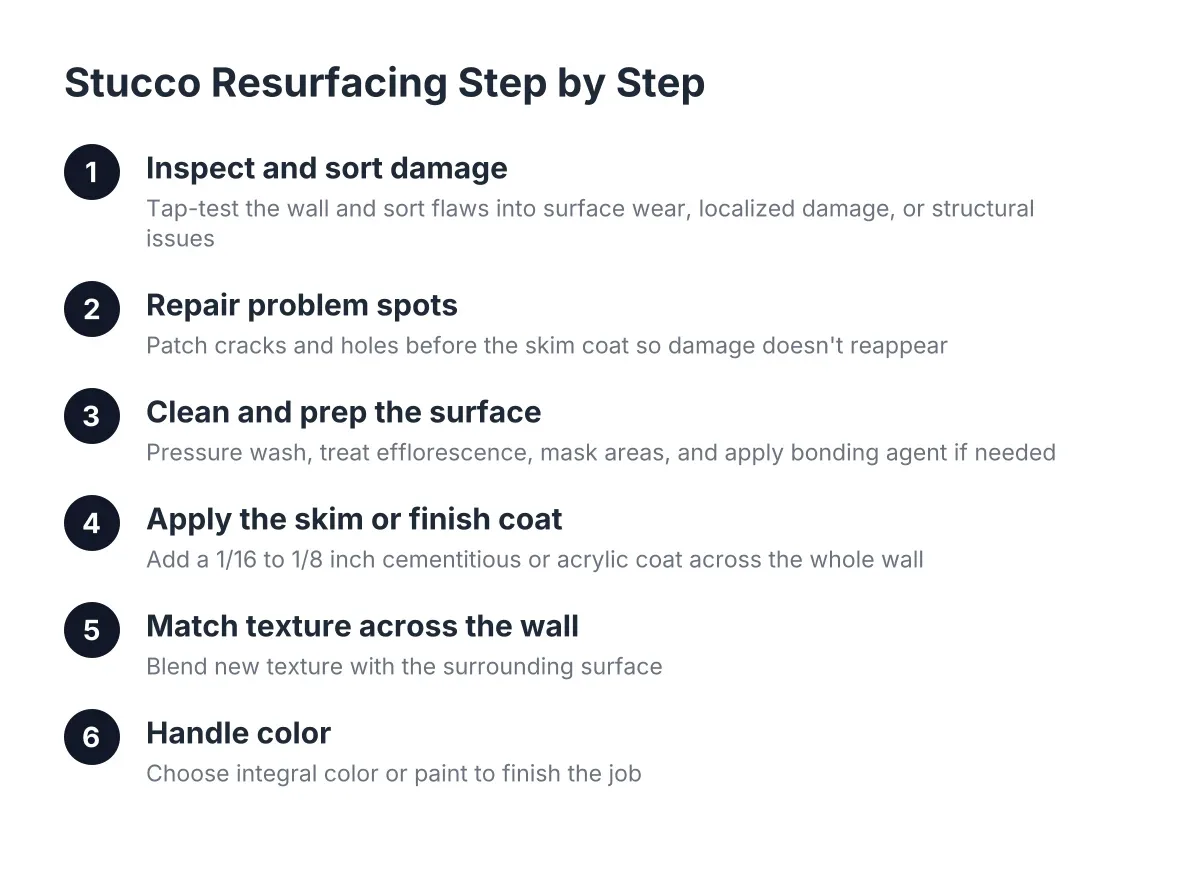
Here is the typical stucco resurfacing process on a Scottsdale home:
- Inspect the walls for hollow spots, bulging, and water damage to confirm the base is sound.
- Repair cracks and patch holes so they do not telegraph through the new coat.
- Pressure wash and prep the surface so the new material bonds.
- Apply a bonding agent, then a new skim coat or finish coat.
- Match the texture to the existing style, then apply integral color or paint.
Done right, resurfacing hides hairline cracking, faded color, chalky finish, and years of patch scars that never quite matched. It is the answer to "how to refresh old stucco" that many homeowners never hear because nobody offered it.
Does Resurfacing Fix Cracks?
Resurfacing fixes the appearance of hairline cracks and includes proper crack repair as part of prep, but it does not fix the cause of structural cracking. Cracks under about 1/16 inch are usually cosmetic and disappear under a new finish coat. Wider, recurring, or stair-step cracks point to movement or moisture problems that a skim coat only hides temporarily.
This is the honest limitation of resurfacing. If the wall is moving, the crack comes back through the new finish, often within a year or two. A contractor should sound the walls, check for soft or hollow areas, and tell you plainly whether the cracking is surface-level before recommending a resurface. If they quote you without touching the wall, get another opinion.
What Full Stucco Replacement Involves
Full replacement strips the wall to the sheathing or framing. The crew removes the old stucco, inspects and replaces damaged lath and moisture barrier, then builds the wall system back up: scratch coat, brown coat, finish coat. It is loud, dusty, and takes days to weeks depending on the house.
Replacement is the right call when the problem goes deeper than the finish:
- Widespread bulging or delamination, where stucco has separated from the lath
- Water damage behind the stucco, soft spots, or staining that keeps returning
- Rusted or failed lath and torn moisture barrier
- Large sections that sound hollow when tapped
- Structural cracks that reopen after every repair
In those cases, resurfacing would be throwing good money after bad. A new finish coat bonded to failing base coats fails with them.
Comparing Resurfacing and Replacement Costs
Resurfacing typically runs a fraction of the cost of replacement because you are paying for one coat of material and skilled labor, not demolition, disposal, lath, moisture barrier, and three coats. As an illustrative estimate, a full tear-off and re-stucco of an average single-story Scottsdale home can land in five figures, while resurfacing the same house often costs a third to half of that. Exact numbers depend on wall area, access, height, and how much crack repair and patching the prep requires.
For context on smaller-scope work, Fixr.com puts the national average cost to repair buckled three-coat stucco in a 10×10-foot area at $900 to $3,000, averaging about $1,700. That is one damaged section, not a whole house. It shows why whole-house quotes climb fast, and why the decision between resurfacing and replacement matters so much to your budget.
Suppose a homeowner in North Scottsdale gets three bids to "redo the stucco" on a 2,000-square-foot house with faded finish and hairline cracking. In that scenario, two contractors bid full replacement without checking whether the base coats were sound, and one bid a resurface after sounding the walls. The resurface bid looks suspiciously cheap next to the others. It is not cheap; it is a different, correctly scoped job.
How to Compare Quotes Apples-to-Apples
Make every contractor state, in writing, whether they are bidding resurfacing or replacement. Then ask each one for the same line items:
- Total wall square footage they measured, not guessed
- Prep scope: crack repair, hole repair, patching, and pressure washing
- What happens if they find water damage or hollow stucco mid-job, and how change orders are priced
- Materials: bonding agent, finish coat product, and color method (integral color versus paint)
- Texture matching approach, so new work blends with anything left untouched
That last question about mid-job discoveries is how you keep an estimate from ballooning. Hidden water damage is the most common reason a resurfacing job grows. A straight answer up front, with unit pricing for extra repair, protects you more than a low headline number.
Side by Side: Where Each Option Wins
Cost. Resurfacing wins clearly. No demolition, no disposal fees, one coat instead of three.
Longevity. Replacement wins. A new three-coat system over new lath is a decades-long reset. A resurface extends the life of stucco that was already sound; it cannot rescue stucco that was failing.
Disruption. Resurfacing wins. Days instead of weeks, minimal debris, and landscaping mostly undisturbed. For a landlord with a tenant in place, that difference matters; a resurface can happen around an occupied rental without a construction zone in the yard.
Fixing hidden problems. Replacement wins. Tearing off the stucco is the only way to fully inspect and replace the moisture barrier and lath. If your home inspection flagged moisture intrusion, resurfacing does not address it.
Curb appeal. Roughly a tie. Both deliver a uniform color and texture. A resurface over sound stucco is visually indistinguishable from new stucco to anyone standing in the driveway, which is why it works well before a sale or refinance.
Resale and inspection. Depends on the wall. If the stucco is sound, a resurface satisfies buyers and appraisers. If an inspector documented delamination or water damage, a cosmetic coat over it can become a disclosure problem. Fix the real issue.
When Resurfacing Is Just Delaying the Inevitable
The fair objection to resurfacing is that a cheaper fix might only postpone a replacement you will pay for anyway. Sometimes that is true. A skim coat over stucco with failing base coats or wet lath buys you two or three years, then you pay for replacement plus the wasted resurface.
However, the reverse mistake is more common in practice: paying for a full tear-off when 90% of the wall system was fine and only the finish had aged out. Sun-faded color, chalking, hairline crazing, and mismatched old patches are finish problems. Replacing an entire wall system to fix a finish problem is like replacing a roof because the shingles faded.
The deciding factor is the condition of the base coats, not the appearance of the surface. Ugly but solid stucco is a resurfacing candidate. Decent-looking stucco that sounds hollow or feels soft is not. This is one place where a professional assessment is worth getting before you commit either way; hollow spots and hidden water damage are hard to judge from the ground.
A quick note on materials: consumer stucco repair products from the hardware store work fine for small cosmetic patching, but whole-wall resurfacing depends on bonding agents and finish coats applied at the right thickness in the right conditions. Arizona heat shortens working time, and a finish coat that dries too fast can craze or fail to bond.
How to Choose Between Resurfacing and Replacement
Deciding between stucco resurfacing and full replacement starts with a hands-on inspection, not a price sheet. Sound the walls, map the cracks, and check for moisture. If the base coats are intact and the damage is cosmetic, resurface and bank the savings. If the wall system is failing, replace it once and be done.
Use this as a working checklist:
- Choose resurfacing if: cracks are hairline, walls sound solid when tapped, there is no soft or bulging stucco, and your main complaints are fading, texture wear, or visible old patches.
- Choose full replacement if: stucco is delaminating, water damage keeps returning, lath or moisture barrier has failed, or structural cracks reopen after repair.
- Get a second assessment if: every bid you receive is for replacement but nobody tested the walls, or the bids vary by more than double for what is supposedly the same scope.
For a Scottsdale exterior, the resurfacing versus replacement cost decision is ultimately a scope question dressed up as a price question. Nail down the scope first. Once every contractor is bidding the same job, the right number, and the right choice, gets a lot easier to see.
If you need stucco repair, Scottsdale Stucco Repair can help.
Prefer to talk it through? Call (480) 637-3464 — a quick call is usually the fastest way to get a straight answer for your situation.