Stucco Resurfacing Cost Factors in Scottsdale: Labor, Materials, and Size
If your stucco looks tired but the walls underneath are still solid, you are probably staring at quotes that make no sense together. One contractor says tear it all off. Another says patch and paint. The numbers land anywhere from a few thousand dollars to the price of a used truck, and nobody explains why. Understanding the stucco resurfacing cost factors behind those numbers, labor, materials, and the size and condition of your walls, is the fastest way to figure out what your house actually needs and what a fair price looks like in Scottsdale in 2026.
Here is the part most homeowners never hear: there is a middle option between doing nothing and paying for full replacement. Resurfacing, sometimes called a skim coat or re-coat, refreshes worn, faded, or hairline-cracked stucco without tearing anything off the wall. Plenty of contractors skip past it because a full replacement is a bigger ticket. This guide explains when resurfacing works, when it does not, and what actually drives its price, so you can read your next three quotes side by side and know which one fits your house.
The Problem: Old Stucco, Confusing Quotes
Stucco is the default exterior in this part of the country. According to the National Association of Home Builders, stucco remained the most-used exterior wall material in the Mountain division, which includes Arizona, at 48% of new single-family homes started in 2024. That means Scottsdale is full of stucco houses built in the 1980s, 1990s, and 2000s that are now showing their age at the same time.
Age shows up in predictable ways here. The desert sun breaks down the paint and the surface layer. Hairline cracks spider across walls that face south and west. The finish chalks when you rub a hand across it. Monsoon-driven rain finds every crack and stains the surface below it.
None of that necessarily means the stucco has failed. The three-coat system under the surface, the scratch coat, the brown coat, and the lath behind them, can be perfectly sound while the outer eighth of an inch looks rough. The problem is that a homeowner cannot tell the difference from the driveway, and quotes rarely explain which situation you have.
That is where the wild price swings come from. A contractor quoting full stucco replacement is pricing demolition, disposal, new lath and paper, three new coats, and finish. A contractor quoting resurfacing is pricing crack repair and a new finish coat over walls that stay put. Those are different jobs at different prices, and if the quotes do not say which one they are, you cannot compare them.
What Stucco Resurfacing Actually Is
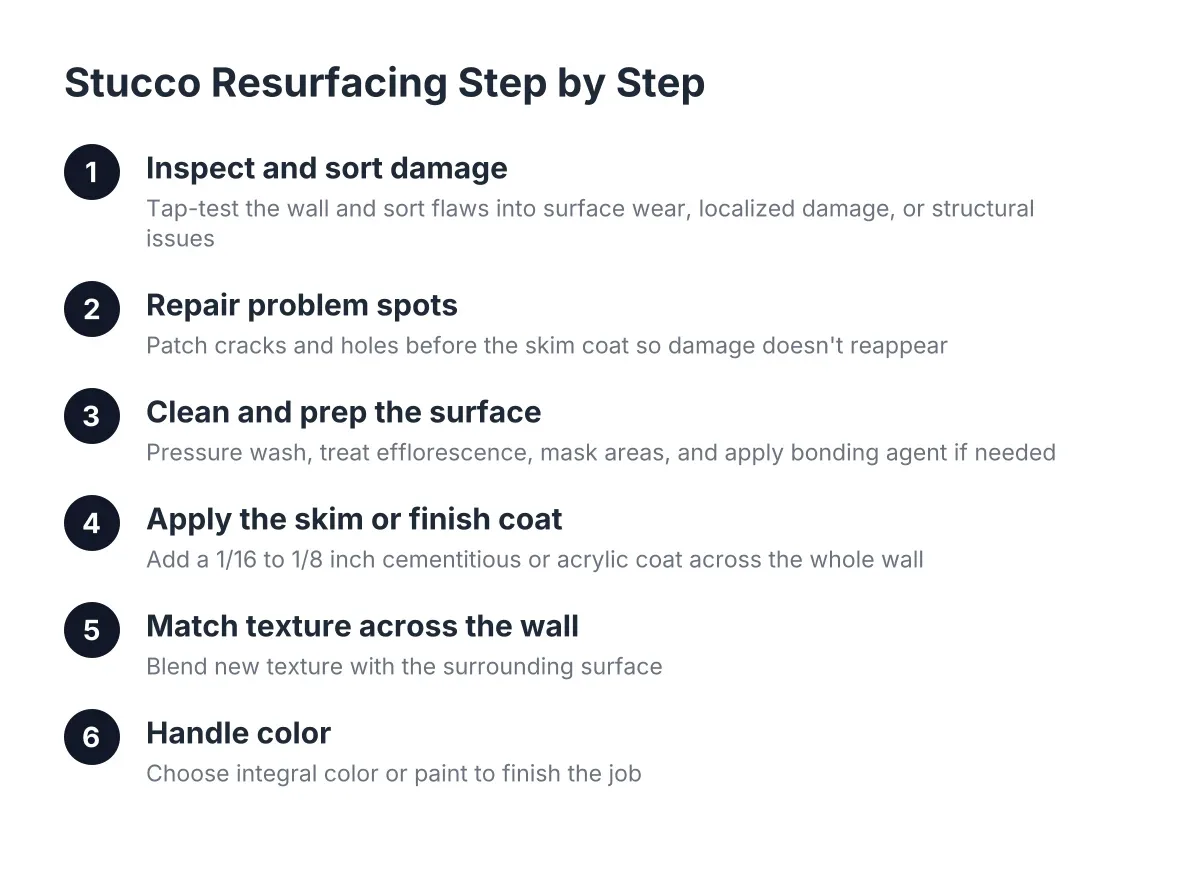
Resurfacing means applying a new finish layer over your existing stucco instead of tearing the old system off the wall. The crew repairs cracks and damaged spots first, then applies a bonding agent, then trowels on a skim coat or new finish coat across the whole surface. You end up with a wall that looks new because the surface is new, while the structure underneath stays exactly where it was.
The process on a typical Scottsdale house runs in this order:
- Inspection and sounding. Someone taps and presses the walls to find hollow spots, delamination, or soft areas that signal deeper trouble.
- Repairs first. Stucco crack repair, stucco hole repair, and patching of any damaged sections, so the new coat goes over sound material.
- Surface prep. Pressure washing to remove chalk, dirt, and failing paint, because a new coat will not bond to a dirty wall.
- Bonding agent. A primer coat that helps the new material grip the old surface.
- The new finish coat. A skim coat of stucco finish troweled across every wall, in the texture you choose.
- Color. Either integral color mixed into the finish itself or paint applied after cure.
Because nothing gets demolished, resurfacing costs a fraction of replacement, finishes in days instead of weeks, and leaves far less mess in your yard. It is the option built for houses where the complaint is how the stucco looks, not whether it is falling off.
Does Resurfacing Fix Cracks?
Resurfacing fixes hairline and cosmetic cracks permanently when the cracks are repaired first and the underlying wall is stable. The crew fills each crack, patches damaged areas, and then buries the repairs under a continuous new finish coat, so old cracks disappear rather than telegraph through. However, resurfacing does not fix structural cracks or hide active movement in the wall.
The distinction that matters is why the crack exists. Hairline cracks from decades of sun and normal settling are surface problems; a skim coat over proper crack repair handles them. Wide cracks that keep growing, cracks that step diagonally from window corners, or cracks paired with bulging stucco point to movement or moisture behind the wall. Coating over those buys you a clean-looking wall for a season, and then the cracks come back through the new finish.
The same logic applies to water damage. Stains, soft spots, or stucco that sounds hollow when tapped mean water got behind the surface. That area needs water damage stucco repair, cut out and rebuilt properly, before any resurfacing happens. A finish coat over trapped moisture seals the problem in, and in Arizona heat that trapped moisture works fast.
This is the honest limitation of resurfacing: it is a surface fix for surface problems. If more than a quarter to a third of your walls need cut-out repairs before the skim coat can go on, the math starts tilting toward replacement, and a contractor should tell you that plainly after walking the house rather than guessing from the curb.
The Stucco Resurfacing Cost Factors That Set Your Price
Stucco resurfacing cost factors come down to five things: the square footage of wall you are coating, the amount of repair work needed first, the labor to prep and trowel the finish, the materials and finish you choose, and access around the house. Two houses with identical footprints can land at different prices because these factors differ, which is exactly why quotes vary so much.
Wall Size, Not Floor Size
Contractors price resurfacing by wall area, not the square footage on your listing. A single-story 1,800-square-foot house might carry 2,000 to 2,400 square feet of exterior wall once you account for wall height and subtract windows and doors. A two-story house of the same floor plan can nearly double that number, and every added square foot is more material and more trowel time.
Complexity counts too. Scottsdale homes love parapets, pop-outs, arches, courtyard walls, and recessed windows. Each of those details takes longer to coat cleanly than a flat run of wall, so a house with lots of architectural detail costs more per square foot than a plain box of the same size.
The Repair Work That Comes First
Every resurfacing job starts with repair, and this is the factor that moves price the most from house to house. A wall with a few hairline cracks needs an hour of crack repair before coating. A wall with holes from an old awning, woodpecker damage, or a soft patch under a leaky scupper needs real patching, and patching takes skilled labor time.
This is also where estimates balloon if the walk-through was sloppy. A contractor who prices the job from photos and finds hollow spots on day one has to come back to you with change orders. A contractor who sounds the walls up front can put the repair work in the written quote, which is the version of the estimate you can actually budget against.
For scale, Fixr.com puts the national average cost to repair stucco between $900 and $3,000, averaging around $1,700 for repairing buckled three-coat stucco in a 10×10-foot area. That is repair alone, before any resurfacing. It shows why the condition of your walls, not just their size, drives the final number.
Labor: Prep and Trowel Skill
Labor is the biggest line on a resurfacing invoice, and most of it is not the finish coat itself. Washing, masking windows and fixtures, protecting landscaping, repairing cracks, and applying the bonding agent all happen before the first trowel of finish goes on. Rushed prep is the number one reason skim coats fail early, so cheap labor on this step is expensive labor in disguise.
The finish coat itself takes a practiced hand. Texture matching matters when you are coating an addition to match the original house, or coating walls next to a garage that is staying as-is. A finisher who can match a 1990s sand finish or a heavy lace texture across an entire elevation is worth more per hour, and the result is the difference between a wall that looks new and a wall that looks re-coated.
Materials and Finish Choice
Material cost splits mainly on two decisions. First, cement-based finish versus acrylic finish: acrylic finishes flex more, resist hairline cracking better, and hold color longer under desert sun, and they cost more per square foot. Second, integral color versus paint: color mixed into the finish never peels and ages evenly, while paint is cheaper up front but becomes a repainting cycle you own forever.
In addition, texture depth changes material use. A heavy lace or dash texture uses more product per square foot than a smooth or light sand finish. None of these choices is wrong; they are trade-offs between upfront cost and how long the finish stays looking new in Arizona sun.
Access and Site Conditions
Finally, the parts of the job nobody thinks about until the crew arrives. Two-story walls need scaffolding or lifts. Tight side yards, pool decks against the house, mature cactus and desert landscaping against the walls, and HOA parking rules all add setup time. Summer scheduling matters too; stucco finish does not like being applied to a 140-degree wall, so hot-season work runs early hours, which can stretch the calendar.
Resurfacing vs. Replacement: The Cost Gap in Plain Terms
Resurfacing costs a fraction of full stucco replacement because it skips demolition, disposal, new lath and paper, and two of the three coats. Replacement means stripping walls to the sheathing and rebuilding the entire system, which multiplies both labor hours and material. For a structurally sound house, resurfacing typically delivers most of the visual result of a full replacement at a fraction of the cost.
Say a homeowner in McCormick Ranch has a 1994 single-story with faded, chalky walls and hairline cracks on the west elevation, and the walls sound solid everywhere. In that scenario, resurfacing is the right-sized job: crack repair, wash, bond coat, and a new acrylic finish in a fresh color. Full replacement on that house would pay for demolition the walls do not need. The reverse is also true; suppose the same house had bulging stucco and soft spots along the whole back wall from years of roof drainage problems. Coating over that would waste every dollar spent.
Here is the point of view worth carrying into your quotes: a contractor who only offers replacement is not necessarily wrong, but a contractor who never mentions resurfacing on a sound house has skipped the option that serves your budget instead of theirs. Ask directly why resurfacing does or does not fit your walls. The quality of that answer tells you more about the contractor than the price at the bottom of the page.
Stucco is not a niche material where you should accept whoever answers the phone. The U.S. Census Bureau's 2024 Survey of Construction found stucco accounted for about 27% of principal siding on homes that began construction in 2023, so this trade is common enough that you can insist on someone who works in it daily, not a general remodeler with stucco as one line on a long list. Stucco Resurfacing done well depends on that specialization, because texture matching and finish selection are judgment calls, not commodity tasks.
Selling the House? Resurfacing Changes the Pre-Listing Math
For a pre-listing seller, resurfacing solves two problems at once: the inspection flag and the curb appeal photo. An inspector or buyer's agent who flags "stucco cracking throughout" is describing a surface condition, and a resurfaced exterior with documented crack repair answers that flag with a clean invoice you can attach to disclosures. The same job makes the listing photos look like a newer house.
However, timing is where sellers need to be realistic. Resurfacing a whole house takes days, not an afternoon, and cure and color schedules do not compress just because a closing date exists. If the calendar is short, targeted stucco repair, crack repair, patching, and color matching on the flagged elevations may fit the deadline better than a full re-coat. That is a smaller job with a smaller invoice, and it still clears the inspection item.
Either way, get the scope in writing before work starts. A quote that lists repair areas, prep steps, finish type, and color method is a document a buyer's agent can read. A one-line "stucco work: $X" invites the next inspector to re-open the question.
How to Compare Quotes on Stucco Resurfacing Cost Factors
Use the stucco resurfacing cost factors above as a checklist when quotes come in, because the goal is to make every bid describe the same job. A quote you can trust for budgeting will spell out, at minimum:
- Wall area measured, not floor square footage copied from the listing
- Repair scope, listing which cracks, holes, and patches get fixed before coating, and how change orders get priced if hidden damage turns up
- Prep steps, including washing and what gets masked or protected
- Bonding agent, named, not assumed
- Finish type, cement or acrylic, and the texture being matched or applied
- Color method, integral color or paint, with the product line
- Access costs, scaffolding or lift charges for two-story walls
- Cleanup and disposal, even on a low-debris job
Therefore, when one bid comes in at triple another, the checklist usually explains it. One priced replacement while the other priced resurfacing, or one included heavy repair work the other ignored, or one measured wall area while the other guessed. If a bidder cannot explain their number against this list, that is your answer about the bidder.
One last piece of judgment: the walls decide, not the brochure. If your stucco shows bulging, wide or growing cracks, or signs of water behind the surface, have someone sound the walls in person before you commit money to any coating. On a sound house, resurfacing is the cost-saving middle option that too many quotes skip past. On a failing wall, it is money spent painting over a problem. Knowing which house you own is worth more than any price per square foot you will find online.
If you need stucco repair, Scottsdale Stucco Repair can help.
Prefer to talk it through? Call (480) 637-3464 — a quick call is usually the fastest way to get a straight answer for your situation.