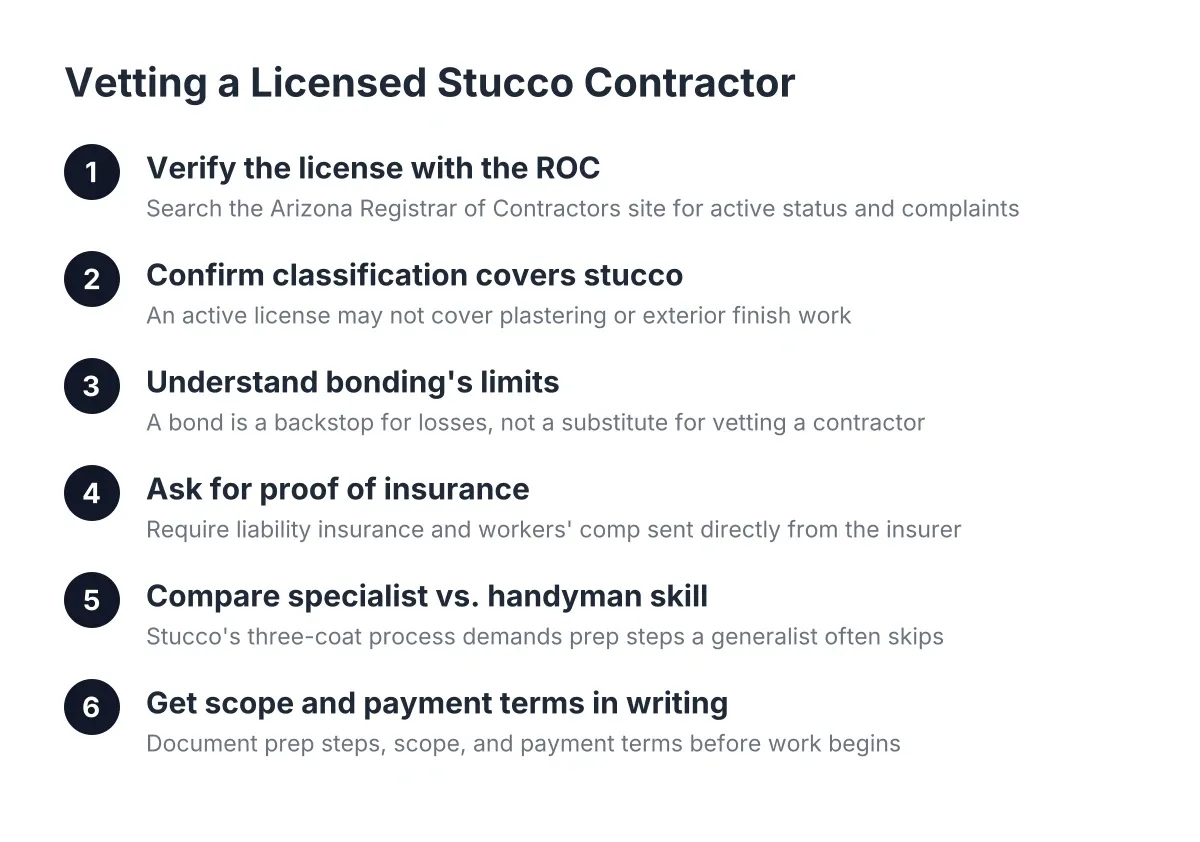
How to Choose a Stucco Contractor: 8 Questions and Red Flags That Matter
Search for stucco contractors near me in Scottsdale and you get two piles of results. One pile is national lead-generation platforms that treat stucco as a checkbox next to gutters and drywall. The other is thin local listings with a phone number and nothing else. Neither tells you the thing you actually need to know: whether the person showing up can repair a crack, match your color and texture, and still answer the phone in three weeks. If you are fixing stucco before a listing, or you sit on an HOA board getting bids for a cracked perimeter wall, that gap is exactly where people get burned.
Stucco is not a side skill here. According to the National Association of Home Builders, stucco was the most-used exterior wall material in the Mountain division, which includes Arizona, at 48% of new single-family homes started in 2024. In a market where nearly half the housing stock wears stucco, you have every right to hire someone who does stucco specifically, not someone who will figure it out on your wall.
Here are eight questions and red flags that separate a stucco specialist from a generalist who will leave you with a patch that reads like a scar in your listing photos.
1. Ask How They Will Match Your Color and Texture, Not Just Fill the Crack
A specialist answers this question with a process; a generalist answers it with "we'll paint over it." Stucco color matching and stucco texture matching are the hardest parts of a visible repair, and they are the whole point if you are prepping a house for photos or an appraisal. A filled crack with the wrong texture is often more noticeable than the crack was.
Listen for specifics. A contractor who does this work will talk about matching the existing finish style, blending the patch edges into the surrounding wall, and how sun-faded stucco complicates a match. There is no single correct troweling technique for a finish coat; different applicators work differently, and what matters is whether the result disappears into the wall. A trade-off worth knowing up front: on older, heavily faded walls, a perfect invisible match is sometimes not achievable with a spot patch alone. An honest contractor will tell you that and may recommend resurfacing or repainting the full wall plane instead of promising an invisible dot.
2. Ask What Is Causing the Crack Before Anyone Quotes a Fix
The right first move on a stucco repair is diagnosis, not a caulk gun. Hairline cracks from normal settling, cracks radiating from window corners, and cracking caused by water damage behind the wall are different problems with different fixes. A contractor who quotes a price without asking what is behind the crack is quoting to fill it, not to fix it.
One diagnostic you can watch for on the walkthrough: tapping the wall and listening. A hollow sound instead of a solid one signals stucco that has detached from the substrate, often because a bonding agent failed. Patching over detached stucco is money spent on a repair that will fail. For HOA boards evaluating bids on a shared perimeter wall, this is the difference between a $4,000 fix that holds and a $2,500 fix the reserve fund pays for twice.
3. Red Flag: They Treat Stucco as One Line on a Long Menu
Look at what the company actually does all day. If the same outfit lists stucco between fence staining, tile work, and pressure washing, stucco is a sideline. Scratch and brown coat work is harder than it looks, which is why even experienced homeowners are told to hire it out rather than attempt it. A sideline contractor is closer to that homeowner than to a specialist.
Surface knowledge shows up in small ways. For example, stucco should not be blasted with high pressure during cleaning, and cleaning products need dwell time on the surface to work. A generalist who pressure-washes stucco like a driveway can damage the finish before the repair even starts. When you compare stucco repair companies, weight the one whose vocabulary, service list, and questions are all about stucco.
4. What Prep Work Do Local Stucco Contractors Need to Complete?
Ask stucco contractors near you one blunt question: what do you do to the wall before any new material goes on? The right answer covers removing loose or failing stucco with scrapers or wire brushes, knocking off burrs and rough spots, and cleaning the surface of dust, oils, and grease. Contaminants prevent the new patch from bonding to the old stucco, so skipped prep is the number one reason patches pop loose later.
A vague answer here predicts a failed patch. Bonding is chemistry, not effort; a patch troweled beautifully over a dirty or crumbling surface will delaminate no matter how good it looked on day one. In addition, if the repair involves cutting out a section, the cut matters. A clean grinder cut through the wall severs the wire lath cleanly, which forces the contractor to open up more wall to weatherproof the patch properly, and that adds cost. Someone who has done hundreds of stucco patches knows this; someone who has done six does not.
5. Red Flag: No Straight Answer on Timeline When Your Listing Date Is Set
Suppose a Scottsdale seller has photos scheduled in twelve days, and the realtor flagged cracks around two window corners plus an old patch that reads darker than the wall. In that scenario, the timeline question is not small talk; it decides whether the repair happens before or after the listing goes live. A specialist can walk through the sequence: repair day, cure time before any color coat, and when the wall will photograph clean.
Watch how the answer is structured, not just the date given. Stucco work has real cure stages, and a contractor who promises same-week invisible results on a multi-coat repair is either cutting the cure or planning to paint over a patch that has not settled. Meanwhile, a contractor who explains what has to dry before what is showing you they have scheduled around stucco before. For HOA boards, the same logic applies to bid timelines; a bid that ignores cure time between coats on a long perimeter wall is a bid written by someone who has not done one.
6. Ask for a Written Scope That Names the Repair Method
Get the scope in writing, and make sure it names what will actually be done: stucco crack repair, hole repair, patching, resurfacing, or full replacement of a section. These are different jobs at different prices, and a one-line quote that says "repair stucco, $1,800" tells you nothing when the work looks wrong later. Specific scopes also make bids comparable, which matters when an HOA board needs two or three bids and a vote before approving reserve-fund spend.
A useful written scope for a typical repair covers:
- Which walls or sections are included, with rough dimensions
- The repair method for each area: crack repair, patch, or cut-out and replace
- Surface prep steps before new material goes on
- How color and texture will be matched, and what happens if the match is off
- Whether painting or sealing is included or excluded
- Cleanup and what the wall should look like when they leave
On cost, a written scope also protects you from the low-bid trap. According to Fixr.com, the national average cost range to repair stucco runs $900 to $3,000, averaging about $1,700 for repairing buckled three-coat stucco in a 10×10-foot area. A bid far below that range for comparable work usually means a skipped step, and the skipped step is almost always prep or matching, the two things you cannot see until it fails.
7. Red Flag: The Contractor Who Cannot Be Found Again
The disappearing handyman is the most common horror story in stucco repair for a reason. The pattern is predictable: quick verbal quote, cash-friendly terms, a patch that looks fine for a month, then a number that goes to voicemail forever when the color shifts or the crack telegraphs back through. If you found them through a marketplace that shuffles leads to whoever bids lowest, tracking them down later is even harder.
Before hiring, check the basics of findability. Do they have a real local presence you can point to, a business name that matches their paperwork, and a track record of stucco work specifically in Scottsdale? For HOA and property-management work this is not optional; a contractor who cannot produce a W-9 and certificate of insurance for the management company is a contractor the board cannot legally pay from reserve funds anyway. Hiring a stucco contractor is less about finding the cheapest bid and more about finding someone who will still exist when the wall needs a follow-up.
8. Judging Stucco Companies Near Me by Their Questions, Not Their Pitch
The best filter for stucco companies near you is the questions they ask before quoting. A specialist asks how old the stucco is, whether the wall has been patched before, whether there is any history of water damage, and what your deadline is. Those questions exist because the answers change the repair method, the prep, and the price.
Conversely, a contractor who quotes from the driveway without touching the wall is guessing, and you will pay for the guess either way. This filter works for a homeowner fixing exterior wall damage before listing and for a board comparing three bids on a community entry monument. Given how common stucco is here, about 27% of principal siding on U.S. homes that began construction in 2023 according to the U.S. Census Bureau, and far higher in Arizona, the good news is that real specialists exist in this market. You do not have to settle for a generalist.
What This Looks Like When You Get It Right
Run every candidate through the same short gauntlet: how will you match the color and texture, what is causing the damage, what prep happens before new material goes on, and what exactly does the written scope say. Two of the eight items above are about the work itself, and six are about whether the person doing it is a stucco specialist or a generalist improvising. That ratio is deliberate. Bad stucco repair rarely fails because stucco is impossible; it fails because the wrong kind of contractor did it.
One honest caveat: some situations need more than a repair bid. If tapping reveals large hollow sections, or moisture has been getting behind the wall for years, get a professional assessment of the substrate before anyone quotes patching, because the right answer may be replacement of that section rather than a cosmetic fix. Whether you are a seller staring down a photo date or a board member staring down a reserve-study report, the searches for stucco repair near me and stucco contractors near me both end the same way: with one person standing at your wall. These eight checks tell you, before any money moves, whether that person is the right one.
If you need stucco repair, Scottsdale Stucco Repair can help.
Prefer to talk it through? Call (480) 637-3464 — a quick call is usually the fastest way to get a straight answer for your situation.