Water Damage Indicators in Stucco: 8 Leak Signs to Check Before You Repair
If you are planning a big stucco job, the first question is not price per square foot. It is whether water is already behind the wall. Water damage indicators in stucco separate a $1,700 patch job from a full tear-off, and they explain why one quote can come in at three times another. A contractor who found trapped moisture is bidding a different project than one who only looked at surface cracks. Understanding the stucco leak warning signs is essential before you request bids.
This matters whether you own one house in Scottsdale or sit on an HOA board responsible for a mile of shared perimeter wall. Stucco is the dominant exterior here; according to the National Association of Home Builders, it was used on 48% of new single-family homes started in the Mountain division in 2024. That means a lot of walls to assess, and a lot of walls that can hide a leak.
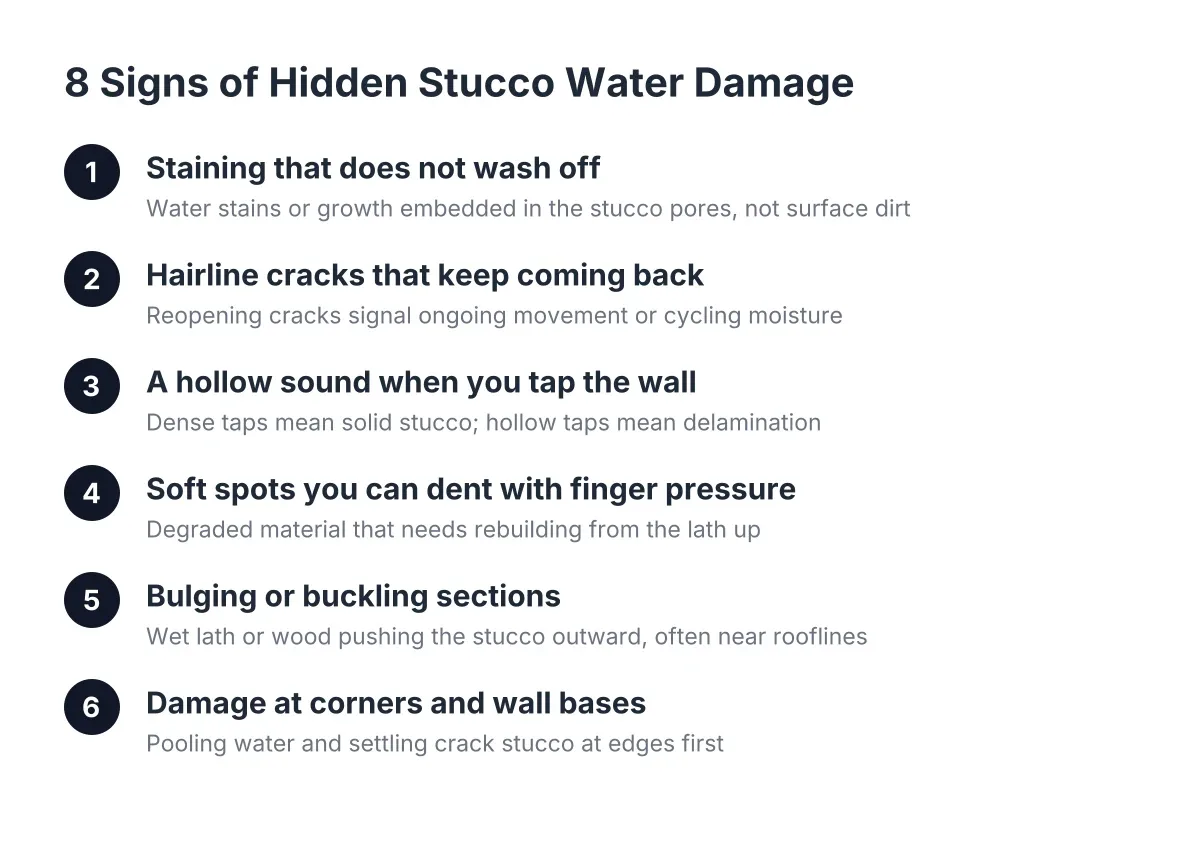
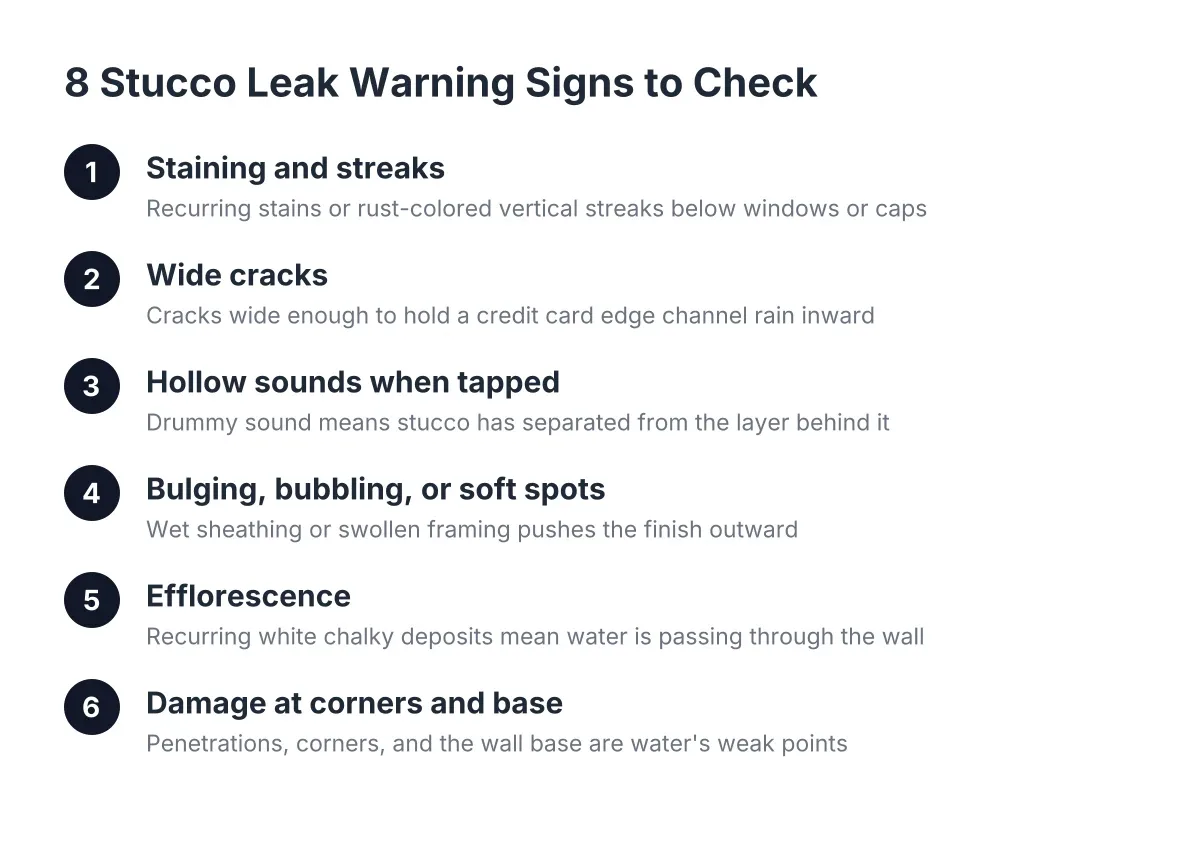
Below are eight water damage indicators stucco walls show before the problem gets structural. Walk your exterior with this list before you request bids. You will understand what each estimator is reacting to, and you will be able to compare quotes apples-to-apples instead of guessing why they diverge.
Stucco Leak Warning Signs: Staining and Streaks That Follow a Pattern
A single faint water mark after a monsoon storm usually dries out and means little. However, stains that reappear in the same spot, darken over time, or run in vertical streaks below windows, scuppers, or parapet caps point to water getting behind the finish coat instead of shedding off it.
Pay attention to rust-colored streaks in particular. Those often mean water has reached the metal lath inside the wall and is corroding it. On an HOA perimeter wall, recurring stains below the wall cap are one of the most common findings in an annual reserve-study walk, and they are worth photographing with dates so you can show a pattern to bidders.
2. Cracks Wide Enough to Hold a Credit Card Edge
Hairline cracks are normal in Arizona stucco. The desert's temperature swings cause them, and most are cosmetic. The water damage question starts when a crack is wide and deep enough that you could rest a credit card edge in it, because that opening channels rain straight to the building paper behind the stucco.
Structural cracks like these need more than paint. They call for proper crack repair with sealant over a backer rod, which, according to Sika, is a closed-cell foam cord placed inside the crack to create a backing before the sealant goes in. Left open for years, the crack lets the building paper behind it turn brittle; once normal wall flexing tears that paper, water intrusion gets worse fast. These structural defects rank among the most important stucco leak warning signs that demand immediate repair.
3. Hollow Sounds When You Tap the Wall
Tapping is the cheapest diagnostic tool you have. Knock on the stucco with your knuckles across a suspect area and listen. Solid stucco sounds dense and flat. A hollow, drummy sound means the stucco has separated from the layer behind it, often because water got between the coats or a bonding agent was skipped in a past repair.
Map the hollow zone with painter's tape as you tap. In addition, test any old patches this way. A patch that sounds hollow and gives under light finger pressure failed in the material or the application; it needs to be broken out and redone, not skim-coated over. This is a point worth raising with any estimator who proposes resurfacing over it.
Detecting Stucco Leak Warning Signs: Bulging, Bubbling, or Soft Spots in the Finish
Stucco should be flat and hard. A bulge or bubble means something behind the surface has expanded, and the usual culprit is wet sheathing or swollen wood framing pushing outward. Press gently near the bulge; softness or crumbling confirms the material has lost its bond and its strength.
This is the indicator that most often shifts a project from stucco patching to stucco replacement in that section. All loose or buckling material has to come off before any repair, because leaving it in place lets every rain keep expanding the wood behind it. A bid that includes demolition of bulged areas will cost more than one that ignores them, and it is the honest bid.
5. Efflorescence, the White Chalky Deposits
Efflorescence is the white, powdery residue that shows up on stucco and block walls when water moves through the material, dissolves minerals, and leaves them behind as it evaporates. One light bloom after heavy irrigation overspray is not alarming. Recurring efflorescence in the same area means water is passing through the wall repeatedly.
For HOA boards, this shows up constantly on community block walls where sprinklers hit the same spot daily. Fix the irrigation first; otherwise any stucco repair in that zone will fail again. The deposit itself brushes off, but treat it as a moisture map, not a cleaning problem.
6. Damage Concentrated at Corners, Penetrations, and the Base of the Wall
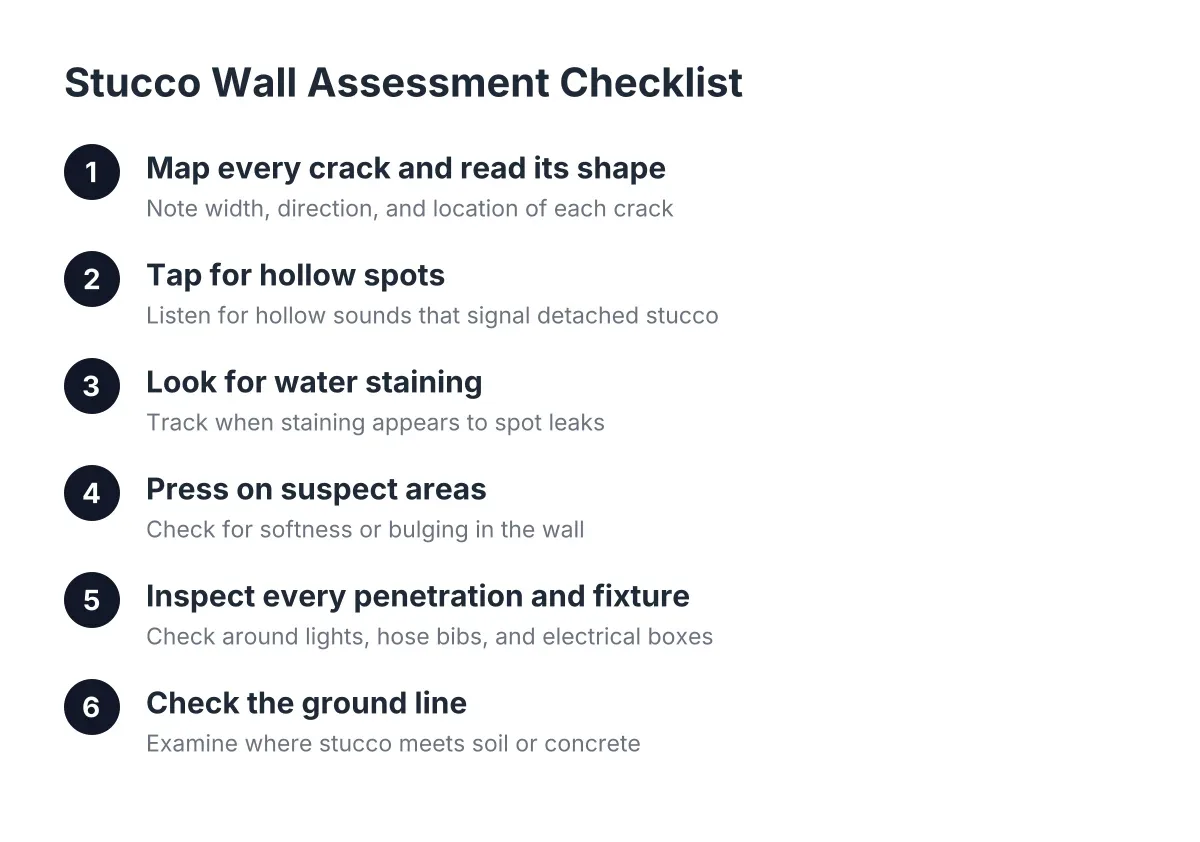
Water does not attack a wall evenly. It finds the weak points: window and door corners, vents, electrical boxes, hose bibs, and the bottom edge where stucco meets the foundation. Check these first during any Stucco Wall Assessment, because keeping water out of penetrations is the single most important goal when those areas are patched.
Corner damage near an air conditioning unit deserves a second look. Equipment vibration transmits into the wall, and when poor drainage also pools water against the foundation, the combination breaks down corners faster than either problem alone. Repeated heavy rain pooling at a foundation can even cause slight settling that cracks corners and finishes from below.
7. Peeling Paint or a Finish That Will Not Hold
Stucco is porous. It absorbs moisture rather than shedding it the way vinyl siding does, so when water is trapped inside the wall, it migrates outward and pushes the paint film off as it evaporates. Paint that peels or blisters in sheets within a year or two of painting is a moisture symptom, not a paint-quality problem.
Therefore, repainting over it is wasted money. Find and fix the water source first, let the wall dry, then repaint. This is also why high-pressure washing stucco before painting backfires; because stucco is layered, moisture driven behind the surface by a pressure washer can create larger structural issues over time.
8. Musty Smells or Interior Signs on the Other Side of the Wall
Not every leak shows on the outside first. A musty smell in a room, soft or stained drywall, or baseboards pulling away on an exterior wall can all mean water has traveled through the stucco assembly and reached the interior side. At that stage you are past cosmetic repair and into drying out the wall cavity.
For example, suppose a Scottsdale homeowner notices a faint musty odor in a bedroom each August during monsoon season, with no visible interior stain. In that scenario, the matching exterior wall often shows one of the earlier indicators on this list, a stained parapet or a wide crack above a window, and the smell is the wall telling you the leak has been active for a while.
How Water Damage Indicators Change Your Stucco Repair Budget
Water damage indicators in stucco are the main reason quotes for the same house vary so widely. A section of sound wall with hairline cracks can be resurfaced; a section with hollow spots, bulging, and corroded lath has to be opened up, dried, and rebuilt in layers. According to Fixr.com, repairing buckled three-coat stucco in a 10×10-foot area runs $900 to $3,000 nationally, averaging around $1,700, and that range widens further once hidden moisture is involved.
Use this list to make bids comparable instead of confusing:
- Walk the exterior yourself first and photograph every indicator you find, with dates.
- Ask each bidder which specific indicators they saw and what each one changes in scope.
- Ask whether the price covers removing hollow or bulged material, or only coating over it.
- For resurfacing bids, ask what happens to the price if the crew opens the wall and finds wet sheathing.
- For HOA projects, require the same scope description in all two or three bids before the board votes.
One honest trade-off: resurfacing over a wall with active water intrusion is cheaper now and more expensive later, because the leak keeps working behind the new finish. If you find two or more of the indicators above in the same area, budget for localized replacement in that zone rather than a cosmetic coat.
When to Stop Assessing and Bring In a Professional
You can find every indicator on this list yourself with your eyes, your knuckles, and a camera. What you cannot do from the surface is confirm how far moisture has traveled, whether the lath is rusted through, or whether framing behind the stucco has rotted. Those answers require opening the wall or using moisture meters, and misjudging them is how estimates balloon mid-project.
As a result, the smart sequence for a big-budget job is simple. Document the water damage indicators your stucco shows, get a professional assessment of the areas you flagged, and only then collect itemized bids for repair, resurfacing, or replacement. You will know what the numbers mean, and the contractor will know you do too.
If you need stucco repair, Scottsdale Stucco Repair can help.
Prefer to talk it through? Call (480) 637-3464 — a quick call is usually the fastest way to get a straight answer for your situation.