Stucco Mesh on Block Walls: Which Type to Use and How It’s Applied
If you own a concrete block wall in Scottsdale, a block fireplace, or a room addition built from cinder block, the question is almost never whether stucco will stick to it. The real question is what goes between the block and the stucco, and that answer usually comes down to stucco mesh. Get the mesh choice right and a block wall repair blends in and stays put through monsoon season. Get it wrong, or skip it where it was needed, and you end up with the spiderweb cracks and hollow patches that make a house look neglected in listing photos.
This guide walks through when block walls need mesh and when they don't, the types of stucco mesh that actually belong on masonry, and how the application methods differ between a full wall, a small patch, and a fireplace. It is written for the situation most Scottsdale owners are actually in: a perimeter wall, a fireplace, or a patched section of exterior wall that looks rough, and a deadline, whether that is a listing date, an appraisal, or an HOA letter about a rental property.
Why Block Walls Are Different From Wood-Framed Walls
Stucco over a wood-framed house wall is a layered assembly. There is a moisture barrier, usually tar paper, then metal lath or chicken wire fastened over it, with the edges trimmed in expansion channel before any stucco goes on. The mesh is structural in that system. The stucco has nothing solid to grab, so the wire carries it.
A concrete block wall is a different animal. Block is masonry, and stucco is a cement product. They are chemically compatible, and stucco can bond directly to clean, porous block without any wire at all. That is why so many Scottsdale perimeter walls, garden walls, and block fireplaces were stuccoed with nothing but a bonding agent and a scratch coat.
However, "can bond directly" is not the same as "always should." Whether your block wall repair needs mesh depends on the condition of the block, what is on it now, and how big the repair is. That is the decision the rest of this guide walks through.
Does a Concrete Block Wall Need Stucco Mesh?
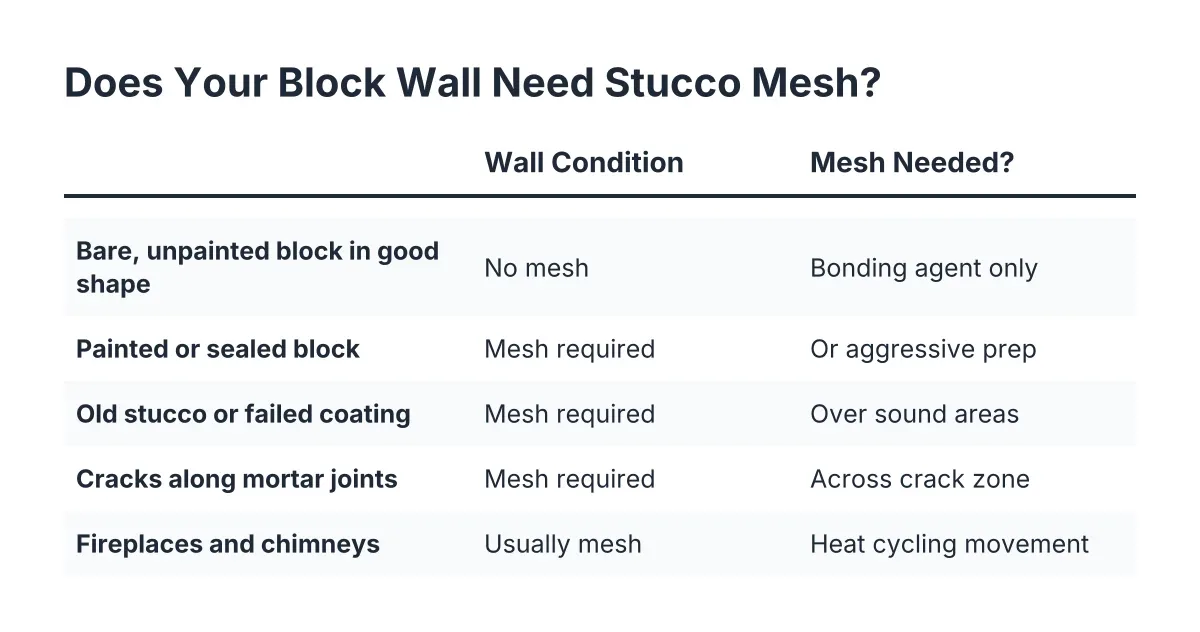
A clean, unpainted, sound concrete block wall usually does not need stucco mesh; the stucco bonds directly to the porous block with a bonding agent and a proper scratch coat. Mesh becomes necessary when the block is painted, sealed, previously coated, cracked along mortar joints, or when the repair spans an area where direct bond cannot be trusted.
Think of mesh as insurance against a bad bond. On bare block, the surface itself provides the grip. On a compromised surface, the mesh provides it instead, mechanically anchored to the wall with fasteners so the stucco hangs on the wire rather than relying on suction alone.
Here is a practical checklist for deciding:
- Bare, unpainted block in good shape: no mesh required. Clean the wall, apply a bonding agent, and stucco directly.
- Painted or sealed block: mesh, or aggressive surface prep. Paint blocks the bond. Either the paint comes off, or wire lath gets fastened through it into the block.
- Old stucco or a failed previous coating: mesh over the sound areas after loose material comes off, because you cannot trust what is underneath.
- Cracks that follow the mortar joints: mesh across the crack zone at minimum. A joint crack telegraphs through new stucco within a year or two if it is only skimmed over.
- Fireplaces and chimneys: usually mesh, because heat cycling moves the masonry more than a static garden wall ever will.
The painted-block case trips up more Scottsdale homeowners than any other. A block wall that was painted in the 1990s looks like an easy stucco candidate, and a thin coating troweled straight onto it may even look fine for six months. Then the bond lets go in sheets. Mesh fastened into the block solves that permanently.
Types of Stucco Mesh and Where Each One Belongs
Not all mesh is the same product, and the hardware store aisle does not make the distinctions obvious. There are three broad categories you will run into, whether you are researching stucco mesh at Home Depot, Lowe's, or a masonry supply yard.
Woven wire and stucco netting
This is the classic galvanized stucco mesh wire, sold in rolls, often 17 or 20 gauge, sometimes called stucco netting or chicken wire lath. It comes in a plain version and a version with paper backing already attached. On wood-framed walls, the paper-backed type is common because it combines the moisture barrier and the wire in one pass.
On a concrete block wall, plain wire is the right call. Block does not need the paper layer the way sheathed wood framing does, and the wire gets fastened directly into the block with concrete nails or masonry screws. The wire should be furred slightly off the surface so the scratch coat can push through and lock around it, not just sit against it.
Expanded metal lath
Expanded metal lath is a stiffer, diamond-patterned sheet product. It carries more weight than woven wire and holds its shape better across gaps. For block wall work, it earns its place in two situations: heavily deteriorated surfaces where large sections of old material came off, and structural transitions, such as where a block wall meets a wood-framed addition. Those transitions move differently on each side, and stiff lath bridges the joint better than netting.
Fiberglass mesh and mesh tape
Fiberglass stucco mesh is a different tool for a different layer. It does not replace wire lath. Instead, it embeds in a base coat or patching compound near the surface to control shrinkage cracking and reinforce thin coatings. Self-adhesive fiberglass mesh tape is the small-repair version, ideal for bridging a hairline crack before the finish coat goes over it.
For the pre-sale fixer, this distinction matters. If your problem is cosmetic cracks in otherwise sound stucco over block, the fix likely involves fiberglass mesh tape and a stucco crack filler, not tearing into the wall to install wire. If your problem is stucco letting go of the block in sheets, tape will not save it; that repair needs the coating removed and wire lath installed.
How Stucco Mesh Gets Applied to a Block Wall
Applying stucco mesh to a concrete block wall follows a consistent sequence: prep the surface, fasten the wire mechanically into the block, trim the edges and corners, then build the stucco in coats over the reinforcement. Each step exists to prevent a specific failure, and skipping any of them shows up later as cracking or delamination.
Here is the sequence a proper block wall installation or large repair follows:
- Surface prep. Loose stucco, flaking paint, and efflorescence come off. The wall gets cleaned so fasteners seat solidly and any direct-bond areas can still grip.
- Fastening the mesh. Wire lath gets attached with masonry fasteners driven into the block, spaced so the wire cannot flex or drum. Sheets and rolls overlap at the seams; a gap in the wire becomes a crack line in the finish.
- Edges and corners. Corner bead, a mesh wire corner piece, reinforces and rebuilds every outside corner. Corners take the most impact and shrinkage stress on a wall, and unreinforced corners are where block wall stucco chips first.
- Scratch coat. The first coat pushes through the mesh and gets scored horizontally so the next coat has tooth.
- Brown coat. This coat builds the wall flat and true. On block walls with mesh, it is where most of the thickness lives.
- Finish coat. Color and texture go on last, matched to whatever the surrounding walls carry.
The finish coat is where pre-sale repairs succeed or fail visually. Matching the texture means matching the technique and the material. The fineness of the sand in the mix has to match the existing finish; coarse sand next to a fine sand wall reads as a patch from the curb. A knockdown dash texture, common across Scottsdale, gets replicated by spraying finish material onto the repaired area and lightly troweling it down to blend with the surrounding wall. Color matching happens after texture matching, never instead of it, because paint cannot hide a texture mismatch in afternoon light.
Repairing Stucco on a Block Fireplace or Chimney
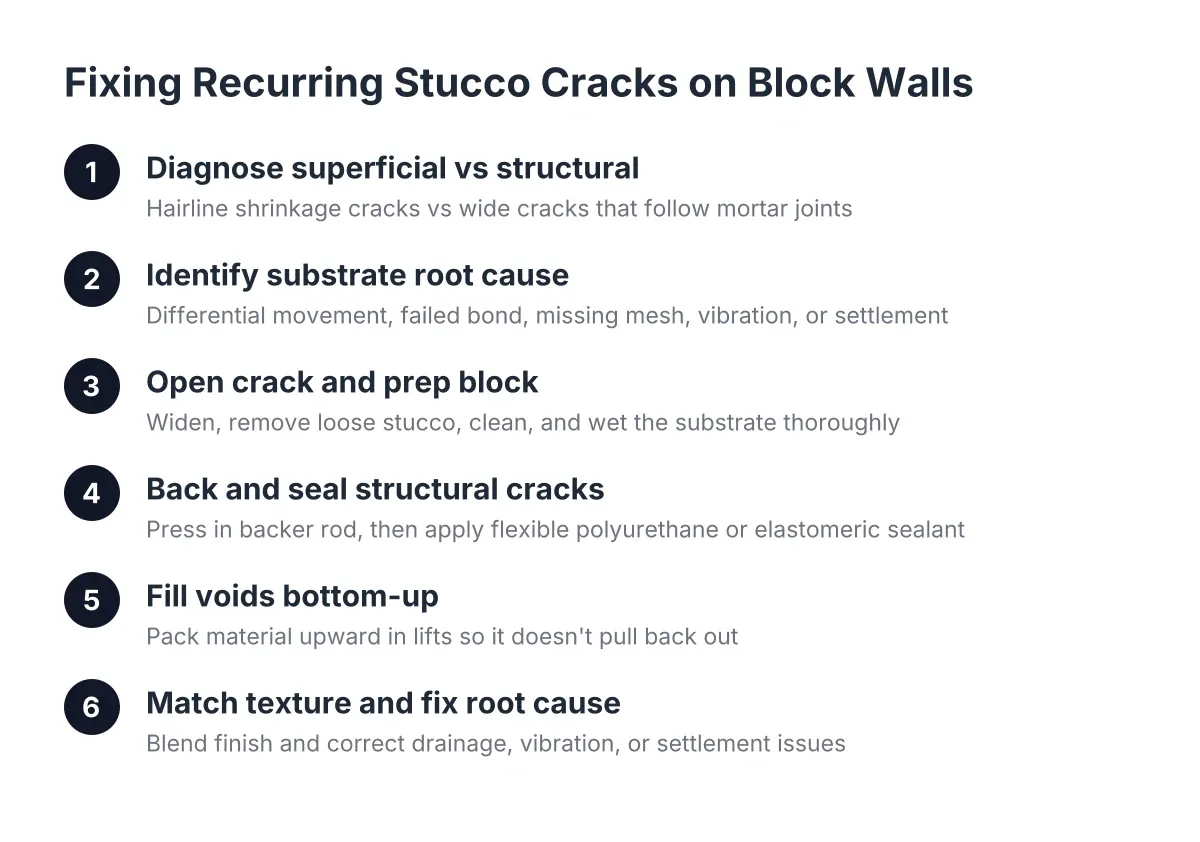
Fireplace stucco repair follows the same principles as wall repair, with one added stress: heat. A masonry fireplace expands and contracts with every fire, which is why stucco over a masonry fireplace cracks along predictable lines even when the workmanship was good. Mesh matters more here, not less, because reinforcement is what keeps thermal movement from opening the same crack every season.
For an exterior block chimney, the repair usually means cutting back the cracked stucco to sound material, fastening new wire lath across the repair zone, and rebuilding the coats. For a wider crack, a backer rod, which according to Sika is a closed-cell foam cord used to create a backing inside a crack before sealant goes in, lets the sealant flex with the movement instead of tearing.
One honest trade-off: interior fireplace surrounds and firebox-adjacent surfaces involve heat clearances and materials rated for them. That is a case for bringing in a professional rather than working from a general exterior guide, because the wrong material near a firebox is a safety problem, not a cosmetic one.
Small Patches: When Mesh Tape Beats Wire Lath
Most pre-sale repairs are not full walls. They are a cracked corner near the garage, a hole where a satellite dish came off, or an old exterior stucco patch that never matched. For repairs smaller than a couple of square feet on sound block, self-adhesive fiberglass stucco mesh tape embedded in patching compound handles the reinforcement, and the materials, including patch compound, latex additive, and corner mesh, are stocked at general hardware stores.
The technique matters more than the material. A hairline crack gets opened slightly, filled with a flexible stucco crack filler, bridged with mesh tape, then skimmed and textured. A corner repair gets a new mesh corner piece; on more involved corner rebuilds, holes get drilled on both sides of the corner so wire can tie through and join the patched sections.
However, corners carry a caveat worth knowing before you list the house. The technically correct repair for a deteriorated corner is to remove the stucco and repatch the full wall section from corner to corner, because a spot patch in the middle of a wall plane almost always reads as a patch. Suppose a Scottsdale seller has a chipped front-entry corner and photos scheduled in three weeks. In that scenario, a spot patch with corner mesh might cost a few hundred dollars, while a corner-to-corner repatch of that wall section might run somewhere in the low four figures as a rough illustrative range. The spot patch is faster and cheaper; the full section is the one that disappears in listing photos. Which one is right depends on how visible the wall is and how sharp the buyer's eye is likely to be.
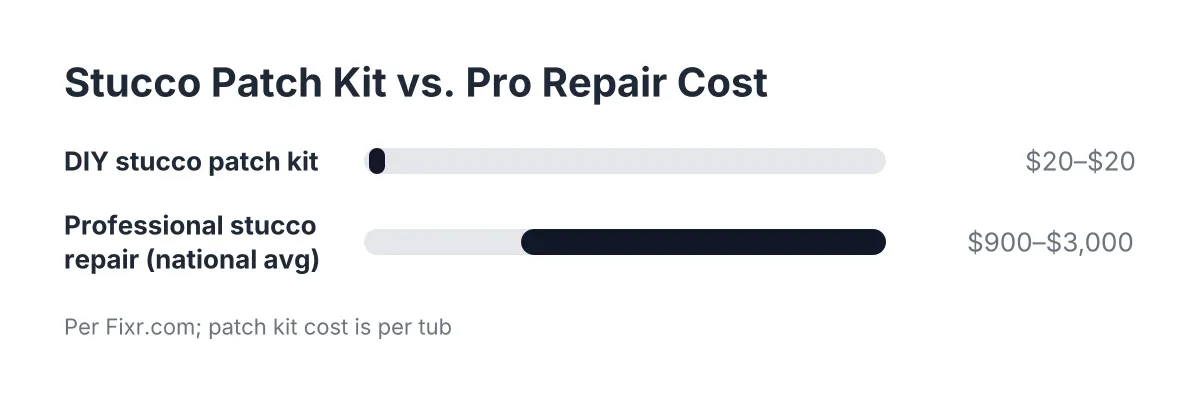
For context on repair spend generally, the national average cost to repair stucco runs $900 to $3,000, averaging around $1,700 for a buckled three-coat section in a 10×10-foot area, according to Fixr.com. Block wall patches often land below that because there is no framing or moisture barrier involved, but paint removal or lath installation pushes the number up.
What Landlords Should Know About Block Wall Repairs Across a Portfolio
If you own a handful of stucco rentals in Scottsdale or the East Valley, block walls are probably your most repeated repair. Perimeter walls take sprinkler overspray at the base, gate posts crack at the hinges, and HOA letters about stained or cracked block walls arrive on their own schedule. The mesh question shows up here too, in a specific way: the cheap fix and the durable fix diverge.
Skimming new stucco over a cracked, previously coated block wall without reinforcement is the fix that generates a second HOA letter in eighteen months. Cutting back to sound material and reinforcing the crack zone with mesh or tape costs more once and stops the repeat calls. Across five or six properties, that difference compounds. Stucco is not a niche material here; it remained the most-used exterior wall covering in the Mountain division, which includes Arizona, at 48% of new single-family starts in 2024, according to the National Association of Home Builders. Your tenants' walls will keep being stucco, so the repair method you standardize on matters.
One more portfolio note. If a wall section ever needs to be cut open for a gate, panel, or utility work, avoid a clean grinder cut through the stucco. A clean cut severs the lath flush, which forces whoever repairs it to open up more wall to expose enough wire to weatherproof the patch properly. A rougher cut that leaves the wire exposed and workable keeps the eventual stucco repair smaller and cheaper.
Getting Block Wall Stucco Ready Before Photos or an Appraisal
Pull the threads together and the decision path for Stucco On Block Walls is short. First, identify what you actually have: bare block, painted block, or failing stucco over block. Second, match the reinforcement to the problem: no mesh for sound bare block, wire lath for compromised surfaces and transitions, fiberglass mesh tape for cracks and small patches. Third, treat texture and color matching as the finish line, because that is what the camera and the appraiser see.
For a seller, the timeline logic is straightforward. Small crack repair and patching cures and blends within days; a full mesh-and-recoat on a painted wall is a multi-coat process with cure time between coats, so it needs to start weeks before photos, not days. For a landlord, the logic is repeat-cost avoidance: reinforce once, correctly, and the wall comes off your call list.
Either way, the mesh is not the visible part of the job. It is the part that decides whether the visible part still looks right two summers from now. On a block wall in the Arizona sun, that is the whole game.
If you need stucco repair, Scottsdale Stucco Repair can help.
Prefer to talk it through? Call (480) 637-3464 — a quick call is usually the fastest way to get a straight answer for your situation.