Stucco Repair vs. Painting: When to Fix Cracks Before You Refresh
Type "stucco repair cost calculator" into a search bar and you get a wall of national averages, sliders, and per-square-foot estimates that never quite match what a Scottsdale contractor actually quotes you. Those tools have a place, but they skip the question that matters most before any number means anything: does this crack need repair, or will a good paint job handle it? Get that call wrong in one direction and you pay for stucco work you did not need. Get it wrong in the other direction and you paint over a structural crack, watch it reopen in a season, and pay twice.
This guide walks through how to tell the difference, what a repair actually involves compared to a paint refresh, and what drives cost in each direction. If you are also staring at a bare block wall or a fresh addition that needs stucco from scratch, the same logic applies; we will cover where new installation fits into the repair-versus-paint decision too.
Why Painting Over Stucco Cracks Sometimes Works and Sometimes Backfires
Paint is not a cop-out. On the right crack, a quality primer and paint is the correct fix, not a shortcut. On the wrong crack, it is a delay tactic that lets water into the wall while the surface looks fine.
The difference comes down to what kind of crack you have. Stucco cracks fall into two broad camps: hairline surface cracks and wider structural cracks. They look similar from ten feet away. Up close, they behave completely differently, and they call for different fixes.
A hairline crack, roughly the width of a credit card edge or thinner, sits in the finish coat. It does not go through the stucco wall to the building paper behind it. A good quality primer and paint will flood that hairline, bridge it, and seal it. No caulk, no patching, no repair crew. If most of your cracks are hairlines, a paint refresh is a legitimate answer.
A structural crack is wider and deeper. You can often fit a fingernail or a coin edge into it. These cracks move with the wall as it expands and contracts through Arizona's temperature swings, and paint alone cannot bridge movement. Paint over a structural crack and the crack telegraphs right back through the new finish, usually within a year. Worse, the crack keeps letting moisture reach the paper behind the stucco the whole time.
Here is the part that costs people real money. Leave a structural crack open for years and the building paper behind it dries out and turns brittle. Once that paper is brittle, normal wall flexing can tear it. At that point you are no longer talking about crack repair; you are talking about water damage stucco repair, which means opening the wall, replacing paper, and rebuilding the stucco in layers. The cheap fix and the expensive fix start as the same crack. Time is what separates them.
How to Tell Repair Cracks From Paint Cracks
You can sort most cracks yourself in twenty minutes with a flashlight and a business card. Walk the exterior walls in raking light, early morning or late afternoon, when shadows make cracks stand out against the stucco wall texture.
Use these checks:
- Width. If a business card slides into the crack, it needs repair, not paint. If the card cannot enter, it is likely a hairline that paint will seal.
- Depth. Shine a flashlight along the crack. If you can see darkness or paper behind it, the crack goes through the stucco and needs to be filled properly.
- Pattern. Cracks radiating from window and door corners are common stress points. Hairlines here are normal; wide diagonal cracks suggest movement worth having a professional look at.
- Location. A crack running along the base of the wall where stucco meets a concrete foundation is usually minor. The foundation and the stucco expand and contract at different rates, and the softer stucco gives at that joint. Annoying, but rarely structural.
- Staining. Rust streaks, white mineral deposits, or dark staining around a crack point to water getting behind the stucco. That moves the crack from "watch it" to "fix it now."
One honest caveat: if a crack is wide, growing, or paired with doors that stick or interior drywall cracks, stop diagnosing and bring in a professional. That pattern can point to foundation movement, which is beyond what any stucco patch or paint job addresses.
What Proper Stucco Repair Costs and Involves, Step by Step
Understanding the repair process helps you judge quotes and spot corner-cutting. A real stucco crack repair on a structural crack looks like this.
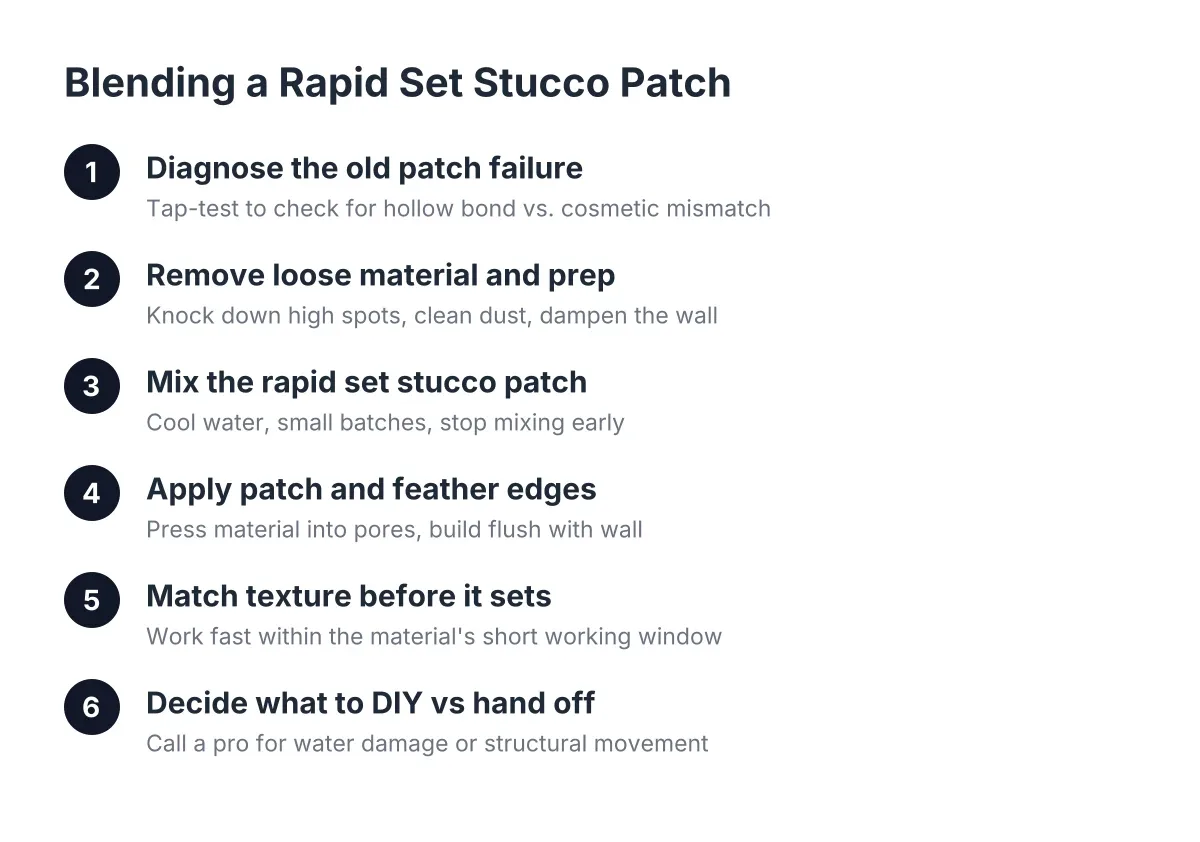
First, the crack gets opened up slightly and cleaned out. Loose material comes out so the filler has something solid to grab.
Next, wider cracks get a backer rod before any sealant goes in. Backer rod is a closed-cell foam cord that creates a backing inside the crack, according to Sika, so the sealant forms the right shape instead of sinking bottomlessly into the gap. A quote that mentions backer rod on wide cracks is a sign the contractor knows the trade.
Then comes elastomeric sealant or a stucco patching compound, depending on crack width and depth. In Scottsdale, timing matters here more than most homeowners expect. Caulking large cracks in the hot afternoon sun causes the material to cure too fast and behave poorly, so crews schedule this work for early morning. If a contractor shows up at 2 p.m. in July to caulk your west-facing wall, question it.
After the fill, the repaired area gets texture matched to the surrounding stucco wall texture. This is where cheap repairs announce themselves. A smooth caulk line running through a sand-finish or lace-texture wall is visible from the street forever. Texture matching takes skill and the right stucco mix; it is the difference between a repair you forget about and one you notice every time you pull into the driveway.
Finally, the repair gets primed and painted, ideally blended into the wall rather than spot-painted in a rectangle of slightly-wrong color. Stucco color matching against sun-weathered paint is genuinely hard, which is why many crack repair jobs end with painting the full wall plane so the repair disappears.
One more trade detail worth knowing: repair work on a wall gets applied from the bottom up. It sounds backwards, but it keeps fresh material from dripping onto and staining finished work below.
What Online Calculators Get Right and Wrong
A stucco repair cost calculator gives you a starting range, and that has value. According to Fixr.com, the national average cost to repair stucco runs $900 to $3,000, averaging about $1,700 for repairing buckled three-coat stucco in a 10×10-foot area. If a quote lands wildly outside a range like that for comparable work, you have a reason to ask questions.
However, online calculators and any plaster repair cost estimator share the same blind spots, and they matter more in Scottsdale than in milder climates.
First, calculators price the patch, not the cause. Suppose a hypothetical homeowner in North Scottsdale patches a recurring corner crack three times in five years because the underlying cause, say poor drainage or vibration from a nearby gate, never gets addressed. The calculator said each patch was cheap. The three patches together cost more than one proper fix, and the crack is still coming back.
Second, calculators average away the difference between a paint-grade hairline and a structural crack. Stucco repair costs per square foot mean little when the real question is whether the square footage needs mortar and mesh or just primer.
Third, they ignore texture and color matching. A patch that structurally works but visually clashes will bother you daily, and matching a weathered lace finish takes more labor than matching fresh smooth stucco. No slider on a calculator captures that.
Fourth, corners are their own case. The technically correct repair for a deteriorated corner is to remove the stucco and repatch the full wall section corner to corner, so no seam shows mid-wall. A partial corner patch is faster and cheaper, and sometimes it is the right call, but you should choose that trade-off knowingly rather than have a calculator hide it.
So use the calculator for a sanity-check range. Then get eyes on the actual wall, because the crack type, not the square footage, decides whether you are in paint territory, patch territory, or replacement territory.
Running Repair Numbers Against a Full Paint Refresh
When you are weighing crack repair against repainting the whole house, run both numbers honestly. A stucco repair cost calculator will price the cracks; a painting quote prices the refresh. The trap is treating them as either-or when they are usually sequential.
Here is the practical decision order:
- Mostly hairlines, paint is tired. Paint the house with a quality elastomeric or masonry paint. The paint seals the hairlines as part of the job. Skip the repair line item entirely.
- A few structural cracks, paint is fine. Repair the cracks, texture match the patches, and blend paint on the affected wall planes. Cheaper than a full repaint, and the wall is actually fixed.
- Structural cracks and tired paint. Repair first, paint second, ideally coordinated so the repairs cure before the painters arrive. Painting first wastes the paint over every crack that later gets cut open.
- Widespread cracking, soft spots, or staining across multiple walls. Stop pricing patches. This is where stucco resurfacing or replacement enters the conversation, and where an average cost of stucco repair figure stops being useful because you are no longer buying a repair.
The order matters more than the totals. Homeowners who paint first and repair second effectively pay for paint twice on every repaired section. It is the most common sequencing mistake in exterior refresh projects, and it is entirely avoidable.
One reassurance for anyone who just had a first coat of new stucco applied on an addition: small cracks appearing after the first coat is normal curing behavior, not a defect. Do not panic and do not let anyone sell you a repair on stucco that has not finished its coat sequence.
Where Bare Block Walls Fit: Repair, Paint, or New Stucco
If your situation is a bare cinder block wall, a block fence, or an addition the builder left unfinished, you are not choosing between repair and paint at all. You are choosing Stucco Installation, which is a different scope with different pricing, and it is worth understanding why so quotes make sense.
Stucco on a block wall skips some steps a wood-framed wall needs. Block does not require the paper and lath layer that framed walls do; the stucco mix bonds to the masonry, typically with a bonding agent or a scratch coat keyed directly into the block. That generally makes stucco on a concrete block wall simpler per square foot than stucco over framing, though prep matters: the block must be clean, and any mortar joints that stick out proud get knocked down first.
The hard part of stuccoing new block next to an existing stuccoed house is not the application. It is the match. Your house's stucco has fifteen or twenty years of Arizona sun on it. New stucco, even tinted correctly, reads brighter and smoother until it weathers. A contractor who does texture matching well will replicate the existing finish, whether that is sand, lace, or smooth troweled, and will tell you honestly whether the color will blend immediately or need a coat of paint across both old and new surfaces to unify them. Ask that question directly before signing.
This is also not a niche project type in Arizona. Stucco remained the most-used exterior wall material in the Mountain division, which includes Arizona, at 48% of new single-family homes started in 2024, according to the National Association of Home Builders. Block walls finished in stucco are the regional default, which means local crews do this constantly. That works in your favor; you are not asking anyone to improvise.
For budgeting, expect new installation on block to be priced by square footage plus texture complexity, sitting in a different bracket than crack repair. As an illustrative estimate only, a modest backyard block fence might land in the low thousands, while stuccoing a full room addition to match the house runs meaningfully higher, driven by wall area, access, and the match work. Your actual quote depends on the wall in front of the estimator, not a national average.
Questions That Sort Good Quotes From Guesses
Whether you are pricing crack repair, a repaint, or new stucco on block, a short list of questions exposes whether the estimator diagnosed your wall or just measured it.
- Which of these cracks need caulking or patching, and which will paint alone seal?
- For the wide cracks, will you use backer rod before sealant?
- What is causing the recurring crack, and does the fix address the cause or just the symptom?
- How will you match the existing texture, and will the color match on day one or after painting?
- For corner damage, are you patching the spot or redoing the wall section corner to corner, and what is the trade-off?
- For new stucco on block, how will you prep the block, and how will the finish blend with the house?
A contractor with real answers to these will also give you a number that holds up. A contractor who quotes off square footage without walking the wall is doing what the online calculator already did for free.
The Bottom Line on Repair Versus Refresh
Paint seals hairlines; it does not fix cracks that move. Sort your cracks first, repair the structural ones properly with backer rod, sealant, and texture matching, then paint. Reverse the order and you buy the paint twice. Ignore the wide cracks long enough and brittle building paper turns a few hundred dollars of crack repair into a water damage rebuild.
Use a stucco repair cost calculator for a rough range and a reality check on quotes, not as a diagnosis. The wall itself, crack width, depth, pattern, and cause, decides what you actually need. In Scottsdale's heat and sun, timing, texture, and matching weathered finishes carry as much weight as the patch material itself. Get the diagnosis right and the cost question mostly answers itself.
If you need stucco repair, Scottsdale Stucco Repair can help.
Prefer to talk it through? Call (480) 637-3464 — a quick call is usually the fastest way to get a straight answer for your situation.